
Walt Murphy’s News and Results Service ([email protected])
This Day in Track & Field–September 4
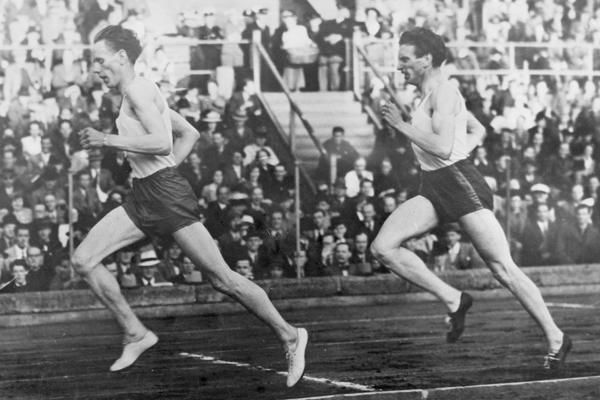
1942–Gunder Hägg regained sole possession of the World Record in the Mile by running 4:04.6 in Stockholm. He had shared the previous mark of 4:06.2 with fellow Swede Arne Andersson.
WR Progression: http://en.wikipedia.org/wiki/Mile_run_world_record_progression
Tribute to Hagg: https://www.worldathletics.org/news/news/a-tribute-to-the-career-of-gunder-hagg
http://www.racingpast.ca/john_contents.php?id=235
1949—Hungary’s Imre Németh, the 1948 Olympic gold medalist, improved his World Record in the Hammer to 195-5 (59.57) in Katowice, Poland. His previous mark of 193-8 (59.02) was set the year before and he would set his 3rd WR of 196-5 (59.88) in 1950.
His son Miklós was the 1976 Olympic gold medalist and former World Record holder in the Javelin
September 4th turned out to be a good date for setting records in this event (see below).
WR Progression: http://en.wikipedia.org/wiki/Men’s_hammer_throw_world_record_progression

1965—Hungary’s Gyula Zsivótzky threw 241-11 (73.74) in Debrecen, Hungary, to set a World Record in the Hammer. His throw ended Hal Connolly’s 9-year reign as the record holder in the event. Connolly set the first of his six records in 1956 (224-10 [68.54]), and his last (233-9 [71.26]) less than three months before Zsivótzky’s big throw.
Zsivótzky won Olympic silver in 1960 and 1964 before winning gold in Mexico City in 1968. He would set his 2nd World Record of 242-0 (73.76) in 1968.
https://www.worldathletics.org/news/news/olympic-champion-zsivotzky-passes-away
1971—West Germany’s Walter Schmidt threw the Hammer 250-8 (76.40) in Lahr, Germany, to break the World Record of 247-8(75.48), which was set by the Soviet Union’s Anatoliy Bondarchuk in 1969.
WR Progression: https://en.wikipedia.org/wiki/Men%27s_hammer_throw_world_record_progression
1972–Valeriy Borzov, winner of the 100, completed the sprint double at the Munich Olympics by taking the gold medal in the 200-meters (20.00). Larry Black, who drew lane one in the blind selection process, finished 2nd in 20.19, and Italy’s Pietro Mennea was 3rd in 20.30. Mennea would win the gold medal 8 years later in Moscow. 4th in his first year in the sport was American Larry Burton (20.37), who went on to play in the NFL for five years as a wide receiver. Jamaica’s Don Quarrie, the co-World Record holder and one of the pre-Games favorites, suffered a hamstring injury in his semi-final race.
16-year old Ulrike Meyfarth was tied for the lead in the Women’s High Jump with Bulgaria’s Yordanka Blagoeva with no misses through 6-2 (1.88), with only Austria’s Ilona Gusenbauer still alive in the competition. The young West German cleared 6-2 ¾ (1.90) on her 2nd attempt and the gold medal was hers when the other two failed at that height(Blagoeva winning silver). The home crowd was already ecstatic with her win when she then cleared 6-3 ½ (1.92) on her first attempt to equal Gusenbauer’s World Record! She would win a 2nd gold medal 12 years later in Los Angeles. 23 women competed in the final!
Kenya got a 1-2 finish in the Steeplechase from Kip Keino (8:23.64-OR) and Ben Jipcho (8:24.62), who passed Finland’s Tapio Kantanen (8:24.66) to grab the silver medal. Keino, the 1968 Olympic champion at the distance, would win the silver medal in the 1500-meters later in the Games.
Keino would return to Munich 50 years later to reminisce about his steeple win.
https://olympics.com/en/original-series/episode/memory-lane-72-a-gathering-of-champions
The Soviet Union’s Viktor Saneyev (a native of Georgia) won the 2nd of his 3 consecutive Olympic titles in the Triple Jump. He got his winning jump of 56-11 ¼w (17.35) in the opening round, and was almost overtaken by East Germany’s Jörg Drehmel, who jumped 56-9 ½ (17.31) on his 5th effort. Brazil’s Nelson Prudêncio, the silver medalist in 1968, won bronze this time with a leap of 55-11 ¼ (17.05).
Results: http://en.wikipedia.org/wiki/Athletics_at_the_1972_Summer_Olympics
Videos: M200 MSC WHJ Meyfarth Looks Back https://en.wikipedia.org/wiki/Ulrike_Meyfarth
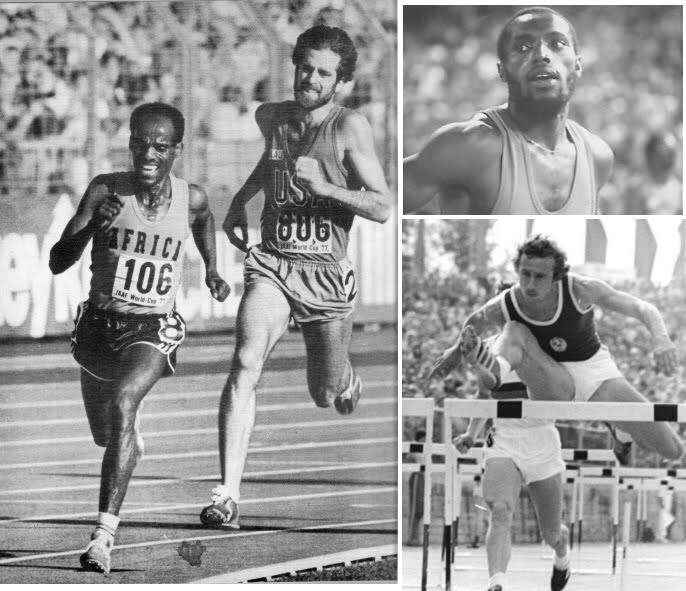
1977—American Records were set by Marty Liquori (5000-13:15.06/2nd to Ethiopia’s Miruts Yifter-13:13.82) and Jan Merrill (3000-8:46.60/3rd, winner was Norway’s Grete Waitz-8:43.50) on the final day of competition at the first World Cup in Düsseldorf, Germany (See September 2 for more details).
https://en.wikipedia.org/wiki/1977_IAAF_World_Cup
AR Progressions
5000: http://trackfield.brinkster.net/RecProg_AllUSA.asp?RecCode=WR&EventCode=MA7&Gender=M&P=F
3000: http://trackfield.brinkster.net/RecProg_AllUSA.asp?RecCode=WR&EventCode=WA6&Gender=W&P=F
1983–Great Britain’s Steve Ovett reclaimed the World Record in the 1500-meters by running 3:30.77 in Rieti, Italy. Sydney Maree had set the previous mark of 3:31.4 just one week earlier. David Mack was the capable pacesetter in both record races.
WR Progression: http://en.wikipedia.org/wiki/1500_metres_world_record_progression
Video: https://www.youtube.com/watch?v=cL_WektvHo4
1983—Making his move with a ¼-mile to go, Steve Scott (3:49.77) held off Ross Donoghue (3:50.10) to win the men’s race at the 3rd edition of the 5th Avenue Mile. 3rd was Sydney Maree (3:50.72), the winner of the inaugural race in 1981. Defending champion Tom Byers finished 6th.
Maree, who had set a World Record for 1500-meters in Europe a week earlier, didn’t arrive in New York until 12 hours before the race after flying in from Rome, but didn’t use that as an excuse, saying he got plenty of rest on his flight.
Winner of the women’s race was Great Britain’s Wendy Sly (4:22.66), who would go on to win the silver medal in the 3000-meters the following year at the L.A. Olympics. 2nd and 3rd were Canada’s Brit McRoberts (4:23.86) and another Brit, Christine Boxer (4:24.49). Finishing 7th in 4:37.40 was another future Olympic medalist—Joan Benoit, who would win gold in the inaugural women’s marathon in L.A.
An estimated 50,000 spectators lined both sides of one of the most famous streets in the world!
From the NY Times: https://www.nytimes.com/1983/09/04/sports/fifth-avenue-mile-to-scott-in-3-49.77.html
1985—High jumper Igor Paklin of the Soviet Union set a World Record of 7-10 ¾ (2.41m) at the World University Games in Kobe, Japan.
WR Progression: http://en.wikipedia.org/wiki/Men’s_high_jump_world_record_progression
Video: https://www.youtube.com/watch?v=7pEkcIlHYpM
1985— Sydney Maree, finishing 2nd behind Morocco’s Said Aouita (4:54.02) in the 2000-meters in Rieti, Italy, set an American Record of 4:54.20. Steve Scott set the previous mark of 4:54.71 in 1982.
1987—Three days after capturing the Heptathlon title at the World Championships in Rome, Jackie Joyner-Kersee won the Women’s Long Jump with a big leap of 24-1 ¾ (7.36).
The Soviet Union’s Yelena Belevskaya (23-5 ¼ [7.14]) edged East Germany’s Heike Drechsler (23-4 ¾ [7.13]), the defending champion (and co-World Record holder with JJK/24-5 ½ [7.45]), to win the silver medal. An injury to her left knee kept Drechsler from taking her final 2 jumps.
JJK almost came away with just the bronze medal, since a red flag went up on her winning jump, but the official’s decision was reversed upon a closer look at the plasticine. She would win a 2nd title in the Long Jump in 1991, while Drechsler would win her 2nd in 1993 (won her 1st at the inaugural WC in 1983).
East Germany’s Jürgen Schult, the World Record holder, won the Men’s Discus with a throw of 225-6 (68.74), the longest ever at a major championship (at the time). Winning the silver medal was 40-year old American John Powell (217-3 [66.22]), and the bronze went to Cuba’s Luis Delís (216-7 [66.02).
Another World Record holder, Norway’s Ingrid Kristiansen, won the Women’s 10,000 comfortably in 31:05.85. Winning the silver and bronze were the Soviet Union’s Olena Vyasova (31:09.40) and East Germany’s Kathrin Wessel (31:11.34). This was the debut for the event at the World Championships—an Invitation event had been held in 1980.
Bulgaria’s Ginka Zagorcheva (12.34/CR), yet another WR holder, won the Women’s 100-Meter Hurdles, while teammate Yordanka Donkova, the former record holder, finished 4th (12.49). 2nd and 3rd were East Germans Gloria Siebert (12.44) and Cornelia Oschkenat (12.46).
East Germany’s Torsten Voss won the Decathlon with a score of 8,680 points, followed by West Germany’s Siegfried Wentz (8461) and the Soviet Union’s Pavel Tamovetskiy (8375. Great Britain’s Daley Thompson, dealing with pre-meet injuries, finished 9th (8124). Thompson, the World Record holder, had been the dominant figure in the event, winning the first World title in 1983 and Olympic gold in 1980 and 1984.
Medalists/Results: http://en.wikipedia.org/wiki/1987_World_Championships_in_Athletics
Athletics Weekly: https://www.athleticsweekly.com/london-2017/iaaf-world-championships-history-rome-1987-62714/
Videos
W10k: https://www.youtube.com/watch?v=9_fnpE3-H-M&pp=QAA%3D
NBC’s Coverage-Day 6: https://www.youtube.com/watch?v=q1sXrjQKeSw
2004— Kenya’s Pamela Jelimo became an instant millionaire by winning the 800-meters (1:55.16) at the Van Damme Memorial in Brussels and clinching the overall Golden League title.
Jelimo, the 2008 Olympic Champion in the 800, had to delay her celebration until the completion of the Women’s High Jump. Croatia’s Blanka Vlašić was still in contention to share the $1,000,000 jackpot, but lost to Germany’s Arianne Friedrich on misses (both clearing 6-6 ¾ [2.00]), leaving Jelimo as the sole winner!
https://www.worldathletics.org/news/news/jelimo-becomes-a-millionaire-in-brussels-bolt
2011–Former Florida teammates Christian Taylor and Will Claye, who finished 1-2 in the Triple Jump at the NCAA Championships in June, almost duplicated that outcome on the final day of competition at the World Championships in Daegu, South Korea. Taylor won the gold medal with a personal best leap of 58-11 ¼ (17.96), while Claye also PB’d, jumping 57-5 (17.50) to win the bronze medal. Great Britain’s Phillips Idowu, the defending champion, split the two with a jump of 58-3 ¾ (17.77).
When he left the pit after his big jump, Taylor did the “Gator Chomp” for the world-feed camera, a gesture well known to American college football fans, but totally bewildering to everyone else!
Great Britain’s Mo Farah (13:23.36), who had earlier finished 2nd in the 10,000, held off Bernard Lagat (13:23.64) to win the Men’s 5000. Galen Rupp, a close 4th with a lap to go, finished 9th (13:28.64). Lagat might still have finished 2nd to Farah, but he had to work his way around Ethiopians Dejen Gebremeskel and Imane Merga as he came off the final turn. Farah would go on to win the next nine global distance titles on the track (5000&10,000-2012, 2013, 2015, 2016/10,000-2017).
South Africa’s Caster Semenya (1:56.35) won the 2nd of her 3 World titles in the Women’s 800-Meters. Winning silver and bronze were Kenya’s Janeth Jepkosgei Busienei (1:57.42) and American Alysia Montaño (1:57.48).
This was another event where the order of finish was reshuffled as the result of subsequent disqualifications. The 3 Russian finalists, including “winner” Mariya Savinova (1:55.87) were all found guilty of doping violations.
Russia’s Tatyana Lysenko (253-0 [77.13]) won the Women’s Hammer Throw over Germany’s Betty Heidler
(249-6 [76.06]) and China’s Zhang Wenxiu (246-1 [75.02]). Lysenko, who had already served a 2-year ban from 2007-2009 for a doping offense, would go on to win gold at the 2012 Olympics and the 2013 Worlds, but was stripped of both titles after being found guilty of another doping violation.
Medalists in the Men’s Marathon were Kenya’s Abel Kirui (2:07:38) and Vincent Kipruto (2:10:06), and Ethiopia’s Feyisa Lilesa (2:10:32).
When the schedule for Daegu was first published, showing the meet ending with the 4x100s, there was quite a negative reaction from fans who were accustomed to having “their” Olympics and World Championships end with the 4x400s.
But whichever IAAF official first suggested that radical departure from tradition deserves a gold medal. Inspired, of course, by the success of Usain Bolt at the 2008 Olympics and 2009 Worlds, the hope was that he would help provide an exciting climax to the Championships.
Up first was the Women’s race, with a U.S. lineup of Bianca Knight, Allyson Felix, Marshevet Hooker, and Carmelita Jeter beating a Jamaica foursome of Shelly-Ann Fraser-Pryce, Kerron Stewart, Sherone Simpson, and Veronica Campbell-Brown(41.56-41.70). Finishing 3rd was Ukraine (42.51).
Jamaica, with a lineup of Nesta Carter, Michael Frater, Yohan Blake, and Bolt made that IAAF official look like a genius, winning the men’s race in 37.04 to break their 3-year old World Record of 37.10, which was set at the Beijing Olympics. (At least that’s the way it happened at the time. Jamaica was ultimately stripped of their 2008 title and the Record after a later retest of Nesta Carter’s urine sample tested positive for a banned substance. The Record progression now shows the 37.04 breaking Jamaica’s 37.31 mark from the 2009 World Championships).
Passing problems had kept the U.S. men out of the final of this event at the 2008 Olympics and the 2009 Worlds, but had made it out of the qualifying round this time. But their heartbreak continued as 3rd runner Darvis “Doc” Patton collided with Great Britain’s anchor, Harry Aikines-Aryeetey, just before he was about to hand-off to Walter Dix. With a clean final pass, the Americans still wouldn’t have beaten Jamaica, but they most likely would have finished 2nd and most certainly would have broken the National Record of 37.40. Silver and bronze went to France(38.20) and St.Kitts&Nevis(38.49), with 35-year old Kim Collins running the 2nd leg.
The veteran Patton, who suffered a separated shoulder as he tumbled to the track, was also involved in the passing mishaps in 2008 and 2009!
Medalists/Results: https://en.wikipedia.org/wiki/2011_World_Championships_in_Athletics
IAAF Coverage Additional Reports/Quotes
Videos: Triple Jump Taylor M5000 Women’s 4×100 Men’s 4×100 W800
Toni Reavis and Josh Cox Recap the Men’s Marathon: https://www.youtube.com/watch?v=R5JSybjsGM0
Side Report: Now that the Championships were over, it was time to unwind with a couple of fellow NBC workers. We found a local karaoke bar where we sang and laughed (and imbibed a few cocktails) to our hearts’ content in a private room until 4:00am! Seemed like a great idea at the time, but the other two had to immediately get back to our hotel where a car was waiting to take them on a 4-hour ride back to the airport in Seoul! (I had a later ride scheduled). The only problem was that one of them fell asleep in their room when they went to get their luggage! No amount of banging on their door could waken them, so a reluctant security guard had to be persuaded to open the door so the exhausted celebrant could be convinced it was time to go! Thankfully, they didn’t miss their flight home!
2018—42-year old Kim Collins ran the last two races of his amazing career in Cheb, the Czech Republic, winning the
60 and finishing 2nd in the 150. He originally announced that he would finally retire at the end of the 2017
season, but wound up competing throughout the year in 2018. “I felt the need to still do one more outdoor
season and be able to say farewell to my fans and all the friends that I made over the years all over the world.”
Some of the highlights of his career
2003 World Champion—100m (out of lane 1);
2001 NCAA Indoor Champion-60m(TCU)
2-time silver medalist in the 60 at the World Indoor Championships (2003, 2008)
4-time bronze medalist at the World Outdoor Championships
(’01-200, ’05-100, ’11-100,4×100)
Competed in 5 Olympics and 8 World Outdoor Championships.
The grand old man of sprinting ran a personal best of 9.93 in 2016 at the age of 40 (Oldest ever to break 10-
seconds)
2020—World Records were set in the Men’s and Women’s 1-Hour Run at the Van Damme Memorial in Brussels.
Great Britain’s Mo Farah covered 21,330-Meters (13 miles, 446y) in the Men’s race to narrowly break the previous Record of 21,285m (13 miles, 397y) that was set by Ethiopia’s Haile Gebrselassie in 2007. Belgium’s Bashir Abdi was only 8-meters behind Farah, but got credit for his own WR of 56:20.2 for 20,000-Meters.
The Netherlands’ Sifan Hassan, battling Kenya’s Brigid Kosgei, the WR holder in the Marathon, the whole way, covered 18,930-Meters (11-miles, 1341y), more than 400-meters past the old mark of 18,517m (11-miles, 888y), set by Ethiopia’s Dire Tune in 2008. Kosgei was disqualified for stepping inside the curb late in the race.
Kenya’s Faith Kipyegon fell short of breaking the World Record of 2:28.98 for 1000-Meters, winning in 2:29.92.
https://www.worldathletics.org/news/report/brussels-diamond-league-farah-hassan-one-hour
https://trackandfieldnews.com/brussels-dl-in-the-long-run-3-world-records/
2024(New) In a much heralded matchup between World Record holders, Sweden’s vault legend Mondo Duplantis defeated
Norway’s 400h specialist Karsten Warholm over 100-meters in Zurich (10.37-10.47).
https://www.youtube.com/watch?v=r-gA_OXxQ5s
(Full Broadcast): https://www.youtube.com/watch?v=ojSzlLN7wAw
Born On This Day*
Mark Lewis-Francis—Great Britain 43 (1982) 2004 Olympic gold medalist-4×100
(Jason Gardener, Darren Campbell, Marlon Devonish, Mark Lewis-Francis)
Bronze medalist in the 4×100 at the 2005 and 2007 World Championships
2006 European Champion-4×100
Bronze medalist in the 60-meters at the 2001 World Indoor Championships…2003 (4th)
1999 World Youth Champion-100
2000 World Junior/Under-20 Champion—100, 4×100
PB: 6.51 (2001), 10.04 (2002), 20.89 (2010)
https://en.wikipedia.org/wiki/Mark_Lewis-Francis
https://pacesportsmanagement.com/former-champion/mark-lewis-francis/
https://worldathletics.org/athletes/great-britain-ni/mark-lewis-francis-14189912
Lidia Șimon—Romania 52 (1973) 2001 World Champion—Marathon;
5-time World Championships bronze medalist:
1997-Half Marathon, Marathon
1998-Half Marathon
1999-Marathon
2000-Half Marathon
5-time Olympian—Marathon (1996-6th, 2000- silver, 2004-DNF, 2008-8th, 2012-44th)
Completed 38 marathons during her career
PBs: 31:32.64 (1998), 1:08:34 (2000), 2:22:54 (2000)
Wiki Bio:
…