
Walt Murphy’s News and Results Service ([email protected])
This Day in Track & Field–October 14
1964–It was the first day of competition at the first of four Olympic Games that I would attend as a member of Track and Field News’s Olympic Tours. I first became aware of the magazine the previous year and quickly signed up when I saw an ad for their trip to the Tokyo Olympics.
One of the tour packages included a stopover in Hawaii, and I had watched the Opening Ceremony with fellow tour members on a TV set up in a hotel hallway in Honolulu. I had even competed (using the term loosely) in a road race that featured local resident Leah Ferris, the 1963 U.S. Indoor 1/2-mile champion. With the time difference, I was also able to watch a World Series game between the NY Yankees and St.Louis Cardinals at 7am!
But now here I was, a young track fan from Brooklyn, walking towards the Olympic Stadium in Tokyo. I can still hear the flag-ropes banging against the tall metal posts in the plaza outside the stadium on that breezy day (took me a few days to figure that out). As luck would have it, my seat was right next to Cordner Nelson and his wife, Mary. What better way to be introduced to the Olympic experience than to talk track (and field) with the co-founder of Track and Field News!
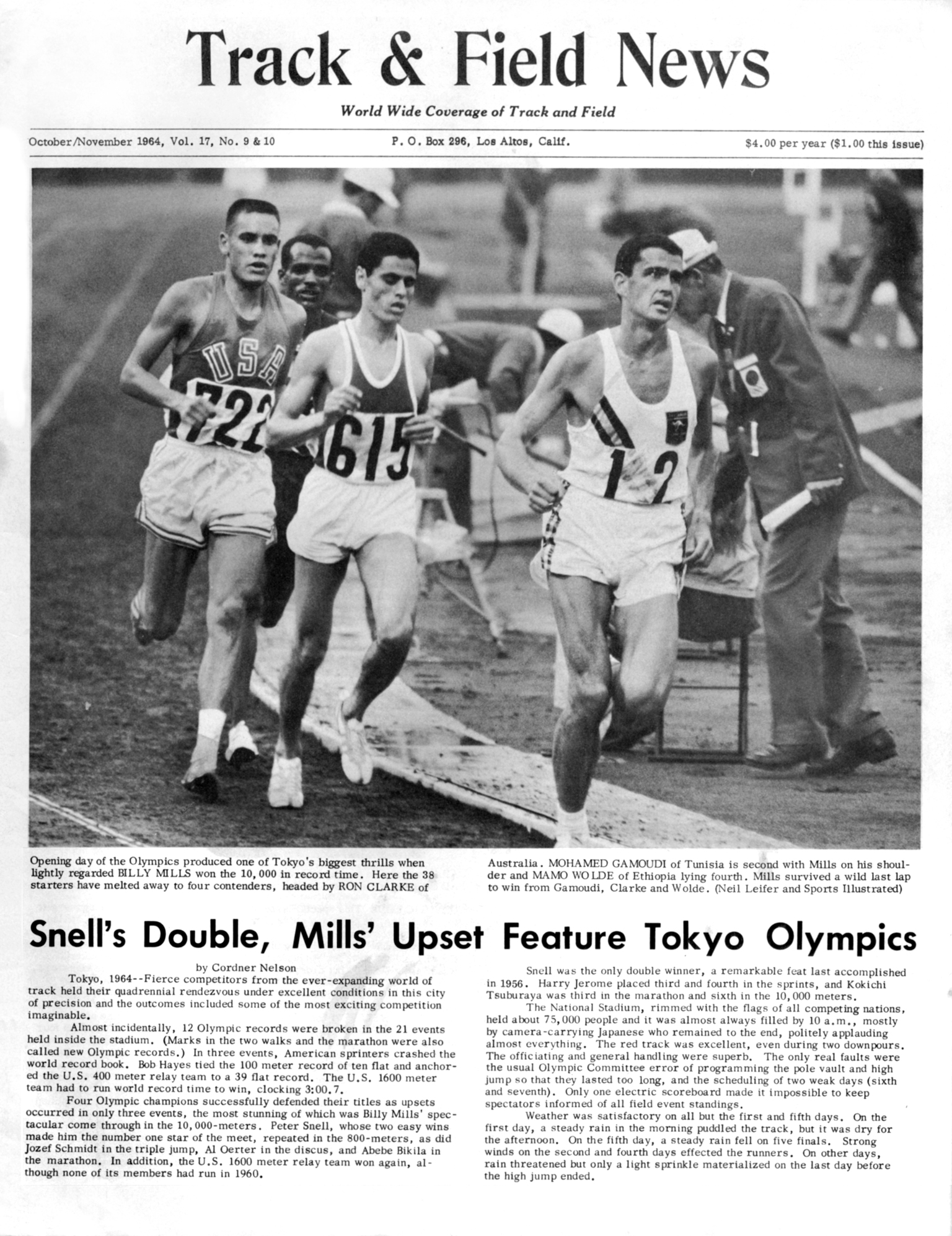
Most of that first day was filled with qualifying rounds (Bob Hayes won his heat and 1/4-final in the Men’s 100-meters), but there was one running final–the Men’s 10,000-meters. Most of the pre-Games chatter centered on Ron Clarke, the world record holder from Australia, defending champion Pyotr Bolotnikov of the Soviet Union, and New Zealand’s Murray Halberg, the 1960 Olympic Champion at 5000-meters. Clarke was the consensus pick of T&F News’s expert panel, with 18-year old Gerry Lindgren considered to be the leading American entry.
A crowded field of 38 runners, still the largest ever to contest an Olympic 10k final, started the race, and the surprising 1/2-way leader was another American, Billy Mills, who went through 5000-meters in 14:04.6, a world-record pace!
Everyone “knew” that Mills couldn’t maintain that tempo, but wasn’t it nice to see him in the lead, at least for a while? Lindgren, who had suffered a sprained ankle shortly before the Games, was out of contention at this point, while Mills was one of only five runners still battling for the three medals. Soon it was down to four, with Mills, Clarke, Tunisia’s Mohammed Gammoudi, and Ethiopia’s Malmo Wolde working their way around lapped runners. With two laps to go, Wolde lost contact with the others and the feeling among excited American fans was, “Wow, Mills is going to get at least a bronze medal”!
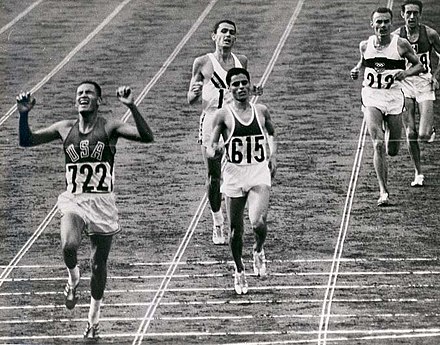
At the bell, still maneuvering around lapped runners, Clarke held the lead, while Mills moved slightly ahead on the turn, but not enough to cut in. They bumped shoulders, with Mills stumbling to the outside of lane two. Then Gammoudi, as much of an underdog as Mills coming into the race, squeezed his way between the two leaders, knocking Mills off stride again. Gammoudi opened up a lead of about 5-6 meters on the backstretch and looked like a sure winner, but Clarke gamely gave chase and drew almost even midway down the final stretch. And then Mills did the unthinkable. His late sprint brought him first past Clarke, and then Gammoudi, as he went on to attain one of the biggest upsets in Olympic history, winning in 28:24.4 (smashing Max Truex’s 4-year old American Record of 28:50.2). Gammoudi held on for 2nd in 28:24.8, with Clarke 3rd in 28:25.8 as all three bettered the previous Olympic Record (as did Wolde, who finished 4th in 28:31.8). Mills, never thinking of himself as the underdog coming into the Games, had written in his running diary that he would be ready to run 28:25 on this day! He is still the only American to win the Olympic 10,000.
Here’s how Cordner Nelson wrote of Mills’s finish in his wonderful coverage for T&F News: “Then suddenly happened a rare moment which made even mediocre track fans say, ‘That was worth the trip, alone’. A hundred and fifty pounds of fighting man went into action with an all-out sprint which abruptly turned sane men (including TV announcers-WM) into screaming hysterics. With each stride of his 5’-11” frame the Marine Lieutenant bore down on his rivals, surging past a mass of lapped runners, past Clarke and Gammoudi 50 yards from the tape so fast that Clarke was stunned and gave up the chase. With a wild grin, Billy Mills hit the tape, arms upraised in a leap of sheer joy”.
All in all, not a bad way to start my Olympic viewing “career”.
Mills, a Native American (Ogala Lakota/Sioux), is currently a much sought-after motivational speaker, both at running and corporate events, and is the spokesperson for the organization he founded, Running Strong for American Indian Youth.
Forever coupled with Mills’s historic win is the dramatic call of the finish on NBC’s coverage. See below for the full story.
There were also two field event finals on this day.
Great Britain’s Mary Rand set a World Record of 22-2 (6.76) while winning the Women’s Long Jump. Winning the silver medal was Poland’s Irena Kirszenstein-Szewińska (21-8 [6.60]), and the bronze went to the Soviet Union’s (and Russia’s) Tatyana Shchelkanova (21-3/4 [6.42]), who set the previous WR of 21-11 ¾ (6.70) in July.
Rand, who finished 9th in 1960 after being considered a potential gold medalist, more than made up for that disappointment by leaving Tokyo with a full set of medals, winning silver in the Pentathlon and bronze in the 4×100.
Kirszenstein-Szewińska, destined to become one of the legends of the sport, would also take home 3 medals from Tokyo, winning a 2nd silver in the 200, and gold in the 4×100 relay.
Finland’s Pauli Nevala (271-2 [82.66]) won the Men’s Javelin over Hungary’s Gergely Kulcsár (270-1 [82.32]) and the Soviet Union’s (and Latvia’s) Jānis Lūsis (264-4 [80.57]), who would win gold in 1968 and silver in 1972. Finishing 4th in his 4th Olympics was Poland’s Janusz Sidło (263-0 [80.17]), the 1956 Olympic silver medalist and former World Record holder. He would finish 7th in his 5th Olympics in 1968.
Medalists/Results: https://en.wikipedia.org/wiki/Athletics_at_the_1964_Summer_Olympics
http://indianyouth.org/billy-mills
Mills was portrayed by Robbie Benson in the movie “Running Brave”.
http://www.imdb.com/title/tt0086220/
http://www.amazon.com/Running-Brave-VHS-Robby-Benson/dp/6304836260
OTHER MILLS LINKS:
(last-lap footage and dramatic NBC race-call)
http://www.youtube.com/watch?v=uOj0zjPzg-c
Another Look (in Color w/comments from Mills):
https://www.youtube.com/watch?v=vs6G8NfEyVk&feature=related
https://www.youtube.com/watch?v=5F5iCsymMj0
Mills Looks Back on 50th-Anniversary
https://indianyouth.org/i-was-there-50-years-ago-billy-mills-50th-10k-olympic-anniversary/
Every Passion has Its Destiny(Excellent Documentary): http://www.youtube.com/watch?v=jHYl8c7f5zU&NR=1
NY Times: http://www.nytimes.com/packages/html/sports/year_in_sports/10.14.html
T&F News Cover(Oct./Nov.) https://trackandfieldnews.com/wp-content/uploads/2020/03/1964_10-11.jpg
Book co-authored by Nicholas Sparks: http://www.alibris.com/search/books/author/Billy%20Mills%3B%20Nicholas%20Sparks
Washington Post(2005):
www.washingtonpost.com/wp-dyn/content/article/2005/10/28/AR2005102802132.html
Running Past: http://www.runningpast.com/billy_mills.htm
In anticipation of his return to Tokyo for the 2020 Olympics, Mills began posting a series of articles (with great photos) in August, 2019, that chronicled the path he took on his way to Olympic glory in 1964. Of course, the Games were postponed until 2021 due to Covid, and, since spectators still wouldn’t be allowed to attend, Billy and his wife Patricia were forced to stay home. https://indianyouth.org/road-to-tokyo/4/
While Mills was still basking in the glow of his historic win, Sri Lanka’s Ranatunge Karunananda was still circling the track, having been lapped four times! Running alone in the packed stadium, he finished almost 5 minutes after Mills had won his gold medal. He became the darling of Japanese fans (as hardcore tracknuts groaned), who gave him a thunderous ovation when he finally crossed the finish line. He even received many gifts in the days following the race. http://kiribath.wordpress.com/2010/08/16/unsung-hero-of-sri-lankan-sports-r-karunananda-1964-olympics/
NBC Call: https://www.youtube.com/watch?v=uOj0zjPzg-c
When you watch the video of the last lap, you’ll hear NBC’s Bud Palmer describing the homestretch battle between Gammoudi and Clarke and then someone else excitedly saying in the last 50-meters, “Look at Mills!, Look at Mills!”. That was the voice of Dick Bank, one of the most knowledgeable track fans in the world, who had been hired by NBC as their expert analyst. Over the years, the common belief was that Bank had “stepped on” Palmer’s call, or had even grabbed the microphone from his broadcast partner, who apparently hadn’t yet spotted Mills making his late move on the leaders. NBC execs, deciding that Bank’s action was “unprofessional”, actually fired him before the Games in Tokyo had ended!
Not too long ago, Bank, who didn’t own a computer, heard through a friend that there were some comments on the internet about Mills’s race and his dramatic call, leading him to set the record straight with his first-hand account of what actually transpired in the TV booth that day.
“LOOK AT MILLS! LOOK AT MILLS!” THE TRUE STORY OF DICK BANK’S VERY BRIEF BUT NOTABLE TELEVISION PARTICIPATION AT THE TOKYO OLYMPICS IN 1964—AS TOLD TO ARTHUR HEAD ESQ.
It has come to my attention that there are some postings about me on the Internet. I don’t own a computer… nor do I want or need one. Mine is between my ears. I still type on an IBM Wheelwriter 1000, drive a 1989 Volvo 240GL with 299,000 miles, and do not have nor do I need a cellular telephone; or one that can take photographs.
So you can well understand why I didn’t know there was something about me on the Internet.
I did know that the last lap was on YouTube, but not the personal comments. Billy has had a DVD made of it that he sells, and I have it. Also, a red T-shirt that says, “Look at Mills! Look at Mills!”
I would like to make known the correct facts relative to my participation on NBC’s telecast of the Tokyo Olympics.
I was hired by Jim Kitchell, the executive producer, who was from NBC News. He had done presidential assassinations, space shots, etc., but he knew nothing about sports. I think my good friend, the late Bud Palmer, might have had a hand in it. I had worked for ABC’s “Wide World of Sports” in 1962, did the US-USSR meet from Stanford that year, from Moscow the next year . . . and from Kiev in 1965. I was hired as an expert commentator. I wasn’t an itinerant, as stated.
Bud Palmer was one of the finest people I have ever met—not too many of his kind in that business—and the last thing I would have done was to embarrass or show him up. That summer, the first of two Olympic Trials were held on Randall’s Island in New York City (the Olympic Trials had been held there in 1936, but it had deteriorated badly over the years).
Bud asked where I was planning to stay when in New York. I told him I had no plans. He said he and his wife Daisy were going to be away at that time, and I was welcome to use their rather large apartment on Park Avenue. Which I did!
As the final two hundred meters of the race unfolded, Bud, for whatever reason, lost sight of Billy Mills. I could see that he was going to win the race and there was not going to be any mention of him until he had crossed the finish line. He was focusing on Clarke and Gammoudi.
I didn’t grab Bud’s microphone. I had my own. What went out over the air was not an attempt to fill in commentary. It was a natural reaction, as if I were a spectator. It just so happened there was dead air, so I was easily heard.
It has been written that I was giggling with glee. It was more like unrestrained euphoria that quickly became tears. My good friend Neil Allen of the London Times came up from his seat in the press section to offer congratulations. I could barely speak.
The next day, Kitchell said what I had done was “very unprofessional.” Dick Auerbach, the producer (he had no knowledge of track and field), told me they would be turning off my microphone during the final events.
My response: “Then why bother to turn it on?”
We did not have an enclosed announce position. I continued to sit there for the next few days, offering easily heard comments under my breath. Bill Henry was the third person. He was a grand old gentleman, stadium announcer at the 1932 Los Angeles Olympics, but was no longer informed on the sport.
After the third day, I found a message when I returned to the Okura Hotel: call Dick Auerbach at the New Otani. He was having dinner on the top floor. I said it was Dick Bank, returning his call.
“I have some bad news for you.” My father had had a heart attack in April 1961, and was confined to our home. He was my first thought. Of course, there would have been a call from my mother.
“From today on, you are no longer working for NBC.” My response: “So what’s the bad news?” He was an oily guy who didn’t have the guts to tell it to my face.
I was never identified over the air. My dear, late friend Harley Tinkham, did identify me in the Los Angeles Mirror-News. Brutus Hamilton, the longtime coach at California and head coach at the Helsinki Olympics in 1952, said to his wife: “That could only be one person . . . it has to be Dick Bank.”
I was confined in that announce position. Now I could hob-nob with the European press . . . and I knew a lot of them, and speak out as I wished.
When I returned home, NBC refused to pay me. My then brother-in-law was an attorney, associated with the infamous Marvin Mitchelson. Marv had been a close friend since our days at Los Angeles High School.
A call was made to NBC in Burbank, advising them that if a check was not in their office by five that afternoon, an action would be taken. It was.
I later worked for CBS, doing thirty-five meets in 1969-70, calling the races and working alone.”
Full transcript of his letter: http://www.letsrun.com/forum/flat_read.php?thread=3925604&page=1
(Bank passed away in February, 2020, at the age of 90)
https://apnews.com/article/dac98a608326d0c791ecc458f309363b
1968—Mexico City’s altitude played a role in 2 World Records being set on this day at the Olympics.
American Jim Hines won the Men’s 100-meters, setting the first IAAAF-approved auto-timed World Record of 9.95. Jamaica’s Lennox Miller (10.04) won the silver medal and American Charlie Greene (10.07), who had suffered a hamstring strain in his semi-final race earlier in the day, won the bronze.
Romania’s Viorica Viscopoleanu won the Women’s Long Jump with a World Record leap of 22-4 ½ (6.82), 4 years to the day after Mary Rand set the previous record of 22-2 (6.76) at the Tokyo Olympics. Winning silver and bronze were Great Britain’s Sheila Sherwood (21-11 [6.68]) and the Soviet Union’s (and Russia’s) Tatyana Talysheva (21-10 ¼ [6.66]).
Americans Randy Matson (67-4 ¾ [20.54]) and George Woods (66-1/4 [20.12]) finished 1-2 in the Men’s Shot Put. Winning the bronze was the Soviet Union’s (and Russia’s) Eduard Gushchin (65-11 [20.09]). All 3 medalists achieved their best mark in the 1st round.
Hungary’s Angéla Németh (198-0 [60.36]) won the Women’s Javelin over Romania’s Mihaela Peneș (196-7 [59.92]), the defending champion, and Austria’s Eva Janko (190-5 [58.04]).
The Men’s 20k-Walk was the closest in Olympic history, with the three medalists finishing within 5 seconds of each other. The Soviet Union’s (and Ukraine’s) Vladimir Golubnichiy, the 1960 gold medalist, won his 2nd Olympic title in 1:33:58.4, while Mexico’s José Pedraza (1:34:00.0) gave the local crowd a thrill by passing the Soviet Union’s (and Ukraine’s) Nikolay Smaga (1:34:03.4) inside the stadium to grab the silver medal.
Medalists/Results
https://en.wikipedia.org/wiki/Athletics_at_the_1968_Summer_Olympics
WR Progressions
M100: http://en.wikipedia.org/wiki/Men’s_10 0_metres_world_record_progression
WLJ: https://en.wikipedia.org/wiki/Women%27s_long_jump_world_record_progression
M100: https://www.youtube.com/watch?v=Zyur9WwYjZ8
2007—The Netherlands’ Lornah Kiplagat set a World Record of 1:06:25 for the Half-Marathon at the 2nd IAAF World Road Running Championships in Udine, Italy (not to be confused with the current form of the World Road Running Championships). She also got credit for a WR for 20-Kilometers with her en-route clocking of 1:02:57. The winner of the $30,000 first-place prize, plus a $50,000 World Record bonus said, “In Kenya for years, people didn’t believe women could run so well”.
2017—North Rockland (NY) sophomore Katelyn Tuohy smashed the 2-1/2 mile course record at NY’s Van Cortlandt Park, running 13:21.8 at the Manhattan College Inv. The previous best of 13:53.9 was set by Jessica Lawson (Corning Painted Post,NY) in 2015.
Post-Race Interview: https://www.youtube.com/watch?v=54oe71ystBk
Tuohy, who would eventually win three Nike Cross Nationals titles (2017-2019), passed up the 2018 Manhattan meet, but returned in 2019, winning the Eastern States title in 13:33.2, the 2nd-fastest time ever run at Vanny. Tuohy, who went on to win 4 NCAA individual titles (2022-5000, X-Country, 2023-Indoor 3000 & 5000), also led North Carolina State to 3 NCAA team titles in X-Country (2021-2023). She also set the current Collegiate Records in the Mile (4:24.26) and 3000 (8:35.20) indoors in 2023.
Can She Defy History?(Apparently so!/June, 2018 Article):
https://www.nytimes.com/2018/06/08/sports/katelyn-tuohy.html
https://gopack.com/sports/cross-country/roster/katelyn-tuohy/9615
Born On This Day*
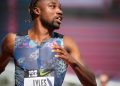
Kenny Bednarek 27 (1998) 2-time Olympic silver medalist-200m (2021, 2024); 7th in the 100 in 2024
Also the silver medalist at the 2022 & 2025 World Championships…5th in 2023
2025 World Champion-4×100, 4th in the 100
2025 U.S. Champion-100m, 2nd in the 200
Had a great double at the 2019 U.S. Junior College Championships—won the 200 and 400 with personal
bests of 19.82 and 44.73, respectively, in Hobbs, New Mexico (3,600’ altitude)…rode a very strong
(+6.1) tailwind to run a sensational 19.49 in his 200 heat!
Led U.S. preps in the 200 in 2018—20.43…was a freshman at Indian Hills Community College in Iowa in 2019…
Born in Oklahoma, he and his fraternal twin Ian were adopted at a young age, and grew up in Rice Lake,WI
PBs: 9.79 (2025), 19.57 (2024/=#8 All-Time, =#5 U.S.), 44.73 (2019); 2025 SBs: 19.58
Known as “Kung Fu Kenny” (Wears a headband when he races)
https://en.wikipedia.org/wiki/Kenny_Bednarek
https://worldathletics.org/athletes/united-states/kenneth-bednarek-14715244
https://www.olympedia.org/athletes/147336
https://www.instagram.com/kenny_bednarek/?hl=en
Mom: https://dailycitizen.focusonthefamily.com/olympian-credits-foster-mom-for-his-success/
https://www.youtube.com/watch?v=RldIpuCk9Vs
Ryan Hall 43 (1982) Ran 2:04:58 in Boston in 2011 to become the fastest American marathoner in history (course not
eligible for American Record consideration). Lost that distinction when Conner Mantz set an American Record of
2:04:43 on Synday at the Chicago Marathon.
2-time U.S. Olympian—marathon (2008-10th, 2012-dnf)
Winner of the 2007 Olympic Trials Marathon
2005 NCAA Champion—5000m/2nd 2003 X-Country (Stanford)
2006 U.S. X-Country Champion (long course)
2006 U.S. Champion-20k
He and wife Sara (Bei) adopted 4 Ethiopian sisters in 2015
Couple founded the Steps Foundation in 2009 with a goal of ending global poverty
Retired in 2016
PBs: 3:42.70 (2001), 8:02.63i (2005), 13:16.03 (2005), 28:07.93 (2007), 59:43 (2007),
https://www.olympedia.org/athletes/115463
http://www.nytimes.com/2016/01/17/sports/ryan-hall-fastest-us-distance-runner-is-retiring.html?_r=0
Steps Foundation: http://www.thestepsfoundation.org/?cbg_tz=480
Wiki Bio: https://en.wikipedia.org/wiki/Ryan_Hall_(runner)
Steve Cram 65 (1960) 1983 World Champion—1500m; 2-time European Champion(1984,1986)
Silver medalist 1984 Olympics (8th-1980, 4th-1988)
Set 3 World Records in less than a month in 1985:
July 16—1500 (3:29.67/Broke Steve Ovett’s mark of 3:30.77)
July 27—Mile (3:46.32/Broke Seb Coe’s mark of 3:47.33/now #8 performer all-time)
www.alltime-athletics.com/m_mileok.htm
August 4—2000 (4:51.39/Broke John Walker’s mark of 4:51.52(now #19 perfomer all-time)
www.alltime-athletics.com/m_2000ok.htm
1500 record was achieved in one of the greatest races in history, with Said Aouita (3:29.71)
also getting under Steve Ovett’s previous WR of 3:30.77
Other PBs: 1:42.88, 2:12.88 (#4 performer all-time) www.alltime-athletics.com/m_1000ok.htm
Ran 3:57.42 for the mile at the age of 17
Currently one of the best TV commentators in the sport
WR Progressions
1500 https://en.wikipedia.org/wiki/1500_metres_world_record_progression
Mile https://en.wikipedia.org/wiki/Mile_run_world_record_progression
Videos
1500: https://www.youtube.com/watch?v=cPzemlXs9qE
Mile: https://www.youtube.com/watch?v=xXn6fbdsFKM
Tribute IAAF Legends of Athletics
Wiki Bio: https://en.wikipedia.org/wiki/Steve_Cram
Career Recap: http://www.thegreatdistancerunners.de/SteveCram.html
Deceased
Ray Ewry 63 (1873-Sep.29, 1937) 8-time Olympic gold medalist—all in the Standing Jumps
1900—High Jump, Long Jump, Triple Jump
1904—HJ, LJ, TJ
1908—HJ,LJ
(He also won the HJ and LJ at the 1906 Inercalated Games)
Charter member of the National Hall of Fame…also a member of the U.S. Olympic Hall of Fame.
Nicknamed the “Human Frog”.
Paralyzed by polio as a child…daily exercises strengthened his legs.
https://en.wikipedia.org/wiki/Ray_Ewry https://www.olympedia.org/athletes/78385
https://usopm.org/ray-ewry/ https://www.lumserve.org/ray-ewry-greatest-jumper-olympic-history/