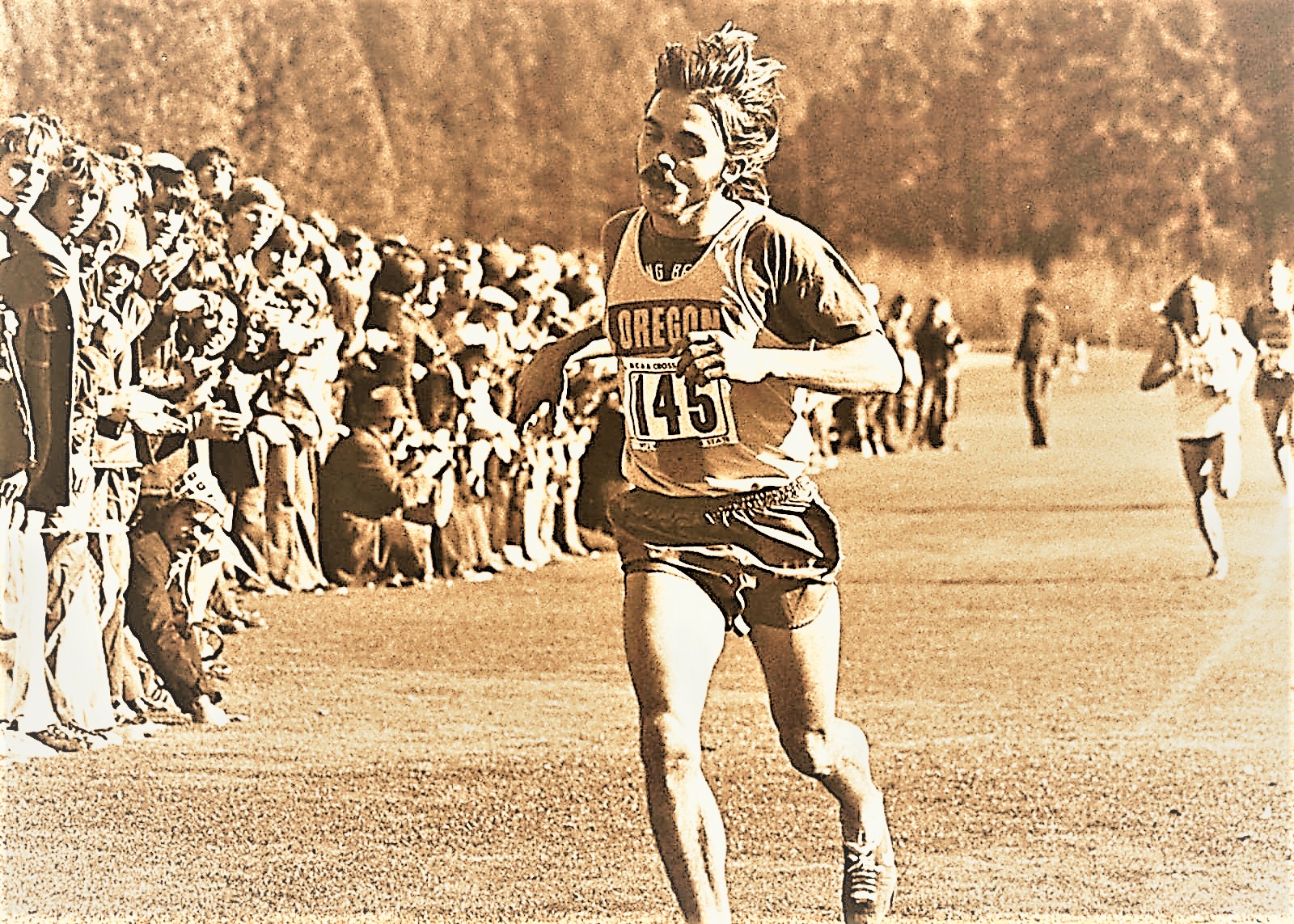
Steve Prefontaine is an American icon. He was an early employee at the fledgling company NIKE, working for Geoff Hollister in the tiny sports marketing department. He was a brilliant cross-country runner, a gutty indoor track racer, and a focused outdoor distance runner. Among Steve’s legacies while at Nike was sending a pair of NIKE Boston’s with a handwritten note to Bill Rodgers, who would wear them to win his first Boston in April 1975.

Steve Prefontaine died on May 30, 1975, coming home from a party after a track meet, where he had run a 5,000 meters. Steve had set up a small meet series in Oregon, hoping to race top Europeans, especially Lasse Viren, in front of his home crowds. Steve had helped organize the series and was disappointed when Viren canceled before the races.
Steve was killed in an auto accident, inaccurately called a single-car accident. Much of the story is written about by the late, great Kenny Moore in Bowerman and the Men of Oregon, but I fear the true story will never be told.
In the end, Steve Prefontaine died much earlier than he should have. Many, like me, still idolize him, and I must say that, way back in 2008, one of my favorite projects was distributing a huge poster of Steve Prefontaine from NIKE (developed by Weiden & Kennedy), celebrating his life. I still have a few of them in my storage units.
I wanted to celebrate his life today. So, here, in no order, are Six Lessons that I have learned from the life and times of Steve Prefontaine:
- Summer running is a great thing. After he did not make the Oregon state meet in track and field during his sophomore year, Steve Prefontaine trained all summer furiously, coming into his junior year fit and ready to race. It is partially why RunBlogRun posts (and has since 2007) daily Summer Mileage programs for high school and junior high athletes.

Steve Prefontaine, during the summer of his sophomore year in high school, photo courtesy of Marshfield High School/TFN News - Consistency is the secret sauce of distance running. During Steve’s time at Oregon, his coach was 1964 Olympic bronze medalist Bill Dellinger, an Oregon grad and a great coach and advisor to generations. Bill Dellinger mentioned to me, more than once, in coaches’ clinics and interviews, that one of the most incredible things about Steve Prefontaine was that Steve never missed a scheduled workout during his four years at the University of Oregon.

Steve Prefontaine, post-workout with Coach Bill Dellinger, photo courtesy of The Eugene Register-Guard - Learn from your tough experiences. Steve Prefontaine put so much pressure on himself at the 1972 Munich Olympics. The 5,000-meter race in Munich was one of the greatest five-thousand-meter races of all time. Lasse Viren, Mohammed Ghammoudi, Ian Stewart, and David Bedford were some of the finest distance runners in the world, and Prefontaine took them on, finishing fourth, being caught near the finish by Ian Stewart. Prefontaine was devastated. David Bedford told me a story about Steve and him having more than a few beers after the race. After that, Steve, according to his friends, changed a bit; he relaxed but stayed focused on being the best distance runner he could be.
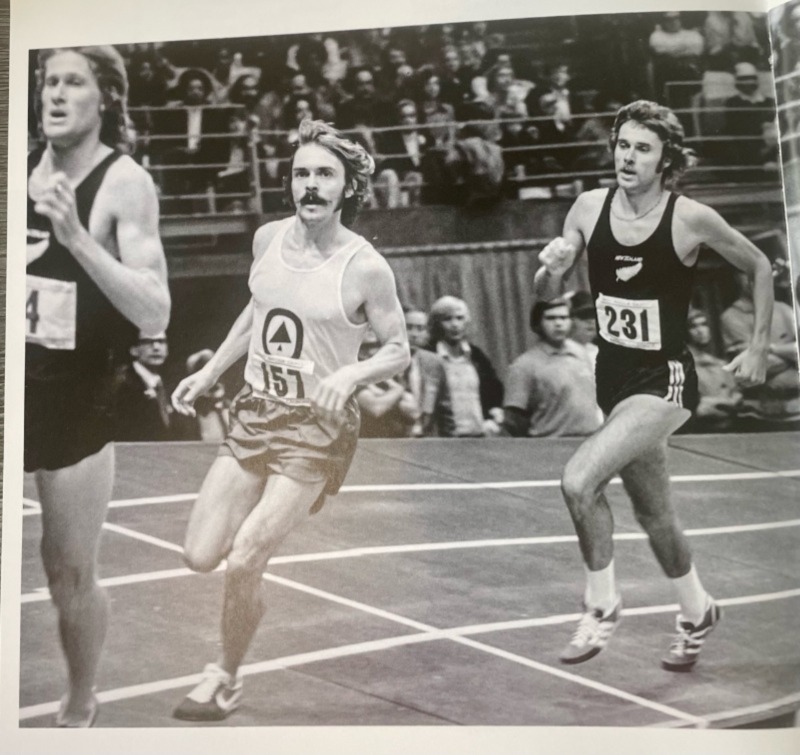
John Walker, Steve Prefontaine, Rod Dixon, racing indoors, photo by Don Chadez - Take on challenges. Dave Wottle, the 1972 Olympic gold medalist at the 800 meters, told me, this past November, at the Heroes and Youth Gala on Staten Island, about racing Steve in front of HIS crowd at Hayward Field, June 20, 1973, at the Hayward Restoration Meet. In that race, Dave Wottle told me, again, fifty years plus late, how Steve gave Dave no quarter, no breaks, and battled him until the very end. Wottle won in 3:53.3, then ran the 3rd-fastest mile of all time. Steve finished in 3:54.6, having led most of the race, putting him, in 1973, among the fastest milers in the world! And at the time, Steve Prefontaine was known as a 5,000-meter racer! I will never forget Dave Wottle’s face as he told me the story; his respect for Steve had endured fifty-two years!
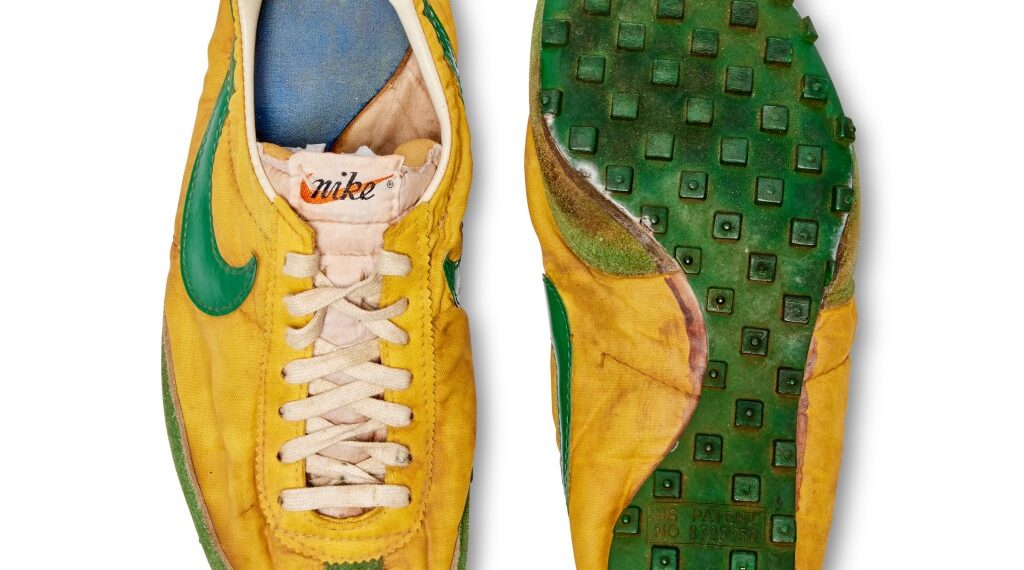
This is a photo of the NIKE Waffle racers that Steve Prefontaine used in 1974-75. They were sold at Sotheby’s for much more than the suggested retail price, photo Sotheby’s. - Do good things. In Tom Jordan’s classic book, a must-read, Pre!, Tom writes about Steve spending time at an Oregon prison, where he helped prisoners develop a running program. Even after Steve’s death, prisoners continued to run, including a group that ran a marathon within the prison. Steve did not have to volunteer, but he did anyway.
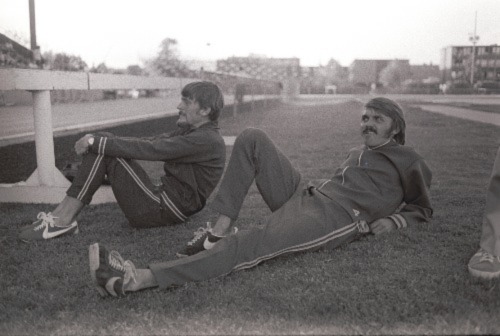
Kenny Moore with Steve Prefontaine, photo by Jeff Johnson, curated by Walt Chadwick - Enjoy your friends. I have been fortunate to have grown up in a generation near Steve Prefontaine. Several of my friends have told me stories about having a good time with Steve after races, and his sense of humor. In the book of stories Best Efforts, by the late Kenny Moore, 1972 Olympic gold medalist (1976 silver medalist), Steve Prefontaine is described as follows: “consider at Satyr.” Steve was a complicated 25-year-old who was a few years from his very best when he died.
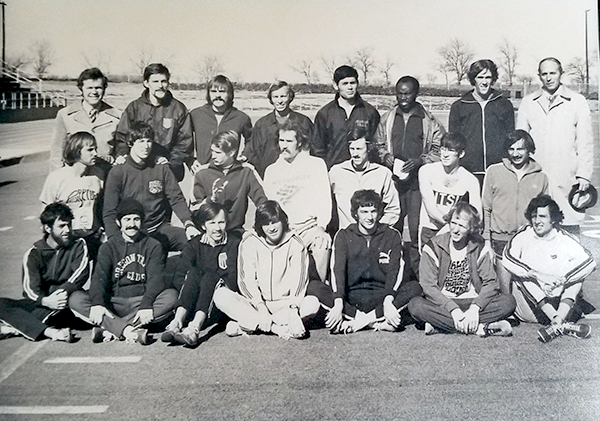
Cooper Institute, 1975, photo by Cooper Institute
Top Row L-R Dr. Mike Pollock, Kenny Moore, Steve Prefontaine, Jim Crawford, Ted Casteneda, Philip Ndoo, Unidentified, Dr. Kenneth Cooper. Middle Row: Jeff Galloway, Doug Brown, Russell Pate, Perry Pittman, Gary Tuttle, Richard Pettigrew, Mike Manley. Bottom Row: Unidentified, Ron Wayne, Jim Johnson, Paul Geis, Don Kardong, Unidentified, Frank Shorter, from Frank Shorter