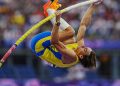


European Athletics Awards
No one could argue with the choice of Audrey Werro as European female athlete of the year at the Golden Tracks awards ceremony in Lausanne, Switzerland, earlier this month. Keely Hodgkinson was the dominant indoor 800 m runner this year, breaking the World Indoor record with a 1:54.87 in Lieven and winning the World Indoors, with Werro second in both races. However, Werro dominated outdoors, winning the European Championship, the World Ultimate, and the Diamond League final, as well as the Diamond League races in Rabat, Stockholm, Zurich, Lausanne, and Paris.

She faced Hodgkinson 3 times outdoors this year and won all three. There was a little controversy in the European Championships when Werro fell in the semi-final and finished 8th. However, she was correctly reinstated when the race video showed that she had fallen after contact from another athlete.

She won the World Ultimate, finishing ahead of rivals Keely Hodgkinson and Femke Broeders Bol, commenting: “I am just so happy with the race I ran tonight. I did everything I wanted to do. I think we have won every race I have done this year during the outdoor season [yes, all 12!]. It is really crazy but, at the same time, it is something I have worked for, and now I am getting the results.”

While Amy Hunt was a serious contender with four gold medals at the European Championships – 100, 200, and two sprint relays – and Nadia Battocletti of Italy was the European 5000m and 10,000m champion, neither can claim Werro’s global reputation.

The men’s European Athlete of the Year award went to Gianmarco Tamberi, ahead of Armand Duplantis from Sweden and Miltiadis Tentoglou from Greece, a decision which was arguably more contentious. Duplantis competed 14 times in 2026, winning 12 times and achieving a 6m clearance in 12 separate events. Tentoglou won 15 long jump competitions during the year, including the World Ultimate. Tamberi competed only seven times in 2026, winning four; not the dominant performance of a Duplantis or Tentoglou. Yet the choice of Tamberi is certainly justifiable on other criteria. He is 34 and perhaps past his best. His PR was ten years ago (2.39). The two competitions he targeted this year were the European Championships and the World Ultimate – and he won both.
At the previous European Champs (Rome 2024), he won again with 2.37. Birmingham 2026 was his fourth European title. The body is no longer able to compete 15 times in the year, but he pulls it off when it really matters. That 2.37 in Budapest was a World Lead.
It would matter to him to become the first Italian in the history of the awards to be crowned either men’s or women’s European Athlete of the Year, an accolade presented annually since 1993.
Tamberi won a record fourth European high jump title in Birmingham before producing a vintage performance at the World Ultimate Championships in Budapest, where he cleared a world-leading 2.37m to win the title.

Tamberi’s comments after the Budapest victory give further insight into his journey: “It was an amazing night. I came here with great memories from the World Championships in 2023, so I was looking forward to competing here knowing that this is an amazing place to jump. I remember before how much the crowd pushed me to pass my limits, now tonight it was even better, probably the best night of the year. I started the season probably 14th in the world rankings, so this was a real comeback. My career has been very tough because, looking at the ups and downs, I cannot even say which one was the hardest to come back from. After I couldn’t reach the final in Tokyo last year, people started saying it was time for me to retire; it was hard to hear and to fight against those feelings. Finally, I’m here with 2.37m, maybe the best result over the last nine or 10 years. I’m really proud of myself, my team, my friends, and my family. They were here today to support me. Now I can say to everyone: never stop believing in your dreams; never put a limit on yourself.”