


ATHLOS had a more entertainment-focused feel, but is it really good for athletics?
There was a moment during the almost three hours of live streaming of the second edition of the ATHLOS track and field meet in New York, where we saw Gabby Thomas arrive in a Toyota SUV to a roar from fans along the red carpet. We had not seen her on the global stage since the US Trials in early August, but her smile brimmed so hard that it felt like this was the most fun she had had all season.
For the second year running, Athlos promised to reinvent what a track meet could be. The lights were brighter, the sound louder, and the ambition larger. Everything about it aimed to elevate athletics into something closer to a spectacle, the kind you would expect from the NFL or the NBA, where sport and entertainment share the same stage.
Alexis Ohanian, the Reddit co-founder and husband of Serena Williams, has long envisioned Athlos as more than competition. His idea was to bring storytelling and star power into track and field, a sport that often struggles to connect with casual fans. It is a bold project, turning the intensity of running, jumping, and throwing into a night out. At Icahn, that idea came alive again. The crowd cheered between events, DJs spun familiar beats, and the camera crews kept the energy flowing. For three hours, track met showtime.
Yet, as the night wore on, it became clear that Athlos leaned more toward entertainment than sport. The seats were filled with people eager to be part of the experience rather than witnesses to elite performances. There were flashes of brilliance, but the rhythm of the competition never fully matched the scale of the spectacle. It felt as though two shows were unfolding at once, one for the athletes, another for the audience, and they didn’t always meet in the middle.
Brittany Brown became the face of the night, sweeping the 100m and 200m with times of 10.99 and 21.89. Her victories carried confidence, her stride full of command, but they also reflected a field that lacked the very best. In a season where the world’s top sprinters are conserving energy before the World Champs, Brown’s double win stood as both a victory and a reminder that Athlos, for all its polish, is still climbing toward the level of global meets. There is nothing hollow about her success, but even the most loyal fans could see that the night missed the edge that comes with true rivalry.
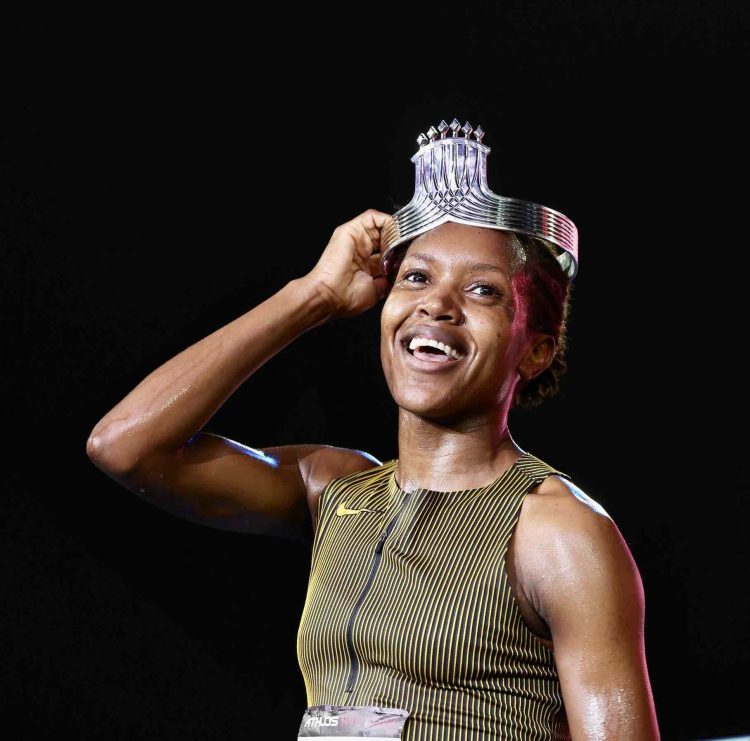
Elsewhere, Faith Kipyegon and Gudaf Tsegay delivered what many had hoped for, a battle worthy of prime time. Kipyegon, the calm force of middle-distance running, took command in the second half of the mile to win in 4:17.78. Her pace was smooth, her expression unbothered, the mark of an athlete who knows how to control a race. Still, even that duel felt slightly isolated, almost detached from the wider atmosphere, as if the track itself was performing beneath an entirely different show.
Tara Davis-Woodhall’s long jump performance might have been the closest Athlos came to uniting its two sides. Her charisma and energy matched the event’s entertainment-first vision. She laughed with the crowd, encouraged applause before her jump, and then flew to a world-leading mark of 7.13 meters. It was a moment that connected the sport to its showmanship roots, a genuine meeting of performance and personality. Around her, fans leaned in, phones up, smiles wide. For that brief stretch of seconds, the fusion Ohanian dreamed of seemed possible.
Still, as the music faded and the crowd drifted toward the exits, a question hung in the night air: What is Athlos trying to be? It has mastered the atmosphere of a festival but not yet the depth of an international meet. Track and field, in its purest form, thrives on tension, the unknown outcome, the shared heartbeat between athlete and audience. Athlos has captured attention, but it is still searching for authenticity. When spectators see more entertainers than competitors, something essential risks being lost.
This is not to say the event failed. On the contrary, its progress from last year’s debut is clear. The presentation is sharper, the production more confident, and the ambition unwavering. But its balance leans heavily toward performance art. The pacing of the evening, with long breaks and heavy crowd engagement, works for a concert but not always for a sport that depends on flow and focus. The best meets, whether in Eugene or Zurich, build rhythm, the kind that carries fans from one event to the next without losing the pulse of competition.
Ohanian’s experiment matters because it asks a necessary question: what will make people care about track again? The sport has lived too long in its own traditions, often unaware of how much audiences crave connection. Athlos is the answer to that call. It’s a reminder that track can be beautiful and fun and loud. But to sustain its promise, it must bring the same care to the quality of competition as it does to production. The next evolution must invite the world’s best to the start line and let the sport, not the staging, lead the story.