


Perfection Is a Dangerous Word unless you’re Mondo Duplantis
For years, the conversation around Armand Duplantis has not been about whether he will win. It has been about how far he can push an event that already appears to bend around his abilities. Pole vaulting, a discipline built on margins, patience and nerve, has found itself dominated by someone who treats its limits as provisional.
In 2025, that dominance hardened into something rarer. Duplantis won his third World Athletics Championships gold medal in Tokyo and claimed a fifth consecutive Diamond League title in Zurich. He did not lose a single competition all year. He broke the world record four times, extending his own ceiling to 6.30 metres. By season’s end, he was named Men’s World Athlete of the Year and the BBC’s Overseas Sports Personality of the Year.

It is difficult to stack up achievements like that without resorting to exaggeration. But the numbers stand on their own. Sixteen competitions. Sixteen wins. Four world records in one calendar year. A sport that usually rewards patience rewarded inevitability instead.
At the Paris Olympics last year, he broke his own world record and then sprinted across the track to kiss his fiancée, Desiré Inglander. The moment was spontaneous and raw. It was replayed millions of times. Overnight, he became more than a dominant athlete. He became a recognisable figure well beyond track and field.

He repeated the scene at the 2025 World Championships in Tokyo. Again, the final jump. Again, a world record. Again, Inglander waiting trackside. This time there was also a new variable under his feet. A custom spike he calls “the Claw,” fitted with an aggressive protrusion at the front designed to maximise grip at high speed. Duplantis describes it jokingly as medieval. The effect is anything but quaint.
That idea goes to the heart of why Duplantis feels different. His advantage is not just height or timing but primarily speed. He runs the runway like a sprinter, building velocity that others cannot quite match. The pole does the rest. He believes the next iteration of the shoe could help him reach 6.40m.
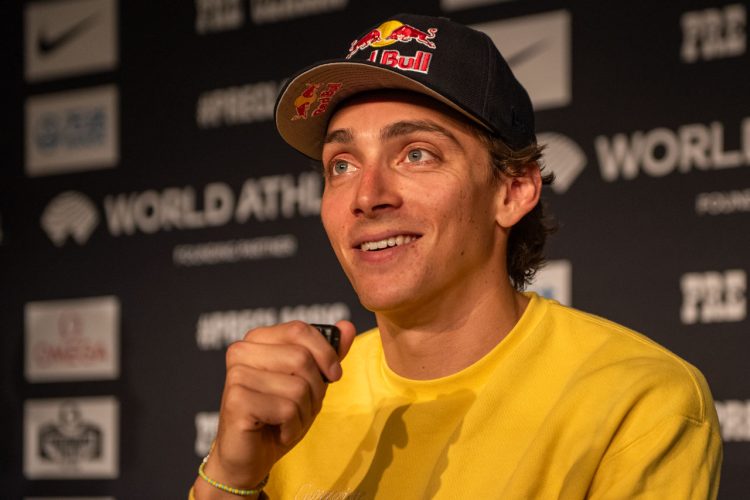
What makes this season especially striking is how unchallenged he appeared. Great athletes are often defined by rivals who sharpen them. Duplantis exists in a slightly different space. The field is strong. It is just not strong enough. His world records do not come after chaos or desperation. They arrive after calm, efficient execution.
That raises an awkward question as the sport moves into 2026. This is not an Olympic year. It is not a World Championships year. For most athletes, such seasons blur into preparation. For Duplantis, preparation has begun to look indistinguishable from peak performance.
He is 26 years old. There could be another decade ahead of him. Another ten world records is not an outlandish projection. More Olympic titles would not shock anyone. By his early 30s, he may well have stripped the event of historical mystery altogether.This is where the conversation becomes less about performance and more about purpose. How does an athlete stay engaged when the chase feels one-sided? At what point does winning stop feeling like progress?

Shohei Ohtani’s 50 home runs and 50 stolen bases in baseball felt like a deliberate redefinition of what was possible within one season. Arsenal’s unbeaten football campaign years ago showed how perfection can still leave something missing. Perfection, it turns out, is subjective. It depends on context and consequence.
Pole vaulting complicates that discussion further. It does not command the global attention of sprinting. It lacks the weekly narrative churn of team sports. For Duplantis, this is both a limitation and a freedom. There are fewer distractions, fewer expectations of reinvention.
Suggestions about experimenting with other events occasionally surface. They are usually well-meaning and mostly beside the point. Duplantis has toyed with sprinting publicly. He is not going to trouble elite 100-metre runners in their prime. And there is no need to dilute what has already proven historic. The truth may be simpler. His challenge now is not finding something else to conquer, but continuing to care about marginal improvements that only he can fully appreciate.

If statues and Mount Rushmore arguments feel premature, it is only because he is still writing the story. What 2025 showed is not that Duplantis has reached the end of ambition, but that he has reframed it. Perfection, for him, is not a finish line. It is a moving target that only he seems able to see. The question is no longer whether he will clear the bar. It is how much higher he is willing to move it.