
Walt Murphy’s News and Results Service ([email protected])
This Day in Track & Field–July 15
1900—It was a busy day at the 1900 Olympics in Paris, with gold medals determined in 10 events, some of which had short Olympic lives. Many religious athletes declined to compete in their respective finals, which were held on a Sunday! And there was no traditional track! Events were contested on a grass field, with running events conducted on a 500-meters loop,
60m/Long Jump-Al Kraenzlein won his 2nd and 3rd gold medals (had won the 110-hurdles the previous day), edging U.S. teammate Walter Tewksbury in the sprint as both were timed in 7.0. The Long Jump was filled with controversy. Marks in Saturday’s qualifying round would count towards determining the eventual winner, and Myer Prinstein led the way with a jump of 23-1 ½ (7.175), with Kraenzlein 2nd at 22-9 (6.93). Even though he was Jewish, and had competed on his own Sabbath, Prinstein was told by his college (Syracuse) that he couldn’t compete on Sunday. He reportedly entered into an agreement with Kraenzlein that neither would compete on Sunday. But Kraenzlein did compete, and wound up as the Olympic champion after topping Prinstein’s qualifying mark by one centimeter (7.185 [23-2). Prinstein had to be restrained from going after Kraenzlein when the result was announced! He gained some consolation by winning the gold medal in the Triple Jump the following day and in the Long Jump at the 1904 Olympics.
400—Maxie Long, the 1899 IC4A Champion from Columbia (and 3-time U.S. Champion) won in 49.4.
1500—Great Britain’s Charles Bennett pulled away from France’s Henri Deloge (4:07.2) in the final stretch to win in the World Record time of 4:06.2
400-meter hurdles—Walter Tewksbury (57.6) was the winner in this unusual rendition of this event. The “hurdles” were a series of 30-foot long telegraph poles except for the final hurdles—a water jump! (They obviously didn’t run the race in lanes).

2500-meter steeplechase—Canada’s George Orton, who was 3rd in the 400-hurdles, won in 7:34.4.
High Jump—With fans allowed to gather close to the event, Irving Baxter won with a clearance of 6-2 ¾ (1.90)
Pole Vault—Shortly after winning the High Jump, Baxter completed a very unusual double by winning this event at
10-10 (3.30). Officials, aware that some athletes had stated they wouldn’t compete on a Sunday, originally told them they could try to better Sunday’s marks on Monday, but changed their minds. A competition was held on Monday, with Bascom Johnson clearing 11-1 (3.38), and yet a 3rd event was held, with Dan Horton clearing 11-3 ¾ (3.45), but Baxter remained as the Olympic champion.
Shot Put—Richard Sheldon won with a toss of 46-3 1/8 (14.10). It was the 6th and final American Record of his career.
Discus—Golfers would have appreciated this event, which was held in the Boulogne Forest. With trees lining the throwing area, many throws ended up in the “rough”. Staying clear of trouble, Hungary’s Rudolf Bauer’s best of 118-3 (36.04), which he threw in the previous day’s qualifying round, held up as the winning performance.
(Notes from the IAAF’s Athletics Statistics Book from the 2012 Olympics).
WR Progression(1500): http://en.wikipedia.org/wiki/1500_metres_world_record_progression
Bios
Tewksbury: https://www.usatf.org/athlete-bios/walter-tewskbury
Kraenzlein: https://en.wikipedia.org/wiki/Alvin_Kraenzlein
Prinstein: https://www.usatf.org/athlete-bios/meyer-prinstein
Long: https://en.wikipedia.org/wiki/Maxie_Long
Medalists/Results: http://en.wikipedia.org/wiki/Athletics_at_the_1900_Summer_Olympics
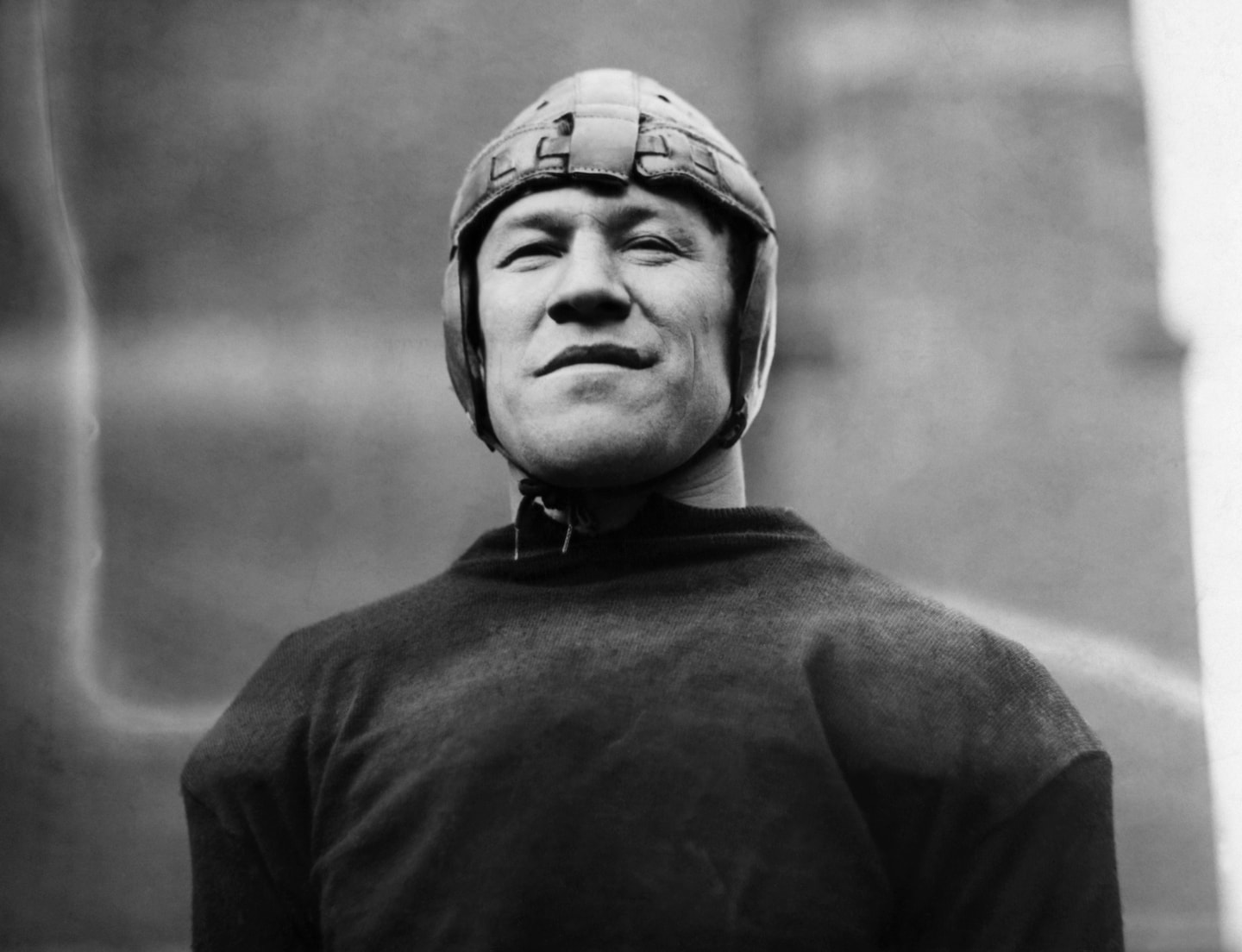
1912—As the Stockholm Olympics came to a close, Jim Thorpe earned his 2nd gold medal by winning the 3-day Decathlon with the World Record score of 8412.955 points (6564 under current scoring tables). Thorpe, who had earlier won the Pentathlon, reportedly ran the 1500-Meters with two “throwaway” shoes-one too small, one too big!
At the awards ceremony, Sweden’s King Gustav is reported to have told Thorpe, “You, sir, are the greatest athlete in the world”. To which Thorpe reportedly replied, “Thanks, King”. Thorpe was later stripped of his titles and medals after being declared a “professional” for accepting money for playing baseball, but he was reinstated by the International Olympic Committee in 1983.
LINKS:
http://home.epix.net/~landis/thorpe.html;
http://espn.go.com/sportscentury/features/00016499.html;
https://en.wikipedia.org/wiki/Jim_Thorpe
(Includes information on a successful petition to restore Thorpe as the sole winner of both the Pentathlon & Decathlon (had been listed as “co-Champion).
Sole Champion: https://www.nytimes.com/2022/07/15/sports/olympics/jim-thorpe-olympics-medal-restored.html
(you can find many more sites by Googling “Jim Thorpe”.
There was a medal sweep in the Triple Jump by Sweden’s Gustaf Lindblom (14.76 [48-5 ¼]), George Aberg (14.51 [47-7 ¼]), and Eric Almlof (14.17 [46-6]).
An All-Star U.S. lineup of Mel Sheppard, Edward Lindberg, Ted Meredith, and Charles Reidpath won the 4×400 relay by more than 4 seconds over runnerup France (3:20.7) and set a World Record of 3:16.6.
Some defunct events: the 12k cross-country race (7-15) was won by Finland’s Hannes Kolehmainen (45:11.6), while Sweden won the team title; Standing High Jump (7-13) was won by American Platt Adams (1.63/5-4 1/4); the Standing Long Jump (7-8) by Greece’s Kostas Tsiklitiras (3.37/11-3/4).
Medalists/Results: http://en.wikipedia.org/wiki/Athletics_at_the_1912_Summer_Olympics
WR Progression: http://en.wikipedia.org/wiki/Men%27s_4_x_400_metres_relay_world_record_progression
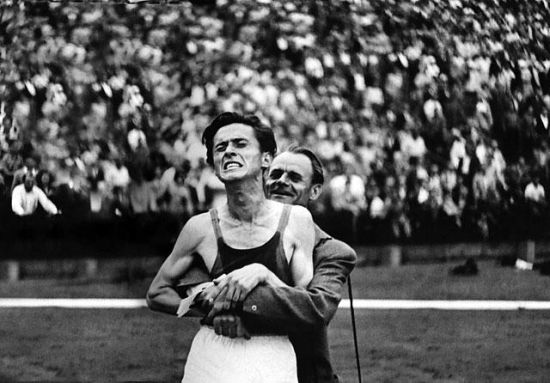
1933—In a highly anticipated matchup, New Zealand’s Jack Lovelock (4:07.6 ) won the Mile over American Bill Bonthron (4:08.7) as both bettered the World Record of 4:09-1/5 at the Cornell/Princeton-Oxford/Cambridge meet at Princeton. Bonthron’s time broke Glenn Cunningham’s month-old American Record of 4:09.8.
WR Progression: http://en.wikipedia.org/wiki/Mile_run_world_record_progression
http://www.stuff.co.nz/timaru-herald/news/8922807/Lovelocks-world-mark-recalled
https://www.nzhalloffame.co.nz/New-Zealand-Sports-Hall-of-Fame-Inductees/L/Jack-Lovelock
Bonthron: http://www.nytimes.com/1983/01/19/obituaries/bill-bonthron-70-set-mile-and-1500-marks.html
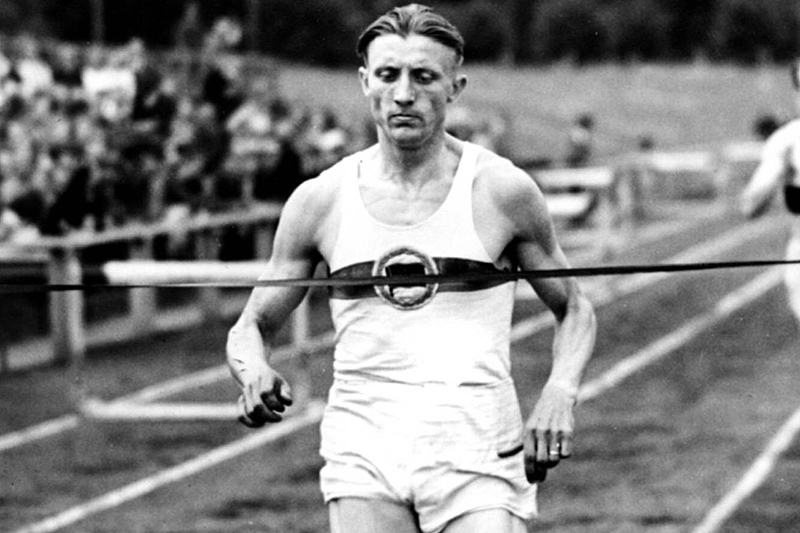
1939–Germany’s Rudolf (Rudi) Harbig took the World Record for 800-meters to a different level by running 1:46.6 on the 500-meter track in Milan, Italy. The previous mark of 1:48.4 had been set the year before by Great Britain’s Sydney Wooderson. The 1.8s differential remains the greatest improvement on a previous record in the history of the event. World War II had something to do with the longevity of Harbig’s record, but it is still notable that it held for 16 years until Belgium’s Roger Moens ran 1:45.7 in 1955. Harbig was killed in action during the war in 1944.
The highly anticipated race had been billed as a matchup between Harbig and Mario Lanzi, but he sprinted away from his Italian rival down the long homestretch. Lanzi came close to the old record with his runnerup time of 1:49.0.
Harbig would add the 400 World Record to his resume a month later, running 46.0 in Frankfurt.
https://www.olympedia.org/athletes/70264
http://racingpast.ca/john_contents.php?id=125
WR Progressions
(800) http://en.wikipedia.org/wiki/800_metres_world_record_progression
(400) http://en.wikipedia.org/wiki/Men’s_400_metres_world_record_progression
1956—Coached by the legendary Mihály Iglói, Hungary’s Sándor Iharos ran 28:42.8 in Budapest to break Emil Zátopek’s World Record for 10,000-meters (28:54.2). Iharos had previously set World Records in the 1500 and 5000.
WR Progression: http://en.wikipedia.org/wiki/Men’s_10,000_metres_world_record_progression
Wiki Bio: https://en.wikipedia.org/wiki/Sándor_Iharos
http://www.racingpast.ca/john_contents.php?id=139
1960–19-year old Harry Jerome ran 10.0 at the Canadian Olympic Trials in Saskatoon to equal Armin Hary’s month-old World Record in the 100-meters. Jerome, who would later pull up with a hamstring injury in his semi-final at the Rome Olympics, went on to have a great collegiate career at Oregon, winning NCAA titles in 1962 (220y) and 1964 (100m). He won the bronze medal in the 100 at the 1964 Olympics in Tokyo.
The popular Jerome, who also competed at the 1968 Olympics, died at the young age of 42 due to a brain aneurysm, but his memory lives on in Canada, as many sporting facilities and awards bear his name, and the Harry Jerome International Track Classic is one of the major fixtures on the Canadian circuit. http://www.harryjerome.com/
Walk of Fame: http://www.canadaswalkoffame.com/inductee/harry-winston-jerome
Photos: http://tinyurl.com/696ucgq
WR Progression: http://en.wikipedia.org/wiki/Men’s_100_metres_world_record_progression
1960—Willye White jumped 20-4 ½ (6.21) in Abilene, Texas, to regain the American Record (again) from former Tennessee State teammate Margaret Matthews, who had jumped 20-3 ½ (6.18) in 1958.
AR Progression (From 1956)
19-04 5.89 Margaret Matthews 8-18-56
19-09 ¼ 6.02 Matthews 8-25-56
19-11 ¾ 6.09 Willye White 11-27-56
20-01 6.12 Matthews 7-05-58
20-02 ½ 6.16 White 8-02-58
20-03 ½ 6.18 Matthews 8-06-58
20-04 ½ 6.20 White 7-15-60
White, who would compete in 5 Olympics, would set 4 additional American Records, her last of 21-6 (6.55) in 1964.
https://en.wikipedia.org/wiki/Willye_White
1961—Wilma Rudolph, the triple Olympic gold medalist (100,200,4×100) at the previous year’s Olympics in Rome, ran 11.3 in Moscow on the first day of competition at the 3rd USA-Soviet dual meet to equal her American Record in the 100-meters. (Full report tomorrow–July 16).
https://vault.si.com/vault/1961/07/24/the-high-meet-the-mighty
1970—Patty Van Wolvelaere ran 13.3 in Stuttgart, Germany, to set the first of her 7 American Records in the 100-meter hurdles. She was inducted into the National Hall of Fame in 2017.
https://www.usatf.org/athlete-bios/patty-vanwolvelaere-weirich
1970—Germany’s Josef Schwarz won the Long Jump in Stuttgart in a dual meet against the U.S. with a leap of 27-4 ¾ (8.35). That matched the low-altitude record that was set by Ralph Boston in 1965.
The Soviet Union’s Igor Ter-Ovanesyan had equaled Boston’s World Record in the high altitude of Mexico City in 1967, and, of course, Bob Beamon set his amazing World Record of 29-2 ½ (8.90) at the 1968 Olympics in Mexico City.
1980–Steve Ovett ran 3:32.1 for 1500-meters in Oslo to equal the World Record held by his British rival, Sebastian Coe.
Mary Decker won the 3000 in 8:38.73 to break Jan Merrill’s American record of 8:42.6, which had been set on the same track in 1978. Video(1500): https://www.youtube.com/watch?v=MgynlaXoVUY
WR Progression: http://en.wikipedia.org/wiki/1500_metres_world_record_progression
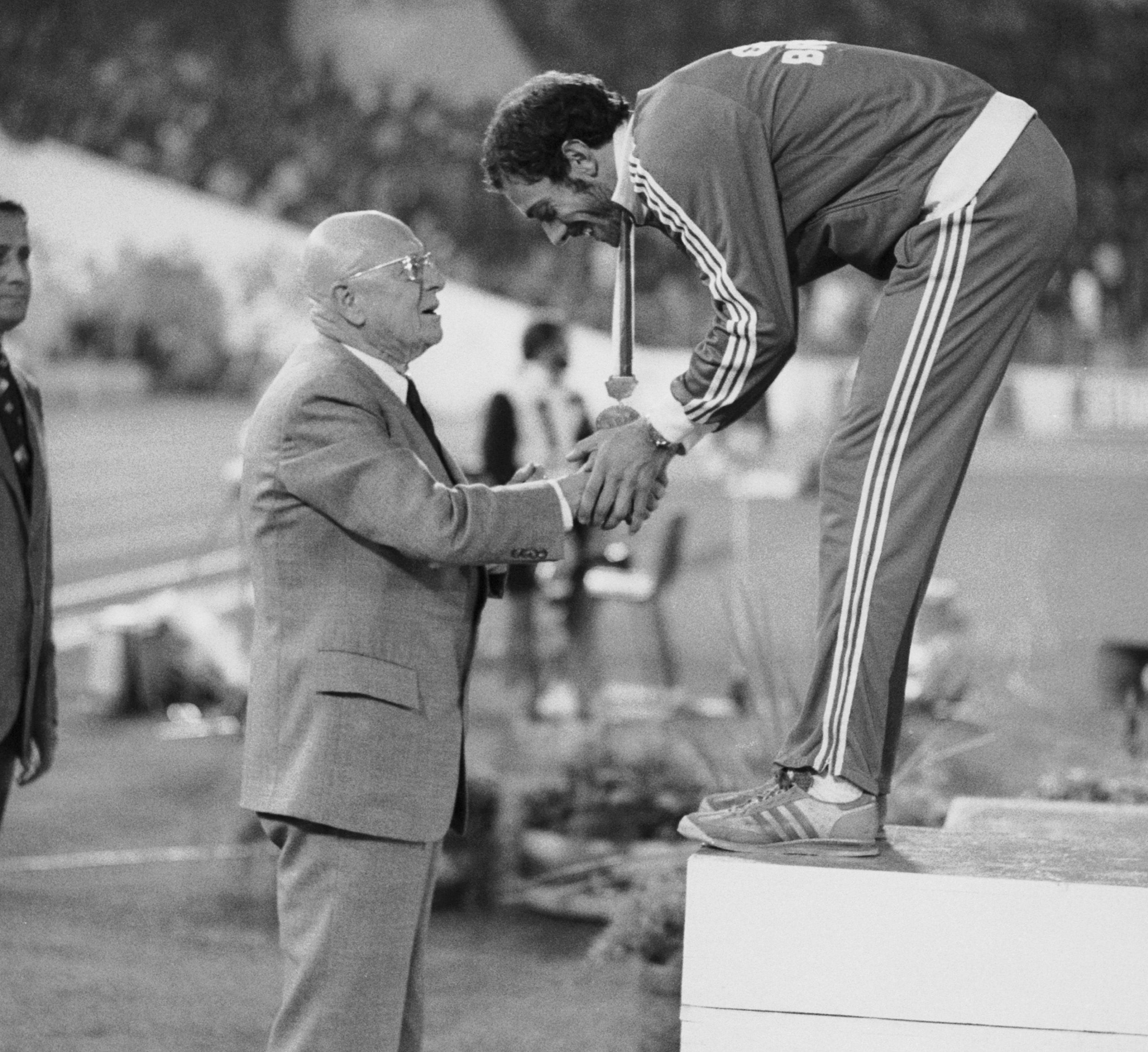
1988—Randy Barnes won the Shot Put (71-9 ½ [21.88]) by more than 3-feet on the opening day of the U.S. Olympic Trials in Indianapolis, Indiana. Also making the team were Gregg Tafralis (68-6 [20.88]) and Jim Doehring (67-8 ¼ [20.63]), who edged Ron Backes (67-8 [20.62]) for the 3rd Olympic berth. Barnes would win the silver medal at the Seoul Olympics.
Results/Notes: https://trackandfieldnews.com/wp-content/uploads/2024/03/1988.pdf
1989—The Soviet Union’s (and Russia’s) Maksim Tarasov set a World Junior Record of 19-1/4 (5.80) in a dual meet against East Germany in Bryansk, Russia. That remained as the WJR until 2017, when Mondo Duplantis ended the season with a best of 19-4 ¼ (5.90).
1994—Pushed by Great Britain’s Yvonne Murray for most of the race, Ireland’s Sonia O’Sullivan ran 8:21.64 in London to set a European Record for 3000-meters. There are some who feel she should get retroactive recognition as a World Record holder, since there is some question about the validity of all of the fast marks that came out of China in 1993, including Wang Junxia’s ratified WR of 8:06.11!
Video (poor quality): https://corkrunning.blogspot.com/2014/07/sonia-osullivan-broke-european-3000m.html
2000—There were 5 finals on the 2nd day of the U.S. Olympic Trials in Sacramento (July 14-23). Making the team were:
Men’s 100-Maurice Greene (10.01), Curtis Johnson (10.07), Jon Drummond (10.07). World Record holder Greene would win
the gold medal in Sydney
Men’s Shot Put-Adam Nelson (72-7 [22.12]), C.J. Hunter (71-9 [21.87]), Andy Bloom (70-10 ¼ [21.61])…John Godina
(69-2 ½ [21.09]) was added to the team after Hunter was suspended for a doping violation. Nelson and Godina
would win silver and bronze, respectively, in Sydney
Women’s 100–Marion Jones (10.88), Inger Miller (11.05), Chryste Gaines (11.13)…Jones would finish 1st in the 100 (and
200) in Sydney, but was later stripped of her medals for doping violations.
Women’s Hammer–Dawn Ellerbe (227-0 [69.20]), Amy Palmer (217-7 [66.31]), Jesseca Cross (217-2 [66.20])
Heptathlon–DeDee Nathan (6343), Shelia Burrell (6339), Kelly Blair-LaBounty (6180)
Results/Writeups: https://trackandfieldnews.com/wp-content/uploads/2018/03/2000.pdf
2004—The U.S. Olympic Trials in Sacramento (July 9-18) resumed after a 2-day break. Making the team on this day:
Men’s 400–Jeremy Wariner (44.37), Otis Harris (44.67), and Derrick Brew (44.69), who edged Darold Williamson (44.70) for
the 3rd spot on the team. Finishing in the same order, the 3 individual Olympians would sweep the medals in
Athens and join Williamson, Wariner’s teammate at Baylor, on the winning 4×400.
Men’s Steeplechase–Daniel Lincoln (8:15.02), Anthony Famigletti (8:17.91), Robert Gary (8:19.46)
Women’s Long Jump–Marion Jones (23-4 [7.11]), Grace Upshaw (22-5 [6.83]), Akiba McKinney (21-6 ¾ [6.57])…Jones
would finish 3rd at the Athens Olympics, but was later stripped of her medal as part of her punishment for doping
violations
Women’s Hammer–Erin Gilreath (231-0 [70,42]), Anna Mahon (227-1 [69.23]), Amber Campbell (216-6 [65.98])
Women’s Steeplechase–Ann Gaffigan (setting an American Record of 9:39.35), Kassi Andersen (9:45.52), Carrie
Messner (9:50.70)
Results/Writeups: https://trackandfieldnews.com/wp-content/uploads/2018/03/2004.pdf
Olympic Trials History (Through 2021): https://trackandfieldnews.com/usa-olympic-trials-history/
2012–The World Junior (Under-20) Championships in Barcelona (July 10-15) featured many future stars:
Winners (unless otherwise noted)
Men’s Javelin–Trinidad & Tobago’s Keshorn Walcott (258-0 [78.64]); Won Olympic gold in London the following month
(2016-Bronze)
Men’s 800–Botswana’s Nijel Amos (1:43.79/MR); won the silver medal at the London Olympics and set a World Junior
Record of 1:41.73. https://www.runnerspace.com/video.php?video_id=73840
Men’s Steeplechase–Kenya’s Conseslus Kipruto (8:06.10); 2016 Olympic gold medalist, 2017 & 2019 World
Champion (silver-2013, 2015)
Men’s Triple Jump–Cuba’s (now Portugal’s) Pedro Pablo Pichardo (55-1 [16.79]); 2021 Olympic gold medalist, 2-time silver
medalist-World Championships (2013, 2015), won gold in 2022
Women’s 400–American Ashley Spencer (50.50/MR); 2-time NCAA Champion (Illinois/2012,2013); 2016 Olympic bronze
Medalist in the 400-meter hurdles…4th in the 400 was the Bahamas’ Shaunae Miller (Uibo), the 2010 Champion;
2-time Olympic gold medalist (2016,2021); 3-time medalist in the 400 at the World Championships-gold (2022), silver
(2015,2019), 2022 World Indoor Champion
Women’s 800–American Ajee’ Wilson (2:00.91); bronze medalist-2017 & 2019 World Championships; 2022 World Indoor
Champion (2-time silver medalist (2016, 2018). American Indoor Record holder, former Outdoor Record holder
Women’s 1500–Kenya’s Faith Kipyegon 4:04.96 (MR); 3-time Olympic gold medalist (2016, 2021, 2024), 3-time World Champion (2017,
2022, 2023 [&5000]/silver medalist 2015 & 2019)…current World Record holder in the 1500 and mile