
This Day in Track & Field-July 26
1934–Glenn Hardin ran 50.6 in Stockholm to shave a big 1.2-seconds off his own World Record in the 400-meter hurdles. Hardin set the first of his three World Records in 1932 (51.9) and his reign as record holder lasted until 1953 (World War II had something to do with that).
Percy Beard ran 14.3 in the 110-hurdles to break the previous World Record of 14.4 that he had shared with 5 others. Beard was the silver medalist at the 1932 Olympics and was a long-time coach at the University of Florida. The Gators’ track in Gainesville bears his name.
Both Hardin and Beard are members of the National Hall of Fame.
WR Progressions:
400-hurdles: http://en.wikipedia.org/wiki/Men’s_400_metres_hurdles_world_record_progression
110-hurdles: http://en.wikipedia.org/wiki/Men%27s_110_metres_hurdles_world_record_progression
Hardin: https://www.usatf.org/athlete-bios/glenn-hardin
Beard: https://www.usatf.org/athlete-bios/percy-beard
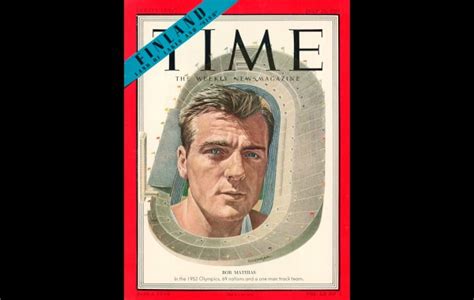
1952—Bob Mathias won his 2nd straight Olympic title in the Decathlon, scoring a World Record total of 7,887 points (7592/auto-current tables) in Helsinki. It was a sweep for Team USA, with Milt Campbell (6975/6986) and Floyd Simmons (6788/6954) winning the silver and bronze medals. Campbell would win Olympic gold 4 years later in Melbourne.
Luxembourg’s Josy Barthel was the shocking winner of the 1500 meters, while Bob McMillen finished a close 2nd to take the silver medal. Barthel, who had finished 9th at the 1948 Olympics, was a clear winner, but both were given the same time of 3:45.2, with McMillen earning an American Record as a bonus. Finishing 3rd was Germany’s Werner Lueg (3:45.4) and 4th was Great Britain’s Roger Bannister (3:46.0). Luxembourg’s National Stadium is named in Barthel’s honor. McMillen competed in the Steeplechase at the 1948 Olympics (1st round).
The Soviet Union’s Galina Zybina set a World Record of 50-1 ¾ (15.28) while winning the Women’s Shot Put over Germany’s Marianne Werner 47-9 ¾ (14.57) and teammate Klavdiya Tochonova 47-7 (14.50).
Australia’s Marjorie Jackson (23.7) won the Women’s 200 over the Netherlands’ Puck Brouwer (24.2) and the Soviet Union’s Nadezhda Khnik’ina (24.2).
Results: https://en.wikipedia.org/wiki/Athletics_at_the_1952_Summer_Olympics
WR Progression: http://en.wikipedia.org/wiki/Decathlon_world_record_progression
Time Magazine: http://tinyurl.com/TimeMathias
Video(1500): https://www.youtube.com/watch?v=lguoJ8695wo
Luxembourg?: https://www.youtube.com/watch?v=vW3NKCy3BMQ
Olympedia Reports: https://www.olympedia.org/editions/13/sports/ATH
Wiki Bio(Barthel): http://en.wikipedia.org/wiki/Josy_Barthel
1957–Tom Courtney, the 1956 Olympic Champion, set an American Record of 1:46.0 for 800-meters in Gavle, Sweden, just missing Roger Moens’ World Record of 1:45.7
https://en.wikipedia.org/wiki/Tom_Courtney
1963—John Pennel raised his American Record in the Pole Vault by a ¼”, clearing 16-9 (5.105) in the dark at the USA-Poland dual meet in Warsaw. Pennel thought he was jumping at a new World Record of 5.11 (16-9 1/4, but a remeasurement showed the bar was actually set at 5.105m! That still would better the existing WR of 16-8 (5.08), but, for unknown reasons, the mark was never ratified by the IAAF (his previous AR of 16-8 ¾ [5.10]) was also never ratified as a WR).
Hall of Fame Bio(2004): https://www.usatf.org/athlete-bios/john-pennel
1964—As reported yesterday, American Records were set at the US-USSR dual meet in L.A. by Willye White in the Women’s Long Jump (21-6 [6.55], the 7th and final AR of her career), and Leah Bennett-Ferris in the Women’s 800-meters(2:08.8)
1976–Tatyana Kazankina (Soviet Union) won the Women’s 800 at the Montreal Olympics in the World Record time of 1:54.9 (1:54.94). (She would later win the 1500). Winning silver and bronze were Bulgaria’s Nikolina Shtereva (1:55.42) and East Germany’s Elfi Zinn (1:55.60).
Another gold medal winner setting a World Record was Hungary’s Miklós Németh, who won the Men’s Javelin with a huge throw of 310-4 (94.58). 2nd was Finland’s Hannu Siitonen 288-5 (87.92) and 3rd was Romania’s Gheorghe Megelea 285-11 (87.16).
The American Record in the Women’s 400-meters took a beating in Montreal. Sheila Ingram, who had recently completed her high school career at Coolidge(DC), won the first 1/4-final in 51.31 to better Rosalyn Bryant’s 2-month old mark of 51.5. And then Debra Sapenter took the mark down to 51.23 while winning the 3rd 1/4-final.
Two days later (7-28), Ingram ran 50.90 in the first semi-final, while Bryant regained the AR by winning the 2nd semi in 50,62 Later in the day, Bryant(50.65) finished 5th in the final, with Ingram placing 6th with another 50.90, and Sapenter (51.66) winding up 8th. Ingram’s first 50.90 established a High School record and she still is the 4th fastest prep in history.
The Men’s Pole Vault, affected by wind and rain, saw three men tie the Olympic Record of 18-1/2 (5.50), with tie-breaking rules in effect at the time determining the medals. Poland’s Tadeusz Ślusarski and Finland’s Antti Kalliomaki had no misses through 18-1/2 (5.50) during the competition, but Ślusarski had one less attempt, giving him the gold. American Dave Roberts, who had set the World record of 18-8 ¼ (5.70) at the U.S. Olympic Trials in Eugene, had to settle for the bronze medal after missing once at his opening height of 17-6 ¾ (5.35).
With the outcome still in doubt, there were six men left when the bar was raised to 18-2 ½ (5.55). Ślusarski and Kalliomaki each missed their first attempt, and then Roberts inexplicably passed, even though a clearance would have put him into the lead. Ślusarski and Kalliomaki both went out at that height, as did Earl Bell and Poland’s Wojciech Buciarski, two of the pre-Games favorites (They had passed at 18-1/2).
With the gold medal his for the taking, Roberts then missed his three attempts at 18-4 ½ (5.60). Showing no regrets, he later explained his tactical decision to T&F News’s Bert Nelson, saying that he had stuck to his original game plan, which had him needing a much higher jump to beat this deep field. He did acknowledge in retrospect that he hadn’t taken into account the adverse weather conditions.
Jamaica’s Don Quarrie (20.23), 2nd in the 100, won the Men’s 200 over Americans Millard Hampton (20.29) and 17-year old Dwayne Evans (20.43), who became the youngest Olympic medalist in this event. 4th in 20.54 was Italy’s Pietro Mennea, who would win Olympic gold 4 years later in Moscow.
Trinidad & Tobago’s Hasely Crawford, the winner of the 100 two days earlier, pulled up with an injury 50-meters into the race.
Finland’s Lasse Viren (27:40.38) won the 10,000-meters over Portugal’s Carlos Lopes (27:45.17) and Great Britain’s Brendan Foster (27:54.92). Viren would win the 5000 4 days later to repeat his 5-10 double win from 1972.
The Heptathlon remains the closest multi-event competition in history. East Germans Siegrun Siegl and Christine Bodner both scored 4745 points, with Siegl earning the gold medal by beating Bonder in 3 of the 5 events. Their teammate, Burglinde Pollak, finished only 5 points behind with 4740 points!
Medalists/Results: http://en.wikipedia.org/wiki/Athletics_at_the_1976_Summer_Olympics
WR Progressions:
800: http://en.wikipedia.org/wiki/800_metres_world_record_progression.
javelin: http://en.wikipedia.org/wiki/Men’s_javelin_world_record_progression
Video-W800: https://www.youtube.com/watch?v=dU_8W1Mte9g
Olympedia Reports: https://www.olympedia.org/editions/19/sports/ATH
1980—Going head-to-head for one of the few times in their careers, Great Britain’s Steve Ovett (1:45.40) beat teammate Sebastian Coe (1:45.85), the World Record holder at the time, to win the 800-meters at the Moscow Olympics. 3rd was the Soviet Union’s Nikolay Kirov (1:46.0).
The U.S.-led boycott of these Olympics was felt big-time in this event, with four of the top six eventual World Rankers (by T&F News) missing: Americans Don Paige (#1) and James Robinson (#5), West Germany’s Willi Wulbeck (#4), and Kenya’s James Maina (#6).
Italy’s Sara Simeoni, the silver medalist in 1976, won the Women’s High Jump (6-5 ½ [1.97] OR) over Poland’s Urszula Kielan and East Germany’s Jutta Kirst, both of whom cleared 6-4 ¼ (1.94). 4th was East Germany’s Rosie Ackermann (6-3 ¼ [1.91]), the World Record holder, who was jumping with an injured knee.
East Germany’s Volker Beck (48.70) won the 400-hurdles (which was missing Edwin Moses, the defending champion). Winning silver and bronze were the Soviet Union’s Vasily Arkhipenko (48.86) and Great Britain’s Gary Oakes (49.11).
The Soviet Union’s Lyudmila Kondratyeva outleaned East Germany’s Marlies Göhr, the World Record holder, to win the Women’s 100 (11.06-11.07). Winning the bronze medal was another East German, Ingrid Auerswald (11.14). Göhr reportedly complained (in vain) to officials about her “faulty” starting blocks before the race! Missing due to the boycott was American Evelyn Ashford.
Great Britain’s Daley Thompson had to endure a cold and rainy 2nd day before winning the Decathlon (8495/8522-current tables) over the Soviet Union’s Yury Kutsenko (8331/8369) and Sergey Zhelanov (8135/8135).
Medalists/Results: http://en.wikipedia.org/wiki/Athletics_at_the_1980_Summer_Olympics
M800: https://www.youtube.com/watch?v=xI8mDWiTbQQ
W100: https://www.youtube.com/watch?v=WqgnA25yEvc
Olympedia Reports: https://www.olympedia.org/editions/20/sports/ATH
1983—Getting ready for the inaugural World Championships in Helsinki, Mary Decker (Slaney) set an American Record of 3:57.12 for 1500-meters in Stockholm. That became the oldest women’s American Record on the books until Shannon Rowbury ran 3:56.29 in Monaco in 2015. In her typical front-running style, Decker smashed her previous mark of 3:59.43, which was set in 1980. She would also set an American Record of 1:57.60 for 800-meters 5 days later in Gateshead, England.
https://vault.si.com/vault/1983/08/08/a-double-decker-for-mary
Hall of Fame Bio: https://www.usatf.org/athlete-bios/mary-slaney-decker
1983–With temperatures approaching 100-degrees, the Czech Republic’s Jarmila Kratochvílová, considered a 400 specialist, won the Women’s 800 in Munich in 1:53.28 to set the still-standing World Record in the event.
World Junior Records were set by the Cheruiyot brothers from Kenya (and Mt.St.Mary’s) as Kip ran 3:34.92 for 1500-meters to break Jim Ryun’s previous mark of 3:36.1, and Charles set a new mark in the 5000 with his time of 13:25.33.
W800-Last Lap: https://www.youtube.com/watch?v=BPSM_j3Er1o
WR Progression: http://en.wikipedia.org/wiki/800_metres_world_record_progression
A Look Back(2013): https://worldathletics.org/news/news/30-years-on-jarmila-kratochvilovas-800m-wor
40 Years Ago (2023):
https://athleticsweekly.com/blog/the-world-800m-record-that-has-stood-the-test-of-time-1039969804/
1994—Derrick Adkins set a meet-record of 47.86 while beating arch-rival Samuel Matete (47.98) in the 400-meter hurdles at the Goodwill Games in St.Petersburg, Russia. Adkins went on to win gold medals at the 1995 World Championships and 1996 Olympics, with Matete, the 1991 World Champion, winning the silver medal on both occasions. Matete (Auburn) beat Adkins (Georgia Tech) to win the 1991 NCAA title.
Another meet record was set by Algeria’s Noureddine Morceli, who won the Mile in 3:48.67. Morceli had set the World Record of 3:44.39 the previous year. Some familiar names trailed Morceli—2.Abdi Bile (3:52.28), 3.Steve Holman (3:52.77), 5.Marcus O’Sullivan (3:53.86).
Medalists: https://en.wikipedia.org/wiki/Athletics_at_the_1994_Goodwill_Games
1996—This was the first day of T&F competition at the Atlanta Olympics. John Godina was leading the Men’s Shot Put after the 5th round (68-2 ½ [20.79]), but then Randy Barnes, who was in 6th place at the time, “stole” the gold medal with his final toss of 70-11 ¼ (21.62). The bronze medal went to Ukraine’s Oleksandr Bagach (68-1 [20.75])
Ecuador’s Jefferson Pérez first made his presence known on the international scene by winning the 20k-walk in 1:20:07. Perez would win 3 World Championships (2003-2005-2007) and won the silver medal at the 2008 Olympics. 2nd & 3rd were Russia’s Ilya Markov (1:20:16) and Mexico’s Bernardo Segura (1:20:23).
“At 22, Perez became the youngest ever Olympic champion in the event, and the first Ecuadorian in history to win a medal at the Games. But he had no intention of resting on his laurels. Honoring a promise he had made to himself, a few weeks after the Games, Perez embarked on a 459km pilgrimage across Ecuador, starting at the cathedral in the capital city, Quito, heading through the mountains (reaching an altitude of 4,800m in places) and finishing in his home village of Cuenca. Along the way, thousands of his compatriots came out to cheer him on and salute his achievement in Atlanta.” More at: http://www.olympic.org/jefferson-perez
Results: https://worldathletics.org/competition/calendar-results/results/6961749
Medalists/Results: http://en.wikipedia.org/wiki/Athletics_at_the_1996_Summer_Olympics
Born On This Day*
Erica Bougard 32 (1993) 2-time U.S. Champion—Heptathlon (2018,2019); 3rd in Götzis in May, 2018-scored a personal
best of 6725 points (#5 All-Time U.S.)
2021 U.S. Olympian—finished 3rd at the Trials, 9th at the Tokyo Olympics; 6th at the 2024 U.S. Olympic Trials
4th at the 2019 World Championships in Doha
2013 NCAA Indoor Champion-Pentathlon (Mississippi State/2nd in 2014,2015)
2-time U.S. Indoor Champion—Pentathlon (2017,2018); 2012 U.S. Junior Champion—Heptathlon
NCAA Hep—2013 (4th), 2015 (2nd), 2016 (2nd)
2nd in the Heptathlon at the 2017 U.S. Championships; competed in her 3rd World Championships in London—
finished 18th((2013-24th, 2015-DNF)
PBs: 12.80(’18), 6-3 ½(1.92/’17), 21-8 3/4(6.63/’18), 4760i (‘18/#3 All-Time U.S.); 6725(‘18/#5 All-Time U.S.);
College PBs: 4586i (#7 All-Time), 6250.
2024 SB: 6192…hasn’t competed in 2025
Wiki Bio: https://en.wikipedia.org/wiki/Erica_Bougard
https://www.olympedia.org/athletes/147107
https://www.tfrrs.org/athletes/3725169.html
https://trackandfieldnews.com/index.php/tafn-lists?list_id=15&sex_id=W&yyear=2008
https://trackandfieldnews.com/index.php/tafn-lists?list_id=11&sex_id=W&yyear=2008
Des (Davila) Linden 42 (1983) Overcame what might have been the worst conditions ever in the history of the event
to win the 2018 Boston Marathon—ran 2:39.54, the slowest winning time since 1978. Became the 1st American
to win the race since Lisa Weidenbach won in 1984. Was a close 2nd at the 2011 Boston Marathon (see link), 4th
in 2017.
Ran her final professional marathon in Boston on April 21, 2025…ran 2:26:19 (17th)…some of the other American
finishers in the race bowed down to her out of respect when she crossed the finish line
2-time U.S. Olympian-Marathon (2012-DNF, 2016-7th), 4th at the 2020 Olympic Trials; PB-2:22.38 (2011-Boston)
10th—2009 World Championships; 2015 Pan-American Games Champion—10,000m
Co-hosts the Podcast “Nobody Asked Us With Des and Kara (Goucher)
https://www.youtube.com/@nobodyaskedus
2018 Boston: https://www.nbcsports.com/video/desi-linden-wins-2018-boston-marathon-womens-race
2011 Boston: https://www.facebook.com/watch/?v=10153335046346657
http://www.runnersworld.com/newswire/desiree-linden-hopes-to-recapture-boston-magic-of-2011
One Last Time (2025 Boston): https://www.youtube.com/watch?v=N4IQECtojk0
https://www.runnersworld.com/news/a64524185/des-linden-2025-boston-marathon/
Bourbon “Geek”: https://www.outsideonline.com/food/desiree-linden-loves-bourbon/
Bruce Kidd—Canada 82 (1943) 1962 Commonwealth Games Champion-6 Miles
1964 Olympian—5000 (1st round), 10,000 (26th)
Three years before a young Gerry Lindgren took the track world by storm, the 17-year old
Kidd lit up the Boston Garden in 1961 by winning the 2-mile at the Knights of Columbus meet. Screaming fans
were on their feet as the youngster held off a late charge by veteran Pete McArdle (8:49.6). Kidd’s time of 8:49.1
stood as the record for 17-year olds until Lindgren ran 8:46.0 early in the 1964 indoor season. Kidd excelled in the
classroom as well as on the track and was the long-time Vice President and Principal at the University of Toronto-
Scarborough before retiring in 2018.
PBs: 4:01.4h (1962), 8:38.2h/2-mile (1964), 13:43.8 (1962), 28:26.13/6-mile (1962)
Sports Illustrated Vault:
https://vault.si.com/vault/1961/01/23/how-young-kidd-made-good
…