
This past February one could say that World Athletics President Sebastian Coe was quite busy.
From his attempt to lead the IOC, to various administrative duties encompassing lots of traveling miles, Coe looked like he wouldn’t have time for much else.
But Coe always set time out for running!
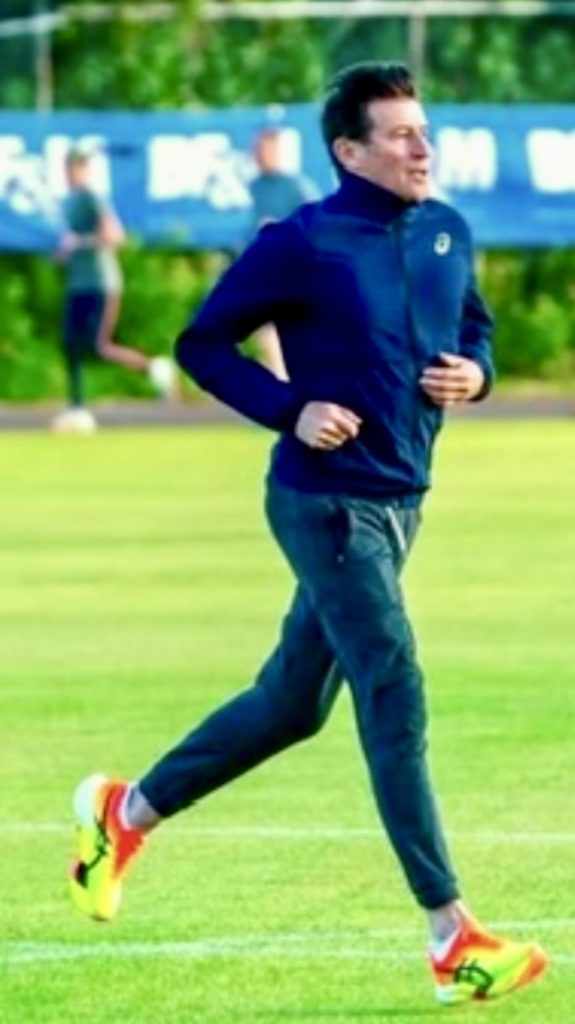
At the Chubb Bermuda Triangle 5K, the Brit Legend laced up his shoes to run a 5K, completing the hot, hilly course in a time of 26 minutes, 48 seconds.
Link – https://m.youtube.com/watch?
“ I did finish second in my age group!,” quipped Coe.
Over 40 years ago Coe faced his biggest athletics challenge of his career, as he had to toe the line at the 1984 Olympic Games in not just one event but two, replicating his 800 (Silver) /1500 (Gold) double from the Moscow Olympiad four years earlier.
Getting to the finals of these two events would not be easy as Coe would have to mix the physical and mental drive to accomplish this feat with semis, heats and the finals.
Seven races in nine days!
Coming into 1984, many in the Sport thought Coe was finished, as his 1983 year was replete with inconsistency, injury and debilitating illness.
Coe’s selection to the 800 & 1500 team led to a negative outcry by many in the British press, and so great was the pressure that Coe and his Father/Coach Peter made the decision for him to travel to the suburbs of Chicago and live and train under the eye of legendary York HS XC Coach the late Joe Newton for three weeks.
Others around Newton were there to support Coe as well.
“My physical challenges were that I had nagging discomfort in my hamstrings, hips and groins,” said Coe.
This led to diagnosis and treatment by chief podiatrist the late John Durkin, podiatrist Richard Braver and Durkin’s brother Mike, himself a 2-time Olympian at 1500 Meters.
“ “We met Coe with Coach Joe Newton at the York track,” recalled Dr. Braver, who still practices and treats some of the top runners today.
Link – https://www.drrun.com/our-
“We studied his gait and saw how he felt.…Seb was not a tall individual but he had incredibly vascularized legs and it was nice to see his musculature when he was completing 10X400 with very little rest – around 50 meters.”
“Another day both Durkin brothers took Seb out for a run in Roselle, and they trailed behind him to see about his foot strike,” said Braver.
“Mike and John were running behind me,” recalled Coe, noting that John Durkin was breathing quite heavily.
“These guys were ahead of their time,” said Coe. “They were some of the first guys who looked at what the challenge was and identifying it.”
“Dr. John Durkin had an engineer’s eye for this stuff, which is why my Father and him got along so well.”
Durkin’s skill definitely paid off.
Seb Coe and Joe Newton, from the book, “Running to the Top of the Mountain”,
“They were able to see supination on the outside of my leg and a fairly aggressive snap back and they had to go about preventing that return movement,” said Coe.
“So they designed an orthotic for my training and for my racing.”
“Dr. Durkin designed the orthotics and we adjusted them for Seb,” recalled Braver. “For the racing one there was no front toe support and they were made with a light-feather felt material.”
“They should be called the “Seb Coe Racing Orthotics!”
“We got him physically ready.”
“It’s pretty amazing that these guys did this stuff without imaging or the modern tech of today,” said Coe.
With the physical components covered Coe now focused on the mental part, which can only be derived by the training program developed, as it had been for over a decade, by his Father.
Contrary to many, Peter Coe and his son were not “tied totally to the rock” when it came to training.
Coe talked about the time when, as a student away from home in Loughborough, he encountered severe weather during the winter of 1978-79.
“There was a heavy blizzard for a few days and I couldn’t get out to run,” recalled Coe.
“You also have to remember communication was not like today – back then there were no cell phones or internet”
“On my own I went to the gym and changed my training around and when I finally spoke with my Father a few days later he said, “That’s exactly what I would’ve told you to do!”
“It was comforting for myself as an athlete that the trust was there to be independent and smart enough to make adjustments.”
That philosophy continued when Coe arrived in LA.
“My father came down to one workouts where I was doing 6X400,” recalled Coe.
“After the third 400 he said, “OK I’ve had enough” and he left me and I completed the workout.”
“Great Coaches rely on intuition!”
Physically and Mentally Coe was now ready to do battle.
“When I got to LA I had petrol in the tank and I realized I was just as good as the others.”
In another nod to the flexibility of his program, Coe had to train with different types of weights and equipment as well.
“There were different types of things,” said Coe, known for not backing off the strength training even during competition. “But I was able to just enough reps to keep the strength up and going.”
The subsequent performances in the LA Coliseum support Coe’s belief –
1) The 800 Meters
800
Friday 8/3- Round 1- 2nd place – 1:45.71
Saturday 8/4 – Quarterfinal – 3rd place – 1:46.75
Sunday 8/5 – Semi- Final – 1st place – 1:45.51
Monday 8/6 Final – 2nd Place Silver Medal – 1:43.64 behind Joaquim Cruz
2) The 1500 meters
Thurs 8/9 – Heat – 2nd place – 3:45.30
Fri 8/10 – Semi-final – 3rd place – 3:35.81
Coe was NOT the only runner attempting the grueling double. Fellow countryman Steve Ovett and Brazil’s Cruz tried to accomplish it as well.
Unfortunately respiratory infections plagued Ovett, as he barely made the 800 final leading to a hospitalization and then amazingly making the 1500 final, where he tragically dropped out with the same issues just past the bell lap.
Although Cruz won the 800 over Coe in an astounding Olympic record of 1:43.00, his racing through the Oregon collegiate season, culminating in an NCAA 800/1500 double victory the previous June, may have affected him as he was scratched from the 1500 final due to respiratory issues possibly from the LA air as well.
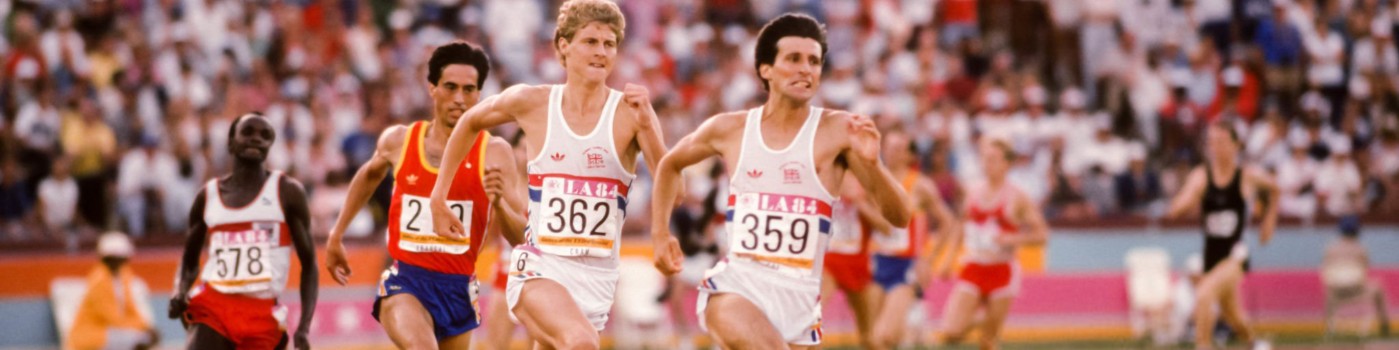
Coe’s glorious victory in the 1500 was not a slow paced affair either as American Steve Scott took it out hard just past the 400 mark with Jose Abascal of Spain then going for Gold, passing Scott and surging to the lead with 500 meters to go.
In the backstretch Coe contended with Abascal and then had to deal with his formidable countryman Steve Cram, whose finishing speed was well-known, having won the inaugural Helsinki World Championship 1500 in 1983.
Yet this was 1984.
Coe, realizing Cram’s presence shifted gears with a little over 200 to go, then shifted again on the turn and finally delivered a devastating 3rd gear over the last 100 meters, powering to Gold in a new Olympic Record of 3:32.53.
Coe still is the only 1500 runner to win double Olympic Gold!
“Coe was a man on a mission,” said Steve Scott.
“Nothing was going to stop him.”
“Of course we were all celebrating watching it on TV,” recalled Dr. Braver.
“We were so happy for him.”
A few days after the heady days of Los Angeles, Coe returned to Durkin’s office for a checkup
and readjustments still in his competitive mode as future races in Europe awaited.
“The British press and others had been really hard on Seb and his Dad,” said Braver. “The victory was definitely a sort of vindication for them.”
Talking about it with Dr. Braver in the office, Seb agreed.
“Seb said, “When I got on that line I knew NO ONE was going to bloody well beat me that day!”
As for the lightweight orthotics in Coe’s racing flats Braver has one regret.
“They should’ve be called the “Seb Coe Racing Orthotics!”