
Walt Murphy’s News and Results Service ([email protected])
This Day in Track & Field-October 18
1958—Romania’s Iolanda Balaș became the first woman to clear 6-feet (1.83) in Bucharest. It was the 5th of her 12 World Records.
WR Progression: http://en.wikipedia.org/wiki/Women’s_high_jump_world_record_progression
http://en.wikipedia.org/wiki/Iolanda_Balaș
1964–Four days after Billy Mills stunned the track world with his win in the 10,000-meters at the Tokyo Olympics, Bob Schul and Bill Dellinger gave American distance running another boost by winning the gold and bronze medals, respectively, in the 5,000-Meters on a muddy track.
France’s Michel Jazy took the lead from Dellinger just as the runners entered the final lap, with Schul sitting in 5th place. Jazy started to pull away as everyone wondered when Schul would unleash his fabled kick. It finally appeared in the middle of the backstretch, but had he waited too long? Jazy still had a good 5-meters on Schul and Germany’s Harold Norpoth in the middle of the final turn, but then Schul caught the fading Frenchman with less than 100-meters to go and went on to win in 13:48.7. Dellinger (13:49.8), like Schul a member of the National Hall of Fame, put on his own furious finish and nipped Jazy (13:49.8) at the line to win the bronze medal (Norpoth won the silver in 13:49.6). Schul’s last 400 was 54.8, and that was after a relatively slow first 100. His final 300 split was 38.7, the same that Peter Snell would run in his dominating win in the 1500 two days later!
While Mills arrived in Tokyo under the radar of most experts, Schul went to the starting line of the 5000 as the favorite. He had the fastest time in the world (an American Record of 13:38.0), had set a World Record for 2-miles in late August (8:26.4), and had shown his speed with a win (3:58.9) over mile specialist Jim Grelle.
But he still had some concerns as the Games approached. “I was very fortunate the Games were held in Tokyo in 1964,” said Schul, who had fought a lifelong battle against asthma. “The monsoons were late that year and it had been raining during the Games. The rain cleared the air of pollen and pollution. It was a great help to me.” Schul said he would not have been able to win a gold medal in the 5,000 meters if the Games had been held in other locations like Rome (1960), Mexico City (1968) or Munich (1972). “It was fate,” Schul said.
An injured Willie Davenport was eliminated in the first semi-final of the 110-meter hurdles, while American teammates Blaine Lindgren and Hayes Jones, the bronze medalist four years earlier in Rome, finished 1-3 in the 2nd semi to advance to the final later in the day.
Jones, as usual, was the quickest out of the blocks in the final, but he only had a slight lead on Lindgren, running in lane one on a wet track, as they reached the first hurdle. They were almost dead even over the next nine barriers, but Jones’ superior speed got him to the finish line first (13.6/13.67) over Lindgren (13.7/13.74), who felt he lost the race by leaning too soon. A close 3rd was the Soviet Union’s (and Russia’s) Anatoliy Mikhailov (13.7/13.78).
Cold and rainy conditions hampered the competitors in the Men’s Long Jump, as Great Britain’s Lynn Davies (26-5 ¾ [8.07]) upset his more well-known rivals-Ralph Boston (26-4 [8.03]), the defending Olympic champion, and the Soviet Union’s (and Ukraine’s) Igor Ter-Ovanesyan (26-2 ¾[7.99]).
The Soviet Union’s (and Belarus’s) Romuald Klim set an Olympic Record of 228-10 (69.74) while winning the Hammer Throw. Winning silver and bronze were Hungary’s Gyula Zsivótzky (226-8[69.09]) and West Germany’s Uwe Beyer (223-4 [68.09]). Zsivótzky (gold) and Klim (silver) would trade places 4 years later at the 1968 Olympics.
Italy’s Abdon Pamich, the bronze medalist in 1960, finished first in the 50k-walk (4:11:12.4), followed by Great Britain’s Paul Nihill (4:11:31.2) and Sweden’s Ingvar Pettersson (4:14:17.4).
Medalists/Results: http://en.wikipedia.org/wiki/Athletics_at_the_1964_Summer_Olympics
Olympedia Reports: http://www.olympedia.org/editions/16/sports/ATH
5000 (Last 3 Laps): https://www.youtube.com/watch?v=F1zYmckCaO8
Bill Rodgers on the race: http://www.billrodgersrunningcenter.com/clcobobscuol.html
Joan Nesbit Interviews Schul (for subscribers)
http://www.runnersworld.com/elite-runners/distant-heroes?page=single
Jones: https://theolympians.co/2015/11/04/hayes-jones-overcoming-hurdles-and-nerves-to-triumph-in-tokyo/
Hall of Fame Bios
Schul: https://www.usatf.org/athlete-bios/bob-schul
Dellinger: https://www.usatf.org/athlete-bios/bill-dellinger
Jones: https://www.usatf.org/athlete-bios/hayes-jones
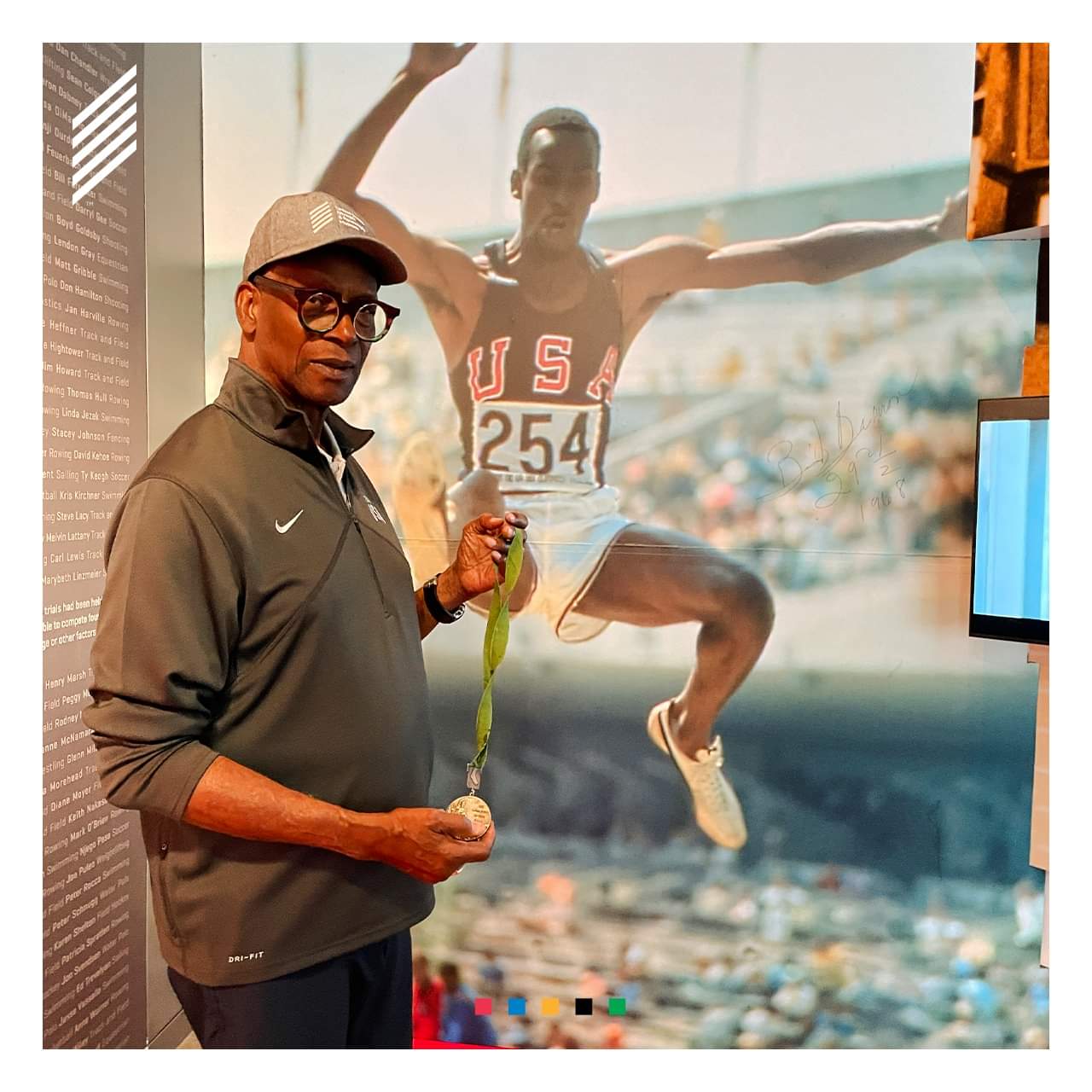
1968–The field for the Men’s Long Jump at the Mexico City Olympics included the four longest jumpers in history–Russia’s Igor Ter-Ovanesyan, who had equaled Ralph Boston’s World Record of 27-4 ¾ (8.35m) in this stadium in 1967, Boston, the 1960 gold medalist, Great Britain’s Lynn Davies, who had upset Boston and “Ter-O” to win the gold medal 4 years prior in the rain at the 1964 Games in Tokyo, and Bob Beamon, the heavy favorite to win the gold medal here.
Given the jumper-friendly 7,350′ altitude of Mexico City, a World Record seemed a certainty. Dick Drake wrote in the T&F News Preview issue, “…a 28-foot jump can not be ruled out”. He was wrong, of course, but nobody was complaining. Jumping 4th in the 1st round of the final, and before the other “heavy hitters”, Beamon, putting his 9.5y speed to good use down the runway (and aided by a maximum legal tailwind of 2.0mps [some still feel it was over the limit]), put a virtual end to the competition by skipping the 28′ barrier with his amazing leap of 29-2 ½ (8.90m).
There was a delay in posting the mark, since officials couldn’t line up the new optical measuring device with Beamon’s mark in the landing pit–they hadn’t anticipated anyone jumping that far! They finally brought out an old-fashioned steel tape and posted the unthinkable–8.90-meters! Sitting right above the long jump pit with other members of the Track and Field News Tour, I quickly found 8.90 in my conversion book and saw (could it be?) 29-2 ½! I looked nervously at other fans doing the same thing and it was like a collective thought had come over us–”I’m not going to be the one to say 29-2 1/2–I’ll get laughed at!”. We finally accepted the fact that we had just seen one of the most remarkable performances in sporting history and joined in the celebration.
After being told by Boston what 8.90 was in feet and inches, an overwhelmed Beamon dropped to his knees when he realized what he had done and was comforted by Boston and Charlie Mays (see photo link). And the term “Beamonesque” was born. A hard rain started falling soon after Beamon’s jump and, combined with the emotional blow of watching Beamon’s jump, none of the other competitors could break 27-feet (8.23m), let alone mount a challenge to Beamon, who passed his last four jumps after reaching only 26-4 ½ (8.04) in the 2nd round. Germany’s Klaus Beer (26-10 ½ [8.19]) won the silver medal while Boston (26-9 ¼ [8.16]) completed his Olympic set by taking the bronze medal by less than two inches over Ter-Ovaneysan (26-7 ¾ [8.12]). Mays had three fouls, one of which was a close one over 28-feet (8.53). Beamon’s mark survived as the World Record for almost 23 years until Mike Powell jumped 29-4 ½ (8.95) at the 1991 World Championships in Tokyo.
Beamon almost missed his date with history. In the previous day’s qualifying round, he fouled on his first two efforts before coming through with a jump of 26-10 ½ (8.19) to make it into the final.
While the vast majority of photographers were concentrating on the Men’s 400-meters, where Lee Evans (43.8/43.86) and Larry James (43.9/43.97) both bettered the existing World Record, England’s Tony Duffy, a relative novice at the time, was one of only a handful that situated themselves at the end of the Long Jump runway. He didn’t realize the importance of his now-famous shot of Beamon’s jump until he returned home to London. Requests for the photo started coming in, a reputation was born, and Duffy became one of the world’s leading sports photographers.
Back to that 400—finishing 3rd behind Evans and James was teammate Ron Freeman (44.4/44.41) to give the U.S. a sweep of the medals. James had set the previous World Record of 44.19 at the U.S. Trials at Echo Summit.
Poland’s Irena Kirszenstein-Szewińska won the Women’s 200-Meters and broke her own World Record with her winning time of 22.5 (22.58). Szewinska, who won the silver in the 200 at the Tokyo Olympics, had earlier won bronze in the 100-meters. Australians Raelene Boyle (22.7/22.74) and Jenny Lamy (22.8/22.88) won silver and bronze.
The U.S. had three finalists in the race, but were shut out of the medals (4.Barbara Ferrell-22.9, 6.Wyomia Tyus-23.0, 7.Margaret Bailes-23.1).
Bill Toomey closed out the first day of the Decathlon by running a great 45.6 (45.68) in the 400-meters. Hate to admit it, but my brother Pete and I missed that race, since the heavy rain took its toll on us and we left early!
Australia’s Maureen Caird (10.3/10.39) edged teammate Pam Kilborn (10.4/10.46) to win the 80-Meter Hurdles. Taipei’s Chi Cheng (10.4/10.51) edged American Patty van Wolvelaere (10.5/10.61) to win the bronze medal.
Romania’s Lia Manoliu won the Women’s Discus (191-2 [58.28]) over West Germany’s Liesel Westermann (189-6 [57.76]) and Hungary’s Jolán Kleiber-Kontsek (180-1 [54.90]).
Medalists/Results: http://en.wikipedia.org/wiki/Athletics_at_the_1968_Summer_Olympics
Olympedia Reports: http://www.olympedia.org/editions/17/sports/ATH
Beamon Links
IOC Video: http://www.olympic.org/videos/mexico-1968-athletics-long-jump-final
Stunning Olympic Moment #2:
http://www.guardian.co.uk/sport/blog/2011/nov/23/50-stunning-olympic-bob-beamon
50th Anniversary(2018): www.worldathletics.org/news/news/bob-beamon-890m-long-jump-world-record-50th-a
ESPN: http://espn.go.com/sportscentury/features/00014092.html
Troubled Youth(scroll down): https://www.ncjrs.gov/pdffiles1/ojjdp/181680.pdf (Scroll down)
Olympic Legends: http://news.bbc.co.uk/sport1/hi/olympics2000/bbc_team/885946.stm
Photo: https://www.pinterest.com/pin/858991328907343017/
Tony Duffy Talks About That Photo:
https://worldathletics.org/news/series/tony-duffy-bob-beamons-world-record-photo
Beamon/Duffy(free registration might be required): http://tinyurl.com/2494hyk
M400: https://www.youtube.com/watch?v=sBQdA5CbSFM
Evans Protest: https://www.youtube.com/watch?v=kDuDvGQ1vSI
W200: https://www.youtube.com/watch?v=BsR2NK_XdFs
WR Progression(400): http://en.wikipedia.org/wiki/Men’s_400_metres_world_record_progression
Szewińska: https://www.olympedia.org/athletes/74618
Sports Illustrated’s Kenny Moore Takes a Look Back in this 1987 article: Giants on Earth
Born On This Day*
Matthew Centrowitz 36 (1989) 2016 Olympic gold medalist—1500m (2012-4th);
First American to win the Olympic 1500 since Mel Sheppard in 1908…led almost every step of the way in a very
tactical race (winning time was 3:50.00!); Semi-finalist at the Tokyo Olympics
2-time medalist at the World Championships (2011-bronze, 2013-silver)
2016 World Indoor Champion-1500m; 2011 NCAA Champion-1500m (Oregon)
5-time U.S. Champion (’11,’13,’15,’16, ’18); 2-time U.S. Indoor Champion (2015-mile, 2016-1500)
8th in the 1500 at the 2019 World Championships
2007 National Scholastic Champion—2-miles (Broadneck,Md/ran 8:41.55
2-time Penn Relays H.S. Champion—3000 (2006), Mile (2007)
PBs:
800: 1:44.62 (2015)
1000i: 2:17.00i (2015/#8 All-Time U.S.)
1000; 2:16.67 (2016)
1500I: 3:35.91i (2016)
1500 3:30.40 (2015/#9 A-T U.S.);
Mile (i): 3:50.63i (2016/#10 A-T U.S.)
Mile: 3:49.26 (2021)
3000: 7:40.74i (2016)
5000: 13:00.39 (2019)
Ran his final competitive race on May 18, 2024—ran 3:35.16…injury kept him out of the 2024 U.S. Olympic Trials
Dad Matt was a 2-time U.S. Olympian (1976-1500, 1980-5000) and former American Record
holder at 5000-meters-former Director of T&F and X-Country at Manhattan College; Mom
Beverly (Bannister) had a best of 2:08 for 800-meters; Sister Lauren was an All-American at Stanford (2009
NCAA-3rd in the 1500/Indoors-3k, 4th-’08, 3rd-’09)
Married to Lyndsay Provencio…couple’s son Luka was born on November 10, 2024.
Ran 2:24:36 in the 2024 Chicago Marathon—was in the race to pace sometime training partner Keira D’Amato, who
eventually dropped out of the race. Ran 2:22:40 in the 2025 race
OG Video(Includes dad’s reaction in the stands): https://www.youtube.com/watch?v=5xRpTK9CUKk
https://www.nbcolympics.com/videos/rio-2016-centrowitz-wins-us-its-1st-1500m-gold-1908
World Feed: https://olympics.com/en/video/men-s-1-500m-final-race-rio-2016-replays
ESPN Wiki Bio: https://en.wikipedia.org/wiki/Matthew_Centrowitz_Jr.
https://worldathletics.org/athletes/united-states/matthew-centrowitz-14234521
https://www.nytimes.com/2016/08/22/sports/olympics/matt-centrowitz-won-1500-meters-metric-mile.html
Like Father, Like Son (Book) “Fun” Marathon Washington Post Article http://tinyurl.com/WashPostOG1500Rio
Robert Harting—Germany 41 (1984) 2012 Olympic gold medalist—Discus;
3-time World Champion (’09,’11,’13/silver-2007); PB: 231-10 (70.66/2012)
Injured in 2016, but brother Christoph kept the Olympic title in the family by winning the gold
medal in Rio. 6th at the 2017 World Championships in London.
Known for his wild post-victory celebrations
Threw 214-1 (64.95) in the final competition of his career in Berlin on September 2, 2018
Wife Julia Fischer was a 2-time German Olympian in the women’s discus
Wiki Bio: https://en.wikipedia.org/wiki/Robert_Harting
2012 OG: https://www.youtube.com/watch?v=Q-96j3T3Dh0
Celebrations
https://www.youtube.com/watch?v=0emtBZ8r0mc
https://www.youtube.com/watch?v=oHdcMROyqRk
http://www.olympedia.org/athletes/114699
Deceased
Evelyn Lawler-Lewis 93 (1929-January 4, 2022) 1950 U.S. Champion in the 80m Hurdles while a student at Tuskegee
Institute and was a former co-American Record holder in the event (11.7). She was 6th at the 1951 Pan-American
Games, but injuries kept her from vying for a berth on the 1952 U.S. Olympic team.
Along with her husband Bill, who passed away in 1987, the couple formed the Willingboro Track Club in New Jersey
in 1969. The club’s most famous alumni, of course, were their children, Carl and Carol. Evelyn also became the
girls coach at Willingboro H.S. and led the team to a win in the 4×100 at the 1981 Penn Relays (with Carol running
the 2nd leg).
Going to Great Lengths (Sports Illustrated-1981)
https://gadsdenmessenger.com/gadsden-native-more-than-just-carl-lewis’-mom/
https://en.wikipedia.org/wiki/Evelyn_Lawler
Cherry Hill Courier-Post Coverage
https://usopm.org/oral-history/storycorps/carl-and-carol-lewis/
https://www.latimes.com/archives/la-xpm-1988-09-15-sp-2952-story.html
https://www.nytimes.com/1981/02/12/sports/jersey-siblings-rival-the-best-in-track-and-field.html
Lina Radke—Germany 79 (1903-Feb.14, 1983) 1928 Olympic gold medalist—800-Meters
Was the first female Olympic champion at 800m and would be the last until the event was added back to the
Olympic program in 1960 (see link below)
Set 3 World Records in the 800
2:23.8 August 27, 1927
2:19.6 July 1, 1928
2:16.8 August 2, 1928 (Olympic final)
https://www.olympedia.org/athletes/69945