
This Day in Track & Field/X-Country–November 29
1956–Former Manhattan College star Lou Jones had set a World Record of 45.2 at the U.S. Trials and entered the Olympic Games in Melbourne as a solid favorite to win the gold medal in the Men’s 400-meters. Jim Lea, the 2-time NCAA Champion from USC (1953-1954), was an early pick to finish 2nd, but injuries and illness since the Trials left him in poor shape and he was eliminated in the first round.
The entrants faced a grueling schedule of four races in two days, a format that had been in place since the 1920 Olympics (and not to be used again). With only three runners advancing from each of two semi-finals, there was bound to be some fast and exciting racing. The Soviet Union’s (and Russia’s) Ardalion Ignatyev won the first in 46.8, with Jones easing up in 3rd (47.3). The fireworks came in the 2nd race. Charlie Jenkins, who had finished 3rd in each of his races in the previous day’s first two rounds, edged Finland’s Voitto Hellsten for first (46.1 for both), while Germany’s Karl-Friedrich Haas (46.2) got the final qualifying spot over Kevan Gosper, who set an Australian Record of 46.2. Gosper had starred at Michigan State (1955 Big-10 Champion) as one of the first Aussies to come to the USA on scholarship. He would later win a silver medal in the 4×400 relay.
Jones drew lane 6 in the final later in the day, the same position he had when he set the WR at the Trials. Running his typical race, he went out fast and was a clear leader at 200-meters. It looked like Jones was on his way to the win, but then he noticed Ignatyev, running inside of him in lane 2, was right with him as they came out of the final turn.
Jones admitted later that he momentarily “froze” at the thought of being pressured this late in the race and his hesitation cost him dearly as he faded down the homestretch. Hellsten was now chasing Ignatyev, who started his own fade. Jenkins had run the first 300-meters relaxed and was able to muster a strong finish that carried him past the leaders and across the finish line in first place. Haas finished well to take the silver, while officials couldn’t separate Hellsten and Ignatyev, who both earned a bronze medal. Jones was a disappointed 5th.
Jenkins’s winning time of 46.8, the result of windy conditions, was the slowest since 1928. After Jumbo Elliott died in 1981, Jenkins succeeded him as the head coach at Villanova. Gosper became an active player in the Australian and International Olympic movements, stepping down in 2013 when he reached the mandatory retirement age of 80.
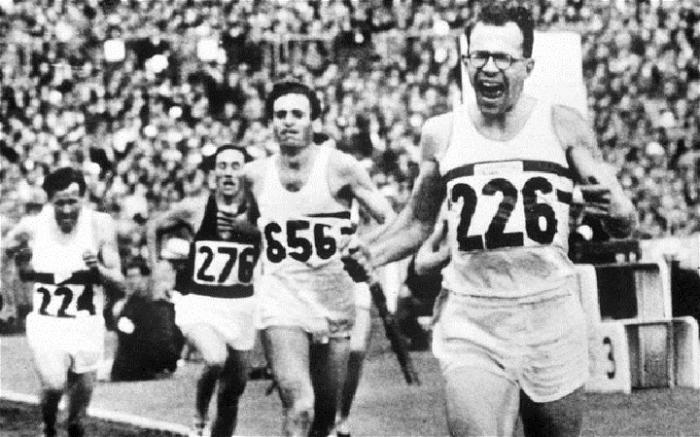
With less than a lap to go in the Men’s Steeplechase, Great Britain’s Chris Brasher made a bold move over one of the hurdles, bumping into Norway’s Ernst Larsen as he did so. Brasher, who played a pivotal role as one of the rabbits in Roger Bannister’s historic sub-4-minute mile race two years earlier, crossed the line in first (8:41.2), followed by Hungary’s Sándor Rozsnyói(8:43.6) and Larsen(8:44.0).
Brasher’s joy was temporarily cut short when it was announced that he had been disqualified for his contact with Larsen. That decision was appealed and officials ruled in Brasher’s favor.
The only American finalist was Charles “Deacon” Jones, who finished 9th. The former Iowa Hawkeye had become the first African-American to win the NCAA X-County title in 1955. Defending Champion Horace Ashenfelter was eliminated in the qualifying round.
After running in the 1979 NY City Marathon, an inspired Brasher returned home and immediately started the ball rolling for the establishment of a similar race in London, with the first edition taking place in 1981.
16-year old Wilma Rudolph, 4 years away from winning 3-gold medals at the 1960 Olympics, was eliminated in the first round of the Women’s 200-meters.
Finishing 11th in his heat of the Men’s 1500-meters was Ethiopia’s Mamo Wolde, who would win the Olympic Marathon 12 years later at the 1968 Games in Mexico City. Other non-qualifiers included Don Bowden, who would become the first American to break 4-minutes for the mile the following year, and Hungary’s István Rózsavölgyi, the World Record holder at 1500-meters.
A no-show was Australian Jim Bailey, who earlier in the year had beaten countryman John Landy, the World Record holder in the mile, in a special mile at the USC-UCLA dual meet at the L.A. Coliseum, and had become the first University of Oregon athlete to run a sub-4 minute mile. Bailey, who beat Duck teammate Bill Dellinger to win the 1955 NCAA mile title, was weakened by a bad case of hayfever and felt he couldn’t be competitive. His 3:58.6 in L.A. was the first sub-4 run on U.S. soil.
Olympedia Reports: https://www.olympedia.org/editions/14/sports/ATH
https://en.wikipedia.org/wiki/Athletics_at_the_1956_Summer_Olympics
Brasher: http://tinyurl.com/yjncmr
Hall of Fame Bio: Jenkins(1992): https://www.usatf.org/athlete-bios/charlie-jenkins
X-Country
1934—Indiana’s Don Lash won the U.S. X-Country title by 3 yards over Michigan State’s Tom Ottey on the University of Iowa’s hilly 10k course. This was the beginning of Lash’s incredible string of 7 consecutive titles, a record that stood until Pat Porter won his 8th title in 1989!
This was the first time the meet was held West of the Mississippi River.
https://timesmachine.nytimes.com/timesmachine/1934/11/30/101447586.html?pageNumber=30
Lash: https://www.usatf.org/athlete-bios/don-lash
1942—NYU freshman Frank Dixon (31:52) didn’t shake the NYAC’s Jim Rafferty (31:58) until late in the race, winning the U.S. X-Country title on a muddy 10k course in Newark,NJ. Dave Williams (32:53.0) edged Joe McCLuskey (32:53.1) for 3rd place. Finishing 8th and 9th, respectively, were future champions Curt Stone (1947) and 17-year old Browning Ross (1950), a student at New Jersey’s Woodbury H.S.!
Finishing in a tie for 16th were Lou Gregory and Joe Kleinerman, who would become one of the founders of the NY Road Runners.
https://timesmachine.nytimes.com/timesmachine/1942/11/30/85614195.pdf?pdf_redirect=true&ip=0
Kleinerman:
1947—It was a 2-man race at the U.S. X-Country Championships at NY’s Van Cortlandt Park, with Curt Stone (32:29) pulling away from Robert Black (32:38) as they exited the hills for the 2nd time, winning by 35 yards over the defending champion. The two had finished in the same order at the previous year’s IC4A Championships. Stone went on to become a 3-time U.S. Olympian (1948-5k, 1952-5k,10k, 1956-5k).
Other Notable Finishers(10k):3.Tom Quinn 32:54(1945 champion), 4.Leslie MacMItchell, 5.George Thompson…7.Eddie O’Toole…10.Joe McCluskey…21.Gordon McKenzie
(For Subscribers): https://timesmachine.nytimes.com/timesmachine/1947/11/30/87562236.pdf?pdf_redirect=true&ip=0
Stone: http://www.olympedia.org/athletes/79099
1953–Fred Wilt came out of retirement to win his 2nd straight U.S. X-Country title (3rd overall), running 31:17.6 on a snow-covered 10k course in Buffalo. Finishing 7th was early leader Horace Ashenfelter, who had won the gold medal in the Steeplechase at the previous year’s Olympics in Helsinki. He was one place behind his brother Bill, who also competed in the Olympic steeplechase (dropped out of his heat).
1954—Gordon McKenzie (10k/29:27.50) beat a strong field to win the U.S. X-Country title at Philadelphia’s Fairmount Park. He went on to make 2 U.S. Olympic teams, finishing 18th in the 10,000m in 1956, and 48th in the Marathon in 1960.
Finishing 2nd and 3rd were Browning Ross (29:31), the 1950 winner, and Horace Ashenfelter, the 1952 Olympic gold medalist in the Steeplechase. Ashenfelter had beaten McKenzie by 20 seconds the week before at the Met. AAU Championship. (From T&F News)
https://en.wikipedia.org/wiki/Gordon_McKenzie_(athlete)
https://www.olympedia.org/athletes/78767
1980—Jon Sinclair (31:47) and Mary Shea (18:19/5k) were the winners on a snow-covered course in Pocatello, Idaho, at the first U.S. X-Country Championships held under the auspices of “The Athletics Congress” (TAC), which had taken over the administration of the sport from the AAU.
Shea, along with her sister Julie (18:32), who was 2nd here (the first time she had lost to her sister), had led North Carolina State to the AIAW title two weeks earlier, with Julie finishing 1st and Mary 5th.
Trailing the Sheas across the line in the cold and windy conditions were Jan Merrill (18:40), Brenda Webb (18:44), Betty Jo Springs (18:44/their North Carolina State teammate), and one F.L. Smith (19:00), better known as Francie Larrieu, who had entered the race under her new married name. All six qualified for the U.S. team that would compete at the following year’s World X-Country Championships. Merrill was the 1976 and 1977 champion, while Larrieu won in 1972 and 1973.
Jon Sinclair, accustomed to Pocatello’s 4,700’ altitude after competing collegiately for Colorado State (Ft.Collins/5,000’), built an early lead and was never challenged as he won by 12 seconds over Penn State’s Alan Scharsu (31:59), who had finished 7th at the previous week’s NCAA Championships. 3rd was Great Britain’s Nick Rose (32:03), the 1977 champion, and 4th was Steve Scott (32:11), America’s #1-miler.
(From www.trackandfieldnews.com)
1986—Pat Porter (30:36/10.3k) won the 5th of his 8th straight U.S. titles in San Francisco. Great Britain’s Steve Jones (30:46) edged Keith Hanson (30:47) for 2nd.
Other Notable Finishers:6.Chris Fox (Syracuse coach), 8.Marcus O’Sullivan (Villanova coach), 9.Thom Hunt, 10.John Treacy.
Winner of the Women’s 5.2k race was Lesley (Welch) Lehane, who also won the 1982 title.
Photos(Men): http://www.runningentertainment.com/runningshots13.html
Born On This Day
Pat Manson 58 (1967) 1996 U.S. Indoor Champion—Pole Vault
3-time Pan-American Games champion (1991,1995,1999); 6th-1997 World Championships
Cleared 18’ or better 22 years in a row (1986-2006); PB: 19-2 ¼ (5.85/1997)
Made the top-10 World Rankings 5 years in a row—’94 (10),’95 (10),’96 (10),’97 (6), ’98 (8)
Ranked in the U.S. top-10 eleven years in a row (1991-2001/#1 in 1996 and 1997)
All-American at Kansas: NCAA—1987 (3), 1989 (2), 1991 (3); Indoors—2nd/1989-1991, 5th/1988
Held the U.S. High School Indoor Record of 17-6 ½ for 25 years (1986-2011)
Now conducts pole vault camps in Boulder,CO; Married to All-American (Indiana) distance runner
Amy Legacki
T&F News Rankings: https://trackandfieldnews.com/rankings/
Brad Schlapak 59 (1966) Upset winner at the 1995 U.S. X-Country Championships on his “home course” in Boston’s
Franklin Park…outsprinted defending Champion Reuben Reina.
All-American at Northeastern—7th in the mile at the 1989 NCAA Indoor Championships
PBs: 3:40.20 (1989), 3:58.5 (1991), 13:44.08 (1995)
https://worldathletics.org/athletes/united-states/brad-schlapak-14250623
https://www.letsrun.com/forum/flat_read.php?thread=730702#731644
Deceased
Jimmy Carnes 76 (1934-March 5, 2011) Legendary career as a coach and administrator
Inducted into the National Hall of Fame in 2008
Coached at Florida from 1964-1976
Former President of The Athletics Congress (USATF)
First Executive Director of the U.S. T&F/Cross Country Coaches Association (USTFCCCA)
https://www.usatf.org/athlete-bios/jimmy-carnes
http://www.ustfccca.org/awards/jimmy-carnes-ustfccca-class-of-1998
https://en.wikipedia.org/wiki/Jimmy_Carnes
https://www.worldathletics.org/news/iaaf-news/former-usatf-president-jimmy-carnes-dies
https://floridagators.com/news/2011/3/6/20034
George Lermond 35 (1904-July 6, 1940) 1924 U.S. Olympian (5000m/1st round)
1925 U.S. Champion: 6-miles
2-time U.S. Indoor Champion-3 Miles (1932,1933)
Younger brother Leo was a 1928 U.S. Olympian—5000m (4th)
Army veteran died tragically at the age of 35. From Olympedia: His home caught on fire, and he and his wife went back in to
rescue two of their sons. George Lermond returned to the flaming house a third time, trying to rescue his youngest son, George,
Jr., but they both perished in the attempt. The two were buried at Arlington National Cemetery, after permission was given by
President Franklin Roosevelt.
https://www.olympedia.org/athletes/78691
https://veteranscribe.com/2013/11/18/this-is-your-america/
Leo: https://www.olympedia.org/athletes/78690
Rosslyn “Roy” Range 87 (1933-May 28, 2021) 1955 Pan-American Games Champion—Long Jump…the U.S. Army Private’s
winning mark of 26-4 ¼ (8.13/helped by Mexico City’s altitude) made him the 3rd longest jumper in history
at the time, trailing only Jesse Owens (26-8 ¼ [8.13] and Willie Steele (26-6 [8.07]).
1955 U.S. Indoor Champion
PB: 26-4 ¼ (8.03/1955)
https://www.rangefuneralhome.com/obituary/Rosslyn-Range
Pan-Am Video: https://www.footage.net/clipdetail?supplier=grinberg&key=31586523