
Reposted October 27, 2026
Original post on July 29, 2018
Editor’s note: It is cross-country season 2026. I repost this piece most cross-country seasons so the next generation never forgets this amazing runner, Janet Bristol. I am forever grateful to Rich Englehart for posting this story, to Jeff Johnson for the photos, and to Walt Chadwick for curating the photos.
This is a wonderful story of Janet Bristol. Jeff Johnson told me that Janet Bristol- he is convinced- could have won an Olympic medal if she had kept running. We thought we’d share a story from the man who gave NIKE its name (he had a dream about it, but that’s another story, dear readers!).
Originally posted on July 29, 2018.
Larry Eder/RunBlogRun does an introduction: At the end of the day, we are storytellers. Our sport is about stories. Stories about the great ones, stories about those who overcame great challenges, stories about those who could have been. Before the written word, our ancestors sat around campfires, listening to stories of the great ones before us.
This is the story of Janet Bristol, one of the US’s most talented and precocious runners. By fifteen, she was a global player, and by seventeen, she was out of the sport.
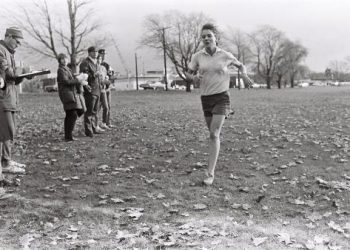
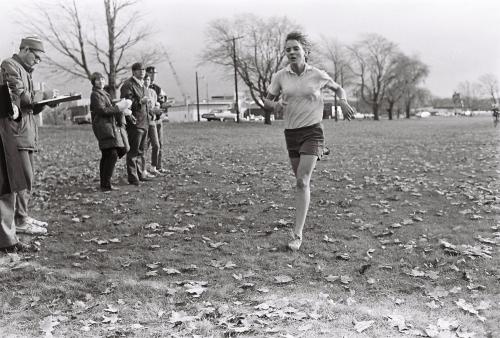
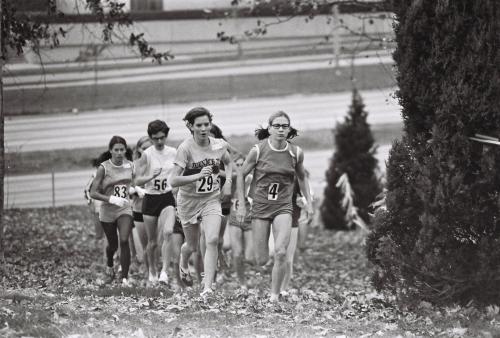
 Janet Bristol, photo by Jeff Johnson (1970 New England AAU Cross Country), photos curated by Walt Chadwick
This story took over three years to come together.
Janet Bristol’s story has been in the making for 47 years.
It started with a message from a friend in 2015. The friend wanted to tell me that Jeff Johnson, the man who, in a dream, came up with the name Nike for Phil Knight, wanted to speak to me. You see, Jeff Johnson likes his privacy. You don’t contact him directly; he doesn’t use answering machines.
After a career at Nike, where he helped build the brand with the great ones, Jeff went back to his first loves, photography and coaching. Much of the history of our sport in the 1960s and 1970s is due to the many photos taken by Jeff Johnson, who was everywhere. Jeff Johnson coached many, and his enthusiasm for the sport is, well, infectious.
I met Jeff Johnson in the late 1970s, but I do not remember where. I knew of his photographs before I ever met Jeff. I heard stories about him. I learned about him through his pictures in Track & Field News. His affection for the focus of his photographs and his respect for the sport came through in all the work he did. I saw Jeff Johnson again on a plane in Manchester, New Hampshire, in 1989, while I worked for a computer magazine publisher in Peterborough, New Hampshire. When I returned to California in the 1990s and began coaching post-collegiates at Foothill College with my mentor, Joe Mangan, I would see Jeff Johnson and Frank Gagliano on the Stanford golf course, and we would chat. Jeff and I would talk as he finished his coaching sessions. Jeff wondered out loud how we made a living publishing American Track & Field (we barely did), and we talked about training. I loved that time, speaking with Gags and Jeff, and tried to soak it all in. Many times, I wished I had a tape recorder.
I have saved a few holiday cards from Jeff. He sent me notes of encouragement around the holidays, and I have treasured them.
In the summer of 2015, Jeff and I spoke for about thirty minutes. He began telling me the story of Janet Bristol, an athlete he swore could have medaled with Joan Benoit Samuelson in 1984. Jeff wasn’t a man for hyperbole, so I listened. The more I listened, the more intrigued I became.
Soon, a gentleman named Walt Chadwick sent me 20 glorious black-and-white pictures of Janet Bristol from 1970, photographed by Jeff Johnson. Walt also put me in touch with Jeff Englehart. It was like the time travel described in Kurt Vonnegut novels. I was seeing into a time and culture just before I began running, in Saint Louis, in 1972. Jeff Johnson had coached this very promising young woman after he saw her crush the competition in the 1970 New England AAU cross country race. After coaching with Jeff Johnson, she went to Saint Louis in the winter of 1971 and finished fifth in the 1971 AAU cross country title, going with Doris Brown Heritage to the 1971 International, where she took fifth in the world! Fifth in the world at sixteen!
And then, it was over.
A year later, she ran her last race, a marathon, and she would not race again.
Walt Chadwick sent me pictures and introduced me to Rich Englehart, a fine writer. Rich produced the following story in the spring of 2016. I put the story in my archive, as I was dealing with the illness of my mother, who passed away in the Fall of 2016. Over the next two years, with family tragedy and my health, my mind was not on much. I am just beginning to catch up on several things left undone. I had totally forgotten about Janet Bristol.
Now, two successful heart surgeries later, my energy has returned.
And then, less than a week ago, I got a text from Tom Carleo, a VP at New Balance. I met Tom, a fine runner in his own right, while he was at Nike. Tom has a wry sense of humor. He noted that he was having an adult beverage with a gentleman and that I had taken a story from him, and neither published it nor paid him for the work. I found the story, read it, reached out to him and Walt Chadwick and, apologized to the writer, on this warm July day in 2018, you see the story of The Road Not Taken.
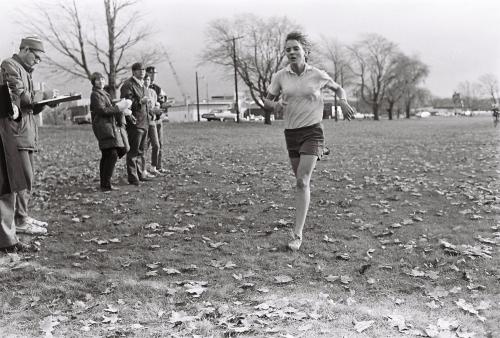
Janet Bristol, 1970 New England AAU champion, photo by Jeff Johnson
Do me a big favor.
Please pass this one around. It is one of the most important stories ever to appear on our site or in our magazines. Thanks to Jeff Johnson, Walt Chadwick, Rich Englehart, Tom Carleo, and, of course, Janet Bristol.
Janet, you are one of the great ones. Your story should be celebrated. Thanks for sharing your life with our readers.
THE ROADS NOT TAKEN, the untold story of Janet Bristol, by Rich Englehart
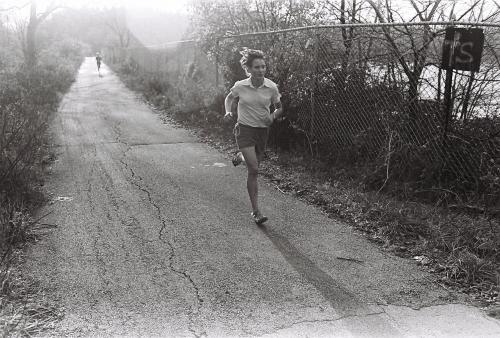 Janet Bristol, 1970 New England AAU, photo by Jeff Johnson
Girls, we are told, mature earlier than boys. This should be a comforting thought to a fifth-grade boy who has lost a one-on-one basketball game or a footrace to a fourth-grade girl. It may also explain why women’s sports consistently produce enormously successful athletes who have barely reached puberty, while men’s sports rarely do. Few male counterparts match Chris Evert, Jennifer Capriotti, Olga Corbet, etc. In distance running, male prodigies emerge toward the end of their high school careers. Jim Ryun and Gerry Lindgren began their international careers as high school juniors. Subsequent high school runners to better the four-minute mile have all done so as seniors.
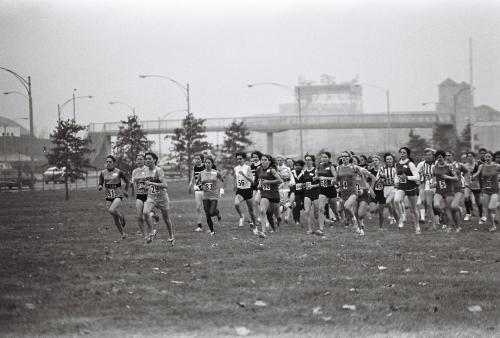 Start of 1971 AAU National Women’s Cross Country, Saint Louis, Missouri, photo by Jeff Johnson
But there have been women distance runners, girls really, who were successful internationalists in the first half of their high school careers. Names like Mary Decker, Lynn Jennings, and Robin Campbell, all of whom will resonate with any long-time fan of US track, were national- or international-caliber runners for most of their high school careers.
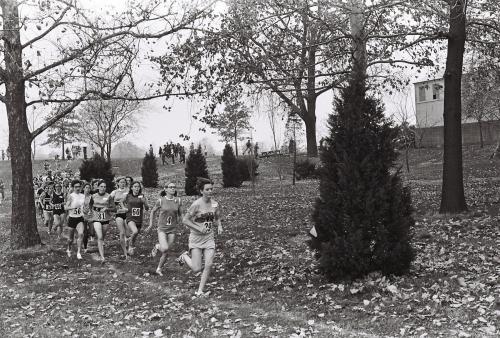 Janet Bristol leads, Doris Brown-Heritage in second, 1971 AAU Women’s Cross Country, Saint Louis, Missouri, photo by Jeff Johnson, curated by Walt Chadwick.
 Janet Bristol and Doris Brown-Heritage, 1971, AAU Cross Country, photo by Jeff Johnson, curated by Walt Chadwick
And so it was that in the fall of 1970, fifteen-year-old Janet Bristol of Burlington, Vt. burst out of nowhere, well, nowhere and Burlington, onto the nascent American and international women’s distance running scene with some amazing race performances, especially in cross country, and then vanished seemingly without a trace. Her story carries tragic elements, and one cannot hear it without wondering what might have been.
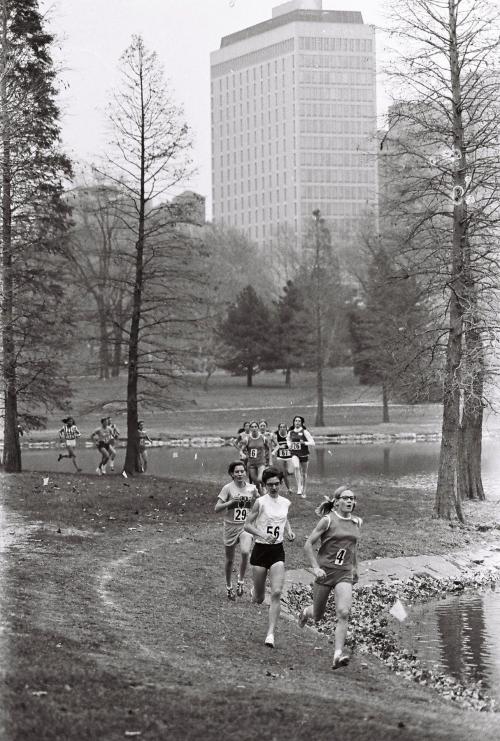 Doris Brown Heritage breaks open race, 1971 AAU Cross Country, photo by Jeff Johnson, curated by Walt Chadwick.
Janet was born in Burlington into what she describes as an ‘athletic’ family. She had three older brothers and an older sister.
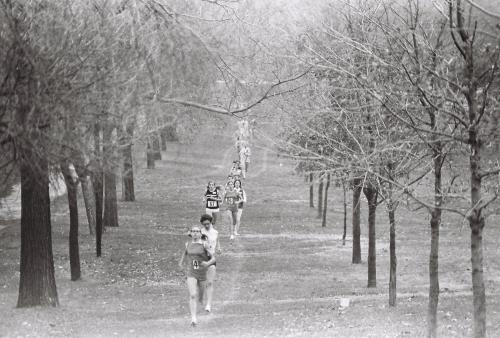 Doris Brown Heritage leads 1971 AAU Cross Country, Saint Louis, photo by Jeff Johnson.
Both parents played tennis and golf. One brother played football, another played tennis, and one was a bodybuilder. Lynn (the sister) played basketball.
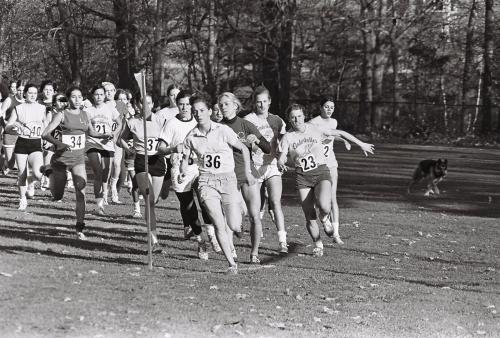 Janet Bristol leading, 1970, photo by Jeff Johnson, curated by Walt Chadwick
To get in shape for football, her brother ran. When Janet was about eleven, she began tagging along on runs. She found that she really liked running and handled it well. She liked it even more as the distances grew longer. This preference both created and limited her possibilities as she progressed through the sport. The longest sanctioned track race available to women at the time was a half mile. Women could compete nationally and internationally in cross country, where the maximum allowable race distance was a bit beyond two miles, much longer than a half mile but still too short for many women who were beginning to take up the sport.
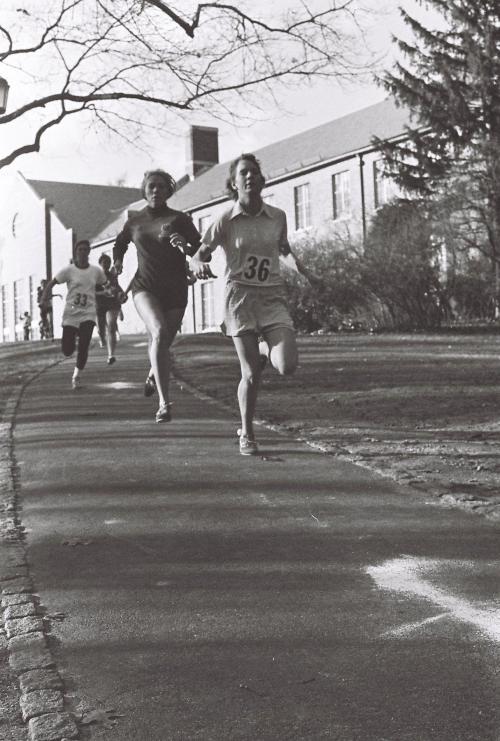 Janet Bristol, 1970, photo by Jeff Johnson, curated by Walt Chadwick
New England has always been a hotbed for distance running in the US. If you were a post-collegiate runner looking to keep competing, New England was one place to go. By 1970, the New England AAU, a predecessor of USATF, was hosting cross country championship races for both men and women. The 1970 event was held at Fresh Pond in Cambridge, MA, on a path that circles a reservoir.
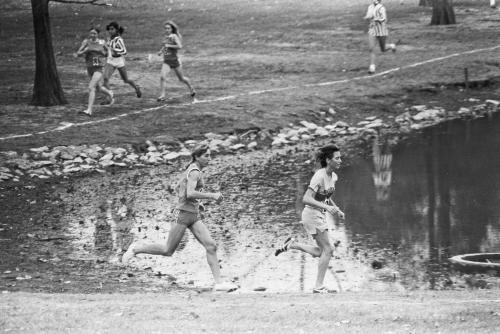 Janet Bristol, 1971 AAU Cross Country, photo by Jeff Johnson curated by Walt Chadwick
At the time, Jeff Johnson, future Nike Employee #1, was coaching the Liberty Athletic Club, a Boston-based club for female runners. He was at the Fresh Pond race with the club runners and his wife, Francie Kraker-Johnson, a 1968 and 1972 800-meter Olympian.
“Janet ran away and hid with that race,” Johnson recalls decades later.
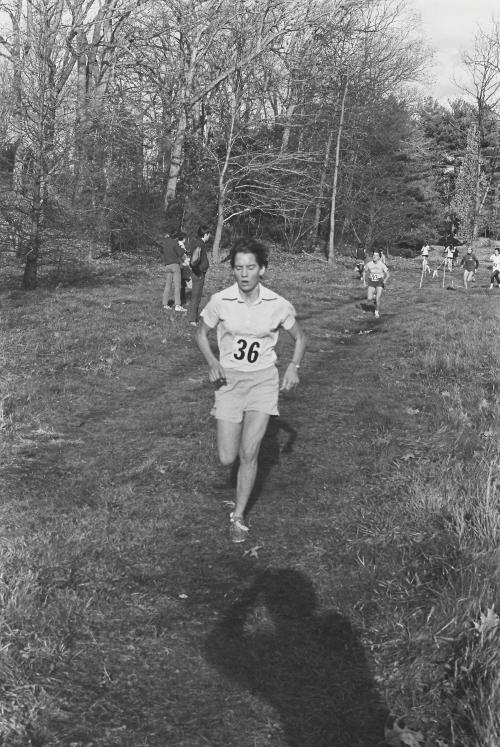 Janet Bristol, 1970 cross country, photo by Jeff Johnson, curated by Walt Chadwick
“Everything but Jan’s performance screamed ‘novice’. She raced in a polo shirt. She had no coach. Her dad had driven her to the event from Burlington. Neither he nor she had any idea about any other competitive opportunities that were available for her.”
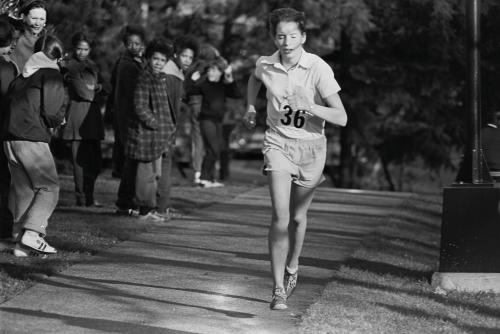 Janet Bristol, 1970, photo by Jeff Johnson, curated by Walt Chadwick
Johnson took the Bristols under his wing, telling them that, as New England AAU champion, she had qualified for an expense-paid trip to the National Championships in St. Louis early the next year. He offered coaching advice. He told them there would be both a junior and senior championship race in St. Louis. At fifteen, Jan could choose to run in either race.
“If she ran the junior race, she’d probably win easily, and they’d give her a real nice medal and send her home. But if she came in the top six in the senior race, which she was well capable of doing, she’d get to go to the International Cross Country Championship in San Sebastián, Spain.”
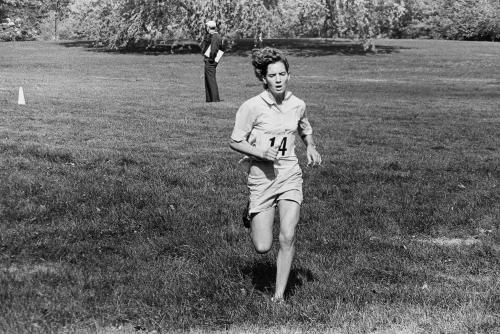 Janet Bristol, 1970, photo by Jeff Johnson, curated by Walt Chadwick
The International Cross Country Championship, forerunner to today’s World Cross Country Championship, was not sanctioned by the IAAF. It dates to 1903, was originally held in the UK, and was a meet for Britain’s home countries, Wales, Scotland, and Ireland. Eventually France was invited, then other English-speaking countries, Canada, Australia, New Zealand, the US, and other European countries, over time.
Janet ran the senior race and finished fifth, qualifying for the International.
She matched that place in San Sebastian, running 11:25 over a 2.8-mile course and finishing 17 seconds behind women’s winner and legend Doris Brown, four seconds out of second place. She recalls feeling terribly homesick for nearly the entire trip. But race day was rainy and muddy, and Jan, who “loved glare ice, snow and rainstorms” (Johnson describes a 12-mile run Jan did in a blizzard in Boston’s Franklin Park before leaving for Spain running entirely on a 300-yard snow- and ice-free stretch of road) because she thought training under adverse conditions made her tougher than everyone else, was in her element. The homesickness passed, and she ran confidently.
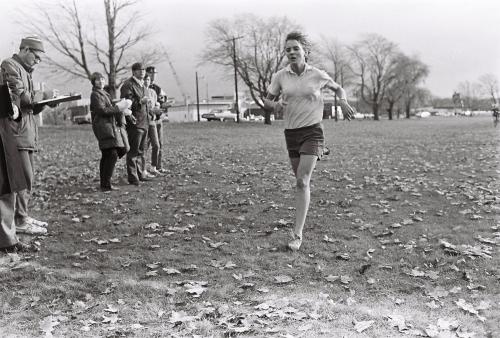 Janet Bristol, 1970 New England AAU, photo by Jeff Johnson, curated by Walt Chadwick
Jan was a pioneer in Burlington. Her Fresh Pond race wasn’t her first competition, and the San Sebastian race wasn’t officially her first international competition. At the time, there was an “International “track meet in Burlington, matching Burlington, Vt with a team from Burlington, On., offering a mile race for women. Jan won as a thirteen-year-old, running 5:29. That winter, she placed fourth in an open mile (men and women) at an indoor meet at the University of Vermont in 5:28.
Her high school had only boys’ teams in cross country and track, but her coach, Duane Ranard, let her run with them, first unofficially and then, as a sophomore, as a full member (i.e., someone who counted in the scoring).
But not all was well. Lynn (Jan’s sister) had been diagnosed with schizophrenia. Before leaving for Spain, Lynn set the family house on fire. No human lives were lost, but the family was traumatized, and Jan lost some beloved pets.
And where do you go from up?
“I didn’t think there was anything I could do to beat Doris Brown-Heritage when she was in her prime rather than when she was old,” (Jan was fifteen at the time, and Johnson remembers Brown saying Jan was “loads of fun.”) And running didn’t seem to matter as much once I got back from Spain,” Jan recalls.
Her sister’s difficulties made her question whether it was selfish to invest the time and energy in herself and her running. Not being able to help Lynn broke her heart. There was no girls’ state championship to win. The 1972 Olympics had been a goal, but she thought the distances allowed for women were too short. And unlike today, few colleges offered scholarships to their women’s teams because few women’s teams existed.
“I don’t think I’d have taken a college scholarship, even if I’d been offered one,” she confesses today. “When I was in sixth grade, I figured out that I really didn’t like school. Twelve years of it was enough. I couldn’t imagine doing four more years.”
She ran her last race in the spring of 1972, but in late April 1972, she completed a 26.2-mile Walkathon in 3 hours 20 minutes.
Always an animal lover, Jan got a job as a veterinary technician, but soon switched to receptionist, and later, to administrative assistant because, “I couldn’t deal with euthanasia.” She married, had a son and daughter, divorced after nine years, then remarried, adding two stepsons to the mix. Her daughter has four kids, and her husband’s kids also have four, making Jan an eight-time grandmother. One grandson has been showing promise as a cross-country runner. Working for a while at a mom-and-pop grocery store, stocking shelves, moving products, etc., wrecked her knees. Today she has two (knee) replacements.
She doesn’t dwell on what might have been. She currently does individual work in a residential facility for patients with dementia, which she finds rewarding. She loved running and credits it with the inner strength and faith to weather life’s storms, but had no second thoughts about putting it aside when other things seemed to matter more.
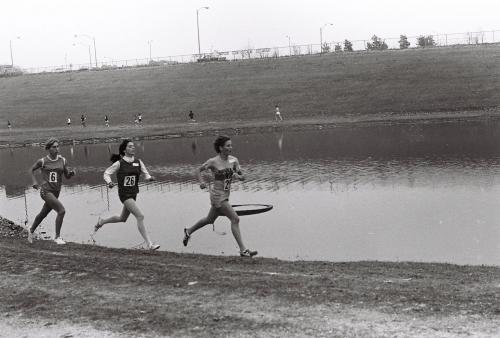 Janet Bristol, 1971 AAU Nationals, Saint Louis, Missouri, photo by Jeff Johnson, curated by Walt Chadwick
Jeff Johnson, who knows as much about women’s running as anyone, thinks she had the potential for a career that would have rivaled Mary Slaney’s or Joan Samuelson’s.
“Imagine,” he says, “the 1984 Women’s Olympic Marathon with Joannie and Jan in that race together. The US could have gone 1-2.”
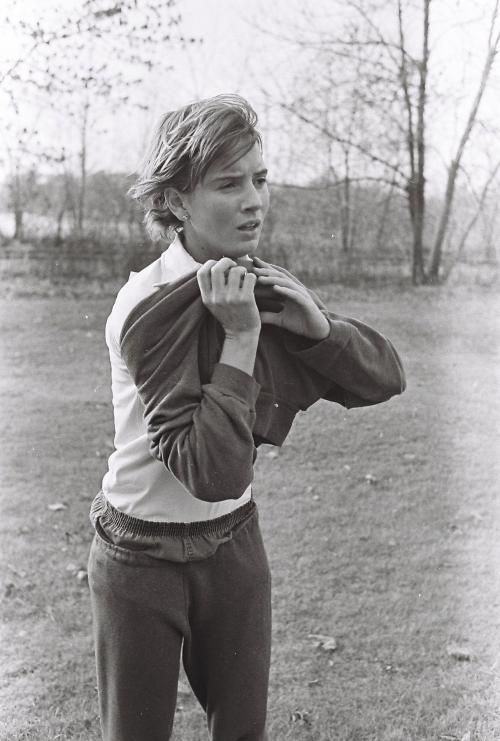
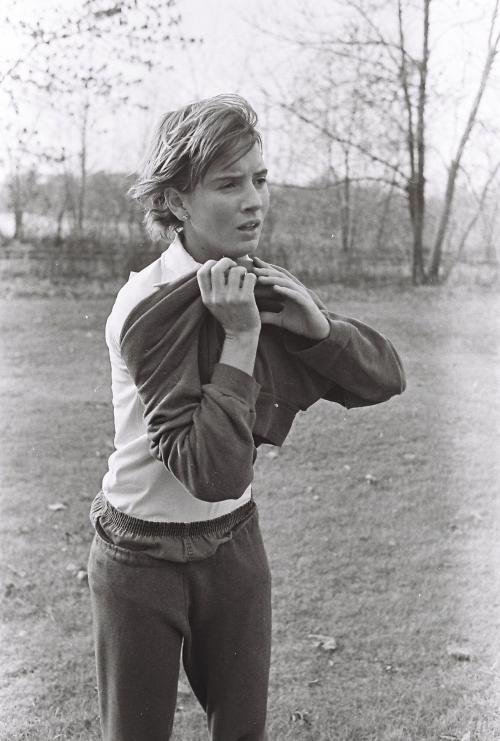 Janet Bristol, photo by Jeff Johnson, curated by Walt Chadwick