
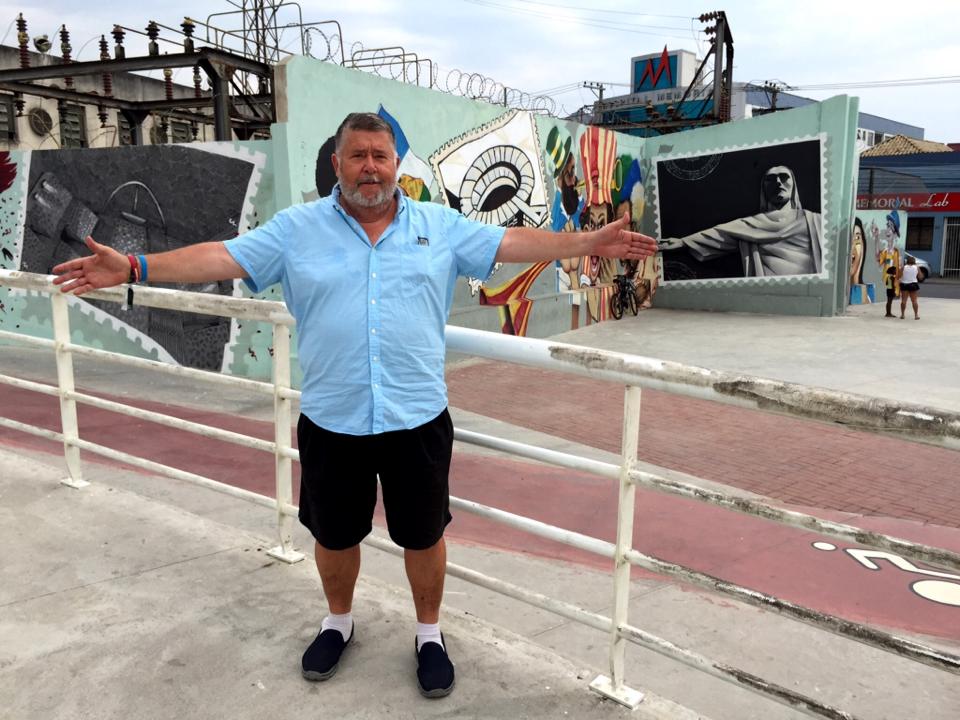
Here is Elliott Denman’s second column from Daytona and the USATF Convention. He focused on Kevin Young, the WR holder in the 400 meter hurdles.
KEVIN YOUNG COLUMNFROM USATF ANNUAL MEETING By ELLIOTT DENMANDAYTONA BEACH, FLA.
– Dashing the 100 meters. Slogging out a marathon. Clearing the high hurdles.Walking the 50K. Jumping/vaulting over highly-placed bars. Whirling the disc. Throwing the hammer. Running up hills anddown dales. Legging it up mountains. Putting one foot forward, then another, in races nearly a wholeday long.
Yes, they’re all disciplines under the purview of at least 1,100 delegates to the annual meeting of USA Track and Field, raging this week at the Daytona Beach Hilton. But it’s time to add another. Call it “spanning the generation gap.” It’s an activity here that has far too few participants.
In this “what have you done for me lately?” sport, it’s hard-hard-hard to find a soul interestedin the achievers and achievements of more than just a handful of yesterdays. Kevin Young can tell you all about it. Fact is, he did just that in a sit-down interview in a Hilton corridor.
“Kevin who?” Ask a high schooler, or a current collegian, even some of the elders who should know alot better, and they’ll ask just that question – “Kevin who?”
Kevin Young smiles when he’s reminded of his virtually anonymous status in the sport.He knows it’s been over 20 years since he won his gold medal at the Barcelona Olympic Gameswith his world-record performance of 46.78 in the 400-meter hurdles. He knows that the 46.78 in ’92 is one of the longest-running WRs still in the books. He knows that five Olympic Games and10 editions of the IAAF World Championships, and a zillion Diamond League meets with their optimal conditions, they’ve all flown by and no other human has ever broken 47 seconds for the 400 hurdles.
Given all that, he can’t really explain his long stay in the realm of obscurity. Or the longevity of his greatest claim to fame. “I am surprised, totally surprised, that the 46.78 is still the world record,” he tells you. He was witness to the rise of Angelo Taylor – to fwo Olympic gold medals. He saw the emergencebut never the expected dominance of Kerron Clement. He saw Felix Sanchez run off with two Olympic golds, but the second one no faster than the first, exactly 48.33 seconds. He saw so many other bright young talents – both domestic and international – rise to the top, stay there briefly, then crash and burn, never having broken 47 seconds.
“When Kerron ran his 47.16, I remember calling him up, and then congratulating him in person.I thought I was looking at the future world record-holder right there; but it hasn’t happened, it hasn’t been done,” said Young. Today’s top pro trackmen have too many distractions, Young analyzes. “Once you’re at that level, and you’re running internationally, your schedule is intermittent, you’re chasing that dollar, you’ve got a shoe contract and you have obligations right there, all while you’re trying to run fast.
“Your lifestyle changes, your priorities change, a lot of things are in play.”And two decades of 400-meter hurdling have produced no more sub-47s.The only sub-47 man in track history, over one lap and ten of those 36-inch (three-foot) barriers,got there with an amazing mastery of pace. “Optimally, you want to run just about six seconds, or just a little better, getting to the first hurdle,” said Young.“I know a lot of other guys are firing out of the blocks way too fast, getting there in 5.5, 5.6, 5.7 seconds. That’s great and fine. But when you run 5.5, 5.6, 5.7, you’ll eventually be paying for it on the back end.“Economy of effort, that’s exactly it.”
Fatigue becomes the one-lap hurdler’s biggest enemy.“What happens is, your parabola changes, your angle of getting the lead leg over the hurdles is going to geta little higher. Your foot speed is going to get a lot slower, you won’t be doing what you need to be doing,and that’s just running.” As he remembers his Barcelona final, after clearing hurdle one, some of Young’s world-record splits were about 21 seconds to number five, about 31.9 to number seven, about 40-high to the 10th hurdle, then 6-ish to the finish line. By the numbers, his stride pattern was 19 to the first, 13-13-12-12.5, then 13s from 6 to 10.
A championship 400 hurdler needs to be able rotate lead legs, but Young needed to do just once in Barcelona, between four and five . Young’s fastest official 400 out of the blocks was 45.11. So that made his official differential for the 400 distanceover those 10 three-footers to be about 1.67 seconds. And that was another big key to the world record – he was more efficient, more technically sound going over the hurdles than any man in history.
For Edwin Moses, and all the other great 400 hurdlers in the annals of the sport, the differentialbetween their flat track speed and 400 hurdling speed was always two seconds or more.“I had no idea I had run that fast when I crossed the line,” said Young.“I’ve run that race so many times in my head. I’d beaten my leading rivals time and time again, so that was a big psychological advantage, too.”
Yet another key to Young was “not getting outside of what I was capable of doing; when you’re at an Olympic Games, it’s so easy to getoverwhelmed; you can’t ever lose your focus.”The absence of top contenders American Danny Harris (who had ended Moses’s long winning streak but was now suspended on a drug count), and Zambia’s Samuel Matete (who’d been DQ’d in the semifinalson a trail leg violation) also made Young’s gold medal excursion around the Barcelona track a little less stressful. “With those guys out, it alleviated a lot of things for me,” he said.
Yet Young actually did lose some focus at the very end, after nicking the 10th hurdle, going a tad off-stride,then raising an arm in reflexive joy before he crossed the line. If not for all that, the 46.78 might have been in the 46.6s. But such are the coulda-wouldas of all sports.Young had taken his share of lumps, losing some races he might have won , through the years bulding up to Barcelona.
Then, shooting for a third Olympic spot, he missed out in the semifinals of the 1996 Trials.Yet Young never did officially retire. Fact is, he ran another 400 hurdles race in the summer of 2012, at age 46Invited to run a special event in the town of Tarare, France, he clocked a 57-second performance over 33-inch barriers.“Yanick (his stepson) was there and he was amazed to see people asking me for autographs, and things like that, he was clueless about why this was happenng,” said Young, smiling. “I had never really told him what I had done in track, and that was fine. I liked it like that.”
Since 2012 was the IAAF’s centennial year, gala ceremonies honoringthe formation of the world track and field governing body in 1912 were held in Barcelona. And Young, named the world athlete of the year for his performance there two decades earlier,was invited back to the scene of the triumph.Of course, of course, Young enjoyed every moment of the occasion – one of the rare times his WR’s been re-acknowledged. Edwin Moses, too, was there and it became the first time the two had actually conversed. Moses, the 1976-84 Olympic king, had never been known for his sociability with other athletes.
“You know what? ‘ said Young. “Edwin’s a great guy, a really nice guy.” Still, why did Young never gain the global renown, or the big bucks, an Olympic champion and world record-breaker surely deserved? Young stays philosophical. “Basically there was never any concerted effort to market me the way I would have liked. “I never reached the degree of marketability other Olympic champions got to.”
These days, Kevin and wife Kareen and stepson Yanick live in Kennesaw, Ga. He works with community groups, coaches young athletes, talks to school kids, encourages them to set thetargets they’ll need throughout life.And – maybe just maybe – some young ‘un in one of his audiences will become a 400-meter hurdler.
If and when, Young will be happy to coach him.And – perhaps-perhaps – to a sub-47-second performance. ####