RunBlogRun opines: The coverage of the COVID-19 coronavirus shows both the good and not so good in the conundrum of being part of the modern media. Allow me to explain. By the time January 2020 hit, I was getting, from sources with China and those in the medical community, that the coronavirus was something to respect. As someone who is in his sixties and who has 3 stents, plus just recovered from thyroid cancer, I am the poster child for those in the coronavirus food chain. So, I did some things. I cancelled a month long trip to Europe. I cancelled plans to go to World Indoors. I meticulously wash my hands. I take Vitamin C daily. I workout and sleep well.
Common sense things.
The speed of modern media is also its weakness. This column, from Journalistresource.org, , is a primer on how to cover a health crisis, when media speed in almost instantaneous, and the chance for grevious errors are huge. I might also suggest that the themes presented here can be guidelines for covering other types of issues as well.
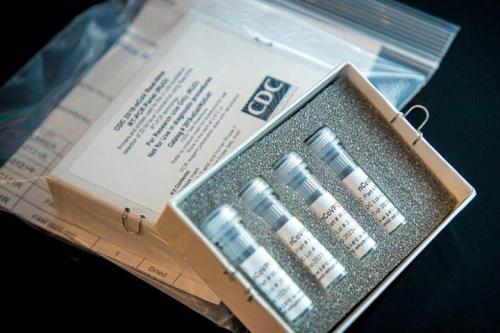 Lab test kit for the new coronavirus that causes COVID-19. (U.S. Centers for Disease Control and Prevention)
Lab test kit for the new coronavirus that causes COVID-19. (U.S. Centers for Disease Control and Prevention)
For several weeks, journalists and researchers worldwide have worked long hours to provide up-to-date information on the new coronavirus disease, known as COVID-19, trying to help members of the public avoid infection while also scrambling to understand the virus and its possible impacts.
Bill Hanage, an associate professor of epidemiology at the Harvard T.H. Chan School of Public Health, and Marc Lipsitch, a professor of epidemiology there, teamed up recently to offer news outlets advice on covering the outbreak. Their essay, “How to Report on the COVID-19 Outbreak Responsibly,” appears on a Scientific American blog.
“The profusion of information that keeps emerging about the growing COVID-19 outbreak presents challenges for reporters and the scientists they talk to when researching their stories,” they write in the essay. “Good reporting and science have to distinguish legitimate sources of information from no end of rumors, half-truths, financially motivated promotions of snake-oil remedies and politically motivated propaganda.”
Journalist’s Resource reached out to Hanage to ask for additional guidance to help reporters improve their coverage of the new coronavirus. Below are five tips, based on his suggestions.
- Choose experts carefully. Receiving a Nobel Prize for one scientific subject doesn’t make someone an authority on all science topics. Nor does having a PhD or teaching at a prestigious medical school.
On deadline and rushing to beat competing news outlets, journalists often ask people who lack specific knowledge of the topic at hand to explain or offer opinions about it. This can be dangerous when covering public health, Hanage says, because audiences rely on news reports to make decisions about their health and the health of loved ones.
“Those quick quotes can be stupid,” he says. “I find it really annoying if I see something ending up in print which I know is going to frighten people or I know I’m going to find myself explaining isn’t true. It makes my heart sink.”

He urges journalists to take time to track down researchers with knowledge and experience in the topic they’re covering. When reporting on new health topics such as the COVID-19, which experts worldwide are scrambling to understand, it’s a good idea to interview multiple researchers.
“I recommend taking the temperature with a few different ones,” Hanage says. “Call four or five independent scientists. If they all say roughly the same thing, then that’s really worth something putting in your reporting.”
He also stresses that journalists should trust — and believe — researchers who say they lack specific knowledge needed to answer a question. “A good [researcher] will say clearly, ‘I don’t know,’ or, ‘That’s not my field of expertise.’ If you asked me detailed questions about how to treat a patient, I’d say ‘Don’t go there,'” says Hanage, who researches the evolution and epidemiology of infectious disease.
- Distinguish what is known to be true from what is thought to be true — and what’s speculation or opinion.
As journalists cover the outbreak, it’s important to explain what experts know and what they think they know, based on their experience and an assessment of the evidence, Hanage explains. “For example, we know that this is a beta-coronavirus — that’s a fact,” he says. “However, if you ask me how many people I think it will infect, that is something else.” That said, news reports should rely sparingly on opinions and speculation about issues researchers still know little about — for instance, why children appear less likely to develop severe symptoms of coronavirus disease.
- Use caution when citing research findings from “preprints,” or unpublished academic papers.
Researchers often publish the results of their studies in scholarly journals. But because the publication process can take months to a year or more, researchers sometimes make their findings public by releasing drafts, called “preprints.”
While preprints of studies on the coronavirus offer the public faster access to the newest information about the virus, Hanage warns journalists to keep in mind that these papers have not undergone peer review — a process designed for quality control through which other researchers with expertise in the topic scrutinize the study and its findings and help prepare the paper for publication in a journal.
The release of preprints focusing on the new coronavirus already has led to “a couple of really bad slips,” Hanage says. One example: several news stories have erroneously reported a link between the COVID-19 and HIV, citing an unpublished paper from scientists in India. The study, posted to the preprint server bioRxiv on Jan. 31, has since been withdrawn.
- Ask academics for help gauging the newsworthiness of new theories and claims. To prevent misinformation from spreading, news outlets also should fact-check op-eds.
“If something seems extremely surprising or unusual or unexpected, do, of course, check it,” Hanage says. He points to a claim made recently by a British news outlet as something epidemiologists could have debunked — a retired professor of applied math and astronomy told the Express that a meteorite that hit China last fall probably brought the new coronavirus to Earth.
“Contact someone else and say, ‘I heard this and it’s kind of surprising,'” Hanage suggests. “If you call me up and I just sputter and laugh and say, ‘You’re going to look like an idiot,’ then you should probably pause before you publish it.”
For the same reason, newsrooms should fact check op-eds. A recent opinion piece in the New York Post argues the coronavirus might be a biological weapon leaked from a Chinese lab. But “there isn’t any evidence for the biological weapon theory at all from a scientific perspective,” Hanage explains. The op-ed, which Hanage calls “opinion dressing itself up in a language of science,” was written by the president of the Population Research Institute, an organization that opposes population control.
- Read the work of journalists who cover science topics well.
Hanage says these journalists do an “amazing” job:
- Helen Branswell, STAT‘s infectious diseases and public health reporter. (Journalist’s Resource interviewed Branswell for our “How to cover an epidemic” tip sheet.)
- Ed Yong, a staff writer who covers science at The Atlantic.
- Carl Zimmer, whose “Matter” column appears each week in The New York Times.
Other resources:
- In an interview with The New York Times, mathematician Adam Kucharski, author of The Rules of Contagion: Why Things Spread — and Why They Stop, explains some of the numbers behind the coronavirus outbreak, including why it’s tough to estimate a fatality rate for this new virus.
- ProPublica reporter Caroline Chen, who covered the Ebola crisis in West Africa and Florida’s fight against Zika, outlines important questions journalists should be asking about the coronavirus in an explainer piece ProPublica published Thursday.
- The World Health Organization is tracking and releasing updated data on the number of people worldwide who’ve been infected with and died from COVID-19.
- FactCheck.org, a project of the University of Pennsylvania’s Annenberg Public Policy Center, monitors the factual accuracy of statements public leaders make about a range of public policy topics, including the new coronavirus.
We welcome feedback. Please contact us here.