
This is This Day in Track & Field History, on July 21, 2025, was compiled and written by Walt Murphy, and used with permission.
Walt Murphy’s News and Results Service ([email protected])
This Day in Track & Field–July 21
1908–At the London Olympics, “Peerless Mel” Sheppard won the 800-meters with a World Record time of 1:52.8. Not sure why, but Sheppard continued on to 880-yards (1:54.0). 2nd and 3rd were Italy’s Emilio Lunghi (1:54.2) and Germany’s Hanns Braun (1:55.2).
It was one of three gold medals for Hall-of-Famer Sheppard, who had earlier won the 1500 (7-14) with an Olympic Record-equaling time of 4:03.6 and later anchored the winning sprint medley (7-25). He won gold in the 4×400 relay and silver in the 800 at the 1912 Olympics. For many years the “Mel Sheppard 600y” was one of the featured events at the Millrose Games (revived in recent years at various distances).
Winner of the High Jump with an Olympic Record of 6-2 ¾ (1.90) was American Harry Porter, and there was a 3-way tie at 6-2 (1.88) for the silver medal—Great Britain’s Con Leahy, Hungary’s István Somodi, and France’s Géo André.
Results: https://en.wikipedia.org/wiki/Athletics_at_the_1908_Summer_Olympics
Reports: https://www.olympedia.org/editions/5/sports/ATH
http://en.wikipedia.org/wiki/Mel_Sheppard
1926— 14-year old Viola Edwards became the first female to clear 5-feet when she high-jumped 5-1/2 (reported elsewhere as 5-1/8) in Chicago.
http://tinyurl.com/ViolaEdwards
1952—Lindy Remigino emerged as the winner of the Men’s 100-meters in Helsinki in the closest sprint finish in Olympic history, with the top 4 men all clocking 10.4. Off to an early lead, Remigino, despite starting his lean 20-meters before the finish, was able to hold off Jamaica’s Herb McKenley, the world record holder in the 440-yard dash, Great Britain’s McDonald Bailey, and U.S. teammate Dean Smith (U.S. Trials winner Art Bragg went out in the semis with an injury).
The finish was so close that officials took 20 minutes before announcing the official results. It wasn’t until the scoreboard started spelling his name in first place that Remigino, who had offered his congratulations to McKenley after the race, knew he had won and a dejected McKenley knew he hadn’t.
Few would have picked the Manhattan College junior as the winner in any pre-Olympic prediction contests. He finished 5th at the NCAA Championships to barely qualify for the U.S. Trials (top 6 advanced), and didn’t make the AAU final.
However, Remigino, who would win a 2nd gold medal as a member of the winning 4×100 relay, disagreed with those who called him the “Cinderella Kid”. “That really wasn’t right,” he said. “I was second in the U.S. Olympic Trials. If you are the second-fastest American qualifier, it’s not a surprise if you do well at the Olympics.” Before the Games began, the U.S. team flew to Finland, and he trained three times a day. “I knew I was going to do well,” he said. “I was beating everybody there. I was the first guy down the straightaway. I didn’t lose one gun start at practice.”
Remigino, who passed away in 2018 at the age of 87, followed his Olympic win with a successful European tour and wound up ranked #1 in the world by Track and Field News. He remained active in the sport as a highly successful coach at Hartford Public High School in Connecticut (his alma mater) for more than 50 years, and was the long-time meet director of the Hartford Inv., once one of the top prep meets on the East Coast.
When asked a few years ago if he ever showed the footage of his Olympic win to his family, he said with a smile, “Every night!”. His son Mike was one of the top preps in the country in the 800 in 1987, running a best of 1:49.94.
The seeds for his Olympic dreams were planted four years earlier. “Track & Field News was first published in 1948,” I’d read it, seen all the names and times. My favorites were Mel Patton and Harrison Dillard. I admired them so much. Guess who passed me the baton in the relay in 1952?” (Harrison Dillard). “So, yes, I dreamed of going to the Olympics in 1948. But the reality was I thought I’d be working in a box shop, making cardboard boxes, on Albany Avenue, because my family didn’t have the money for college.”
4th-placer Dean Smith, who won a gold medal in the 4×100, went on to have a successful career as a Hollywood stuntman. Hie memoir, “Cowboy Stuntman: From Olympic Gold to the Silver Screen”, was published in April, 2013.
http://www.nytimes.com/2013/03/31/us/cowboy-stuntman-dean-smith-writes-a-memoir.html?_r=1&
http://www.amazon.com/Cowboy-Stuntman-Olympic-Silver-Screen/dp/0896727890
Remigino wasn’t the only American to win gold on this day. Parry O’Brien hadn’t yet become the dominant thrower of his era, but his first-round toss of 57-1 ½ (17.41) held up to give him the first of his two Olympic gold medals in the Shot Put (he also won in 1956). U.S. Trials winner Darrow Hooper almost stole the gold medal from O’Brien with his final put of 57-3/4 (17.39), which was good enough to win the silver medal. World record holder Jim Fuchs, hampered by ankle and wrist injuries, made it a U.S. sweep with his best of 55-11 ¾ (17.06). And Charlie Moore, the former Cornell Athletic Director, won the 400-hurdles in 50.8 to match the Olympic Record he set in his quarter-final race. Winning silver and bronze in the event were the Soviet Union’s Yuriy Lituyev (51.3) and New Zealand’s John Holland (52.2).
Medalists/Results
http://en.wikipedia.org/wiki/Athletics_at_the_1952_Summer_Olympics
Remigino:
Race Video: http://www.runnerspace.com/video.php?video_id=73454-Mens-100-Final-Lindy-Remigino-10-4-Olympic-Games-1952
Gary Cohen Interview: http://www.garycohenrunning.com/Interviews/Remigino.aspx
http://www.nbcconnecticut.com/news/sports/Connecticut-Runner-Was-Fastest-Man-Alive-147371295.html
http://www.courant.com/sports/high-schools/hc-sp-riley-column-lindy-0720-story.html
Hall of Fame Bio: https://www.usatf.org/athlete-bios/lindy-remigino
1961—In the first-ever dual meet between Great Britain and the U.S., Max Truex finished 3rd in the 3-mile behind Brits Gordon Pirie (13:16.4) and Bruce Tulloh (13;16.8) and set an American Record of 13:21.0
Willye White long-jumped 21-1/4 (6.44) to set her 3rd American Record in five days. She had previously jumped 21-0 (6.40) in Moscow on July 16 and 21-3/8 (6.41) in Karlsruhe, Germany, on July 17.
No AR in the men’s 440y, but it was the race of the 2-day meet, with Ulis Williams (46.3) holding off GB’s Adrian Metclafe (46.4) for the win, while his U.S. teammate, Adolph Plummer (46.8), edged Robbie Brightwell (46.8) for 3rd place. Great Britain got a taste of revenge the next day (July 22) by beating the U.S. in the Mile Relay (3:07.0-3:07.4).
(From T&F News)
1962—Hal Connolly set a World Record of 231-10 (70.67) in the Hammer Throw on the first day of the USA-Soviet Union dual meet at Stanford.
WR Progression: http://en.wikipedia.org/wiki/Men’s_hammer_throw_world_record_progression
1963–Valery Brumel set his 6th (and final) World Record in the High Jump, clearing 7-5 ¾ (2.28) at the 4th edition of the highly popular USA-Soviet dual meet series in Moscow (7-20/21).
Bob Hayes won the 100-meters and thought he had anchored the winning 4×100 relay, but officials ruled that he received the baton too soon from 3rd-leg Paul Drayton, who had earlier won the 200.
WR Progression: http://en.wikipedia.org/wiki/Men’s_high_jump_world_record_progression
Tribute Video: https://www.youtube.com/watch?v=9r0hdHV95sU
Sports Illustrated Vault: https://vault.si.com/vault/1963/02/04/the-big-jump-a-siberian-champion-tells-his-story
1984—Mike Tully cleared 19-1 (5.82) at the Prefontaine Classic in Eugene to better his own month-old American Record (19-3/4 [5.81) in the Pole Vault. Results
There was another major meet on the West Coast on this day, with Johnny Gray running 1:14.16 in the seldom-run 600-meters at the Sacramento Summer Games to break Lee Evans’ 16-year old American Record of 1:14.3. Gray would set the current AR of 1:12.81 in 1986.
Between them, the two meets, held less than two weeks before T&F action began at the L.A. Olympics, drew almost 30,000 fans (Pre-13,600, Sacramento-16,000).
1984—Jane Frederick, who missed making the Olympic team in the Heptathlon after no-heighting in the High Jump at the U.S. Trials, achieved some redemption by scoring 6611 points (1971 tables/6678-1985 tables) in Potsdam, East Germany, to regain the American Record from Jackie Joyner, who had scored 6520 (6579) points at the Trials. Frederick would improve the Record to 6714 (6803) in Talence, France, in September
East Germany’s Marita Koch won the Women’s 200-Meters in 21.71 to equal her 5-year old World Record.
Hall of Fame Bio(Frederick/2007): https://www.usatf.org/athlete-bios/jane-frederick
1988—Torrential rain plagued the first day (July 20) of the Decathlon at the U.S. Olympic Trials (July 15-23) in Indianapolis, Indiana (the High Jump was moved indoors), but conditions were much better on the 2nd day.
Making the team were Gary Kinder (8293), Tim Bright (8287), who set an American Dec Record of 18-4 ½ (5.60) in the Pole Vault, and Dave Johnson (8245).
The weather on the 20th led to the postponement of the Pole Vault final until the 21st. Remarkably, Bright went right to the event after finishing the Decathlon 1500, a race which he admittedly “dogged” in an effort to conserve his energy for the vault!
Kory Tarpenning (19-3 ¾ [5.89]), Earl Bell (19-0 [5.79]) easily secured the first two spots on the team, while Billy Olson dashed Bright’s hopes of qualifying for the Olympics in a 2nd event by clearing (18-8 [5.69]) on his first attempt, while Bright needed three tries before clearing.
Making the team in the Women’s Discus were Connie Price-Smith (201-0 [61.28]), Ramona Pagel (201-0 [61.28]), and Carol Cady (199-0 [60.66])
Results/Notes: https://trackandfieldnews.com/wp-content/uploads/2024/03/1988.pdf
1992—Aided by the altitude (6,600’) in Sestriere, Italy, and a healthy tailwind (+4.4), Mike Powell recorded the longest of long-jumps with his mark of 29-6 (8.99). Powell had hoped to break his year-old World Record of 29-4 ½ (8.95), a feat which would have earned him a $200,000 Ferrari Testarossa as a bonus!
Not to be outdone, Germany’s Heike Drechsler jumped a wind-aided 25-1/2 (7.63), the only 25-footer ever achieved by a woman under any conditions. The following wind on her big jump was only 2.1mps, just above the allowable limit of 2.0.
Video(Powell): https://www.youtube.com/watch?v=yatDMR1vPLQ
All-Time Lists: https://trackandfieldnews.com/tfn-lists/
1998—Jeff Hartwig raised his American Record in the Pole Vault by one centimeter by clearing 19-8 ½ (6.01) at the Goodwill Games in Uniondale,NY.
Maurice Greene (9.96) won the Men’s 100 over a field that included Ato Boldon (10.00), Jon Drummond (10.25), Dennis Mitchell (10.29), and Canadians Bruny Surin( 10.30) and World Record holder (and 1996 Olympic Champion) Donovan Bailey, who was obviously not in top form.
Other winners: Michael Johnson (400-43.76), Noureddine Morceli (Mile-3:53.39), Jonathan Edwards (Triple Jump-
57-11/17.65m).
Medalists: http://en.wikipedia.org/wiki/Athletics_at_the_1998_Goodwill_Games
2000—Making the team at the U.S. Olympic Trials in Sacramento (July 14-23):
Men’s 5000–Adam Goucher (13:27.06), Brad Hauser (13:27.31), Nick Rogers (13:29.48)…Bob Kennedy, short of conditioning after hurting his back in an auto accident, finished 7th (13:46.07)
Men’s Hammer—Lance Deal (258-8 [78.87]), Kevin McMahon (2 40-6 [73.36]), Jud Logan (233-0 [71.01])
Women’s 5000—Regina Jacobs (14:45.35/American Record), Deena Drossin-Kastor (15:11.55), Elva Dryer (15:12.07)…with Jacobs withdrawing from the team with a “breathing problem”, and Drossin planning to concentrate on the 10,000 in Sydney, Amy Rudolph (15:21.16) and Anne Marie Lauck (15:23.71) were added to the team.
Women’s Shot Put—Connie Price-Smith (61-1 ½ [18.63]), Jessica Cross (58-2 ½ [17.74]), Dawn Dumble (57-1 [17.40])
Results/Notes: https://trackandfieldnews.com/wp-content/uploads/2019/10/2000.pdf
U.S. Olympic Trials History (Through 2021): https://trackandfieldnews.com/usa-olympic-trials-history/
2002— 2 relay records were set on the final day of competition at the World Junior Championships in Kingston Jamaica(July 16-21).
A U.S. lineup of Ashton Collins, Wes Felix, Ivory Williams, and Willie Hordge) won the Men’s 4×100 in 38.92 to break the 19-year old World Junior Record of 39.00 that was set by another U.S. team in 1983. A Jamaican team anchored by Usain Bolt finished 2nd in 39.15. Bolt also ran the 2nd leg on the team that finished 2nd to the U.S. in the 4×400 (3:03.71-3:04.06).
As reported yesterday, Bolt won the 200 and went on to become one of the greatest athletes the sport has ever known.
A team of Christina Hardeman, Monique Henderson, Tiffany Ross, and Lashinda Demus set an American Junior Record of 3:29.95 in the Women’s 4×400. The previous mark of 3:30.35 was set at the inaugural World Juniors in Athens in 1986. The team ran without Sanya Richards, who had sprained her ankle in the qualifying round the previous day (she was also scheduled to run on the 4×100 team).
It was supposed to be a joyous homecoming for the Jamaica-born Richards, who moved with her family to Florida when she was 12 and had recently become a U.S. citizen. “It was a big irony that the first meet I would compete in as an American was going to be held in Jamaica. It was obviously great for me that I had tons of family and friends that were still (living) there.”
A heavy favorite to win the 400 (7-18) after setting the current U.S. High School Record of 50.69 at the U.S. Junior Championships in June, the 17-year old Richards (51.49) finished 2nd in the final to teammate Monique Henderson (51.10), who was the runnerup at the U.S. Juniors. Richards later admitted she had expended too much energy by running a faster-than-necessary 23.13 to win her heat of the 200 a little more than 2 hours before the 400 final (She won the bronze medal in the 200).
Despite having an overall disappointing experience in Kingston, Richards, the 2012 Olympic and 2009 World Champion in the 400 (and the American Record holder at 48.70), looks back fondly on the meet, telling the IAAF website in 2008, “It was the event which made me want to be a professional athlete. It was my first year on the team and I was nominated team captain and flag bearer. I felt there was so much love and encouragement. You rarely get that in track and field because it is an individual sport but to be part of the US team really inspired me to make future teams, to take the sport seriously and move on to the next level.”
https://www.worldathletics.org/news/news/world-junior-champs-is-route-to-becoming-prof
https://worldathletics.org/news/news/sanya-richards-pleases-jamaican-crowd
Here are some other future stars (and some of their accolades) who gave fans an early glimpse of their talent in Kingston (in addition to Meseret Defar and Tirunesh Dibaba, who are featured below)
Men’s 400
1.Darold Williamson (US) 45.37…2004 Olympic gold medalist-4×400…2-time World Champion-4×400(2007,
2009)…2005 NCAA Champion-400 (Baylor)
Men’s 400-Meter Hurdles(7-19)
1.LJ van Zyl (RSA) 48.89…bronze medalist 2011 World Championships…PB:47.66
2.Kenneth Ferguson (US) 49.38 (broke the 34-year old U.S. High School record of 49.8, set by Bob Bornkessel in
1968)…ran lead-off leg on winning 4×400
3.Bershawn Jackson (US) 50.00…2005 World Champion(bronze medalist-2009)…2008 Olympic bronze medalist…
3-time World Champion-4×400 (2007,2009,2011)…PBs-45.06, 47.30
Women’s 100(7-17)
1.Lauryn Williams(US) 11.33…2005 World Champion-100…silver medalist in the 100–2004 Olympics, 2007 WC
2012 Olympic gold medalist-4×100, 2004 NCAA Champion-100(Miami)
Women’s 200(7-19)
5.Allyson Felix (US) 23.48…with 11 medals, she’s the most decorated American athlete in Olympic history; 3-time World
Champion—200m(2005,2007,2009); 2015 World Champion-400m
Women’s 400-Meter Hurdles (7-19)
1.Lashinda Demus (US) 54.70 (World Junior Record)…2011 World Champion, 2012 Olympic gold medalist
2.Melaine Walker (JAM) 56.03…2008 Olympic gold medalist, 2009 World Champion
Women’s High Jump(7-20)
1.Blanka Vlašić (CRO) 6-5 (1.96)…2-time World Champion (2007,2009), 2-time World Indoor Champion (2008,2010)
2-time Olympic medalist (2004-silver, 2016-bronze)…2-time WC silver medalist(2011, 2015); PB:6-9 ¾ (2.08)
Women’s Shot Put(7-20)
1.Val Adams (NZL) 58-2 (17.73)…10-time Global Champion—Olympics (2/2008,2012), World Championships
(4/2007,2009,2011,2013), World Indoor Championships (4/2008,2010,2012,2014)
Heptathlon(7-20)
1.Carolina Klüft (SWE) 6470-World Junior Record…2004 Olympic gold medalist…3-time World Champion; PB:7032 (#2 All-Time)
As reported previously, Andra Manson won the Men’s High Jump (7-18) and set the current U.S. High School and American Junior
Records at 7-7 (2.31). He was the 2004 NCAA Indoor & Outdoor champion while at Texas.
Ethiopians Meseret Defar and Tirunesh Dibaba eventually became two of the greatest female distance runners in history, and they met on the track for the first time on this date with Defar (15:54.94), 18 at the time, winning the 5000-meters over Dibaba (15:55.99), who was less than 3-months shy of her 17th birthday. Defar had earlier won the 3000 (9:12.61/7-16).
Here are some of their accomplishments, courtesy of Mirko Jalava (http://www.tilastopaja.org/)
Defar
2 Olympic Golds–2004: 5000 2012: 5000; 2 World Titles–2007: 5000 2013: 5000
4 World Indoor Titles–2004: 3000 2006: 3000 2008: 3000 2010: 3000
5000 m World Championships Silver Medalist 2005; 2 World Championships Bronzes
2009: 5000 2011: 5000; 5000 m Olympic Bronze Medalist 2008
Dibaba
3 Olympic golds—2008: 5000, 10000 2012: 10000
9 World Titles–2003: 5000 2005: 5000, 10000, CC Short, CC Short 2006: CC Short 2007: 10000
2008: CC Short 2013: 10000; 3 Olympic Bronzes–2004: 5000 2012: 5000 2016: 10,000
And some of their PBs
3000 2-miles 5000 10,000
Dibaba 8:29.55 9:12.23(i/#7 AT) 14:11.15(WR at the time, now #6 AT) 29:42.56(#10-AT)
Defar 8:23.72i(#7 AT) 8:58.58(WR) 14:12.88(#8-AT) 29:59.20
Defar had a 21-14 career edge over DIbaba in head-to-head competition at all distances.
Results: https://en.wikipedia.org/wiki/2002_World_Junior_Championships_in_Athletics
IAAF Coverage:
DyeStat: http://archive.dyestat.com/us/2out/WorldJr/index.htm
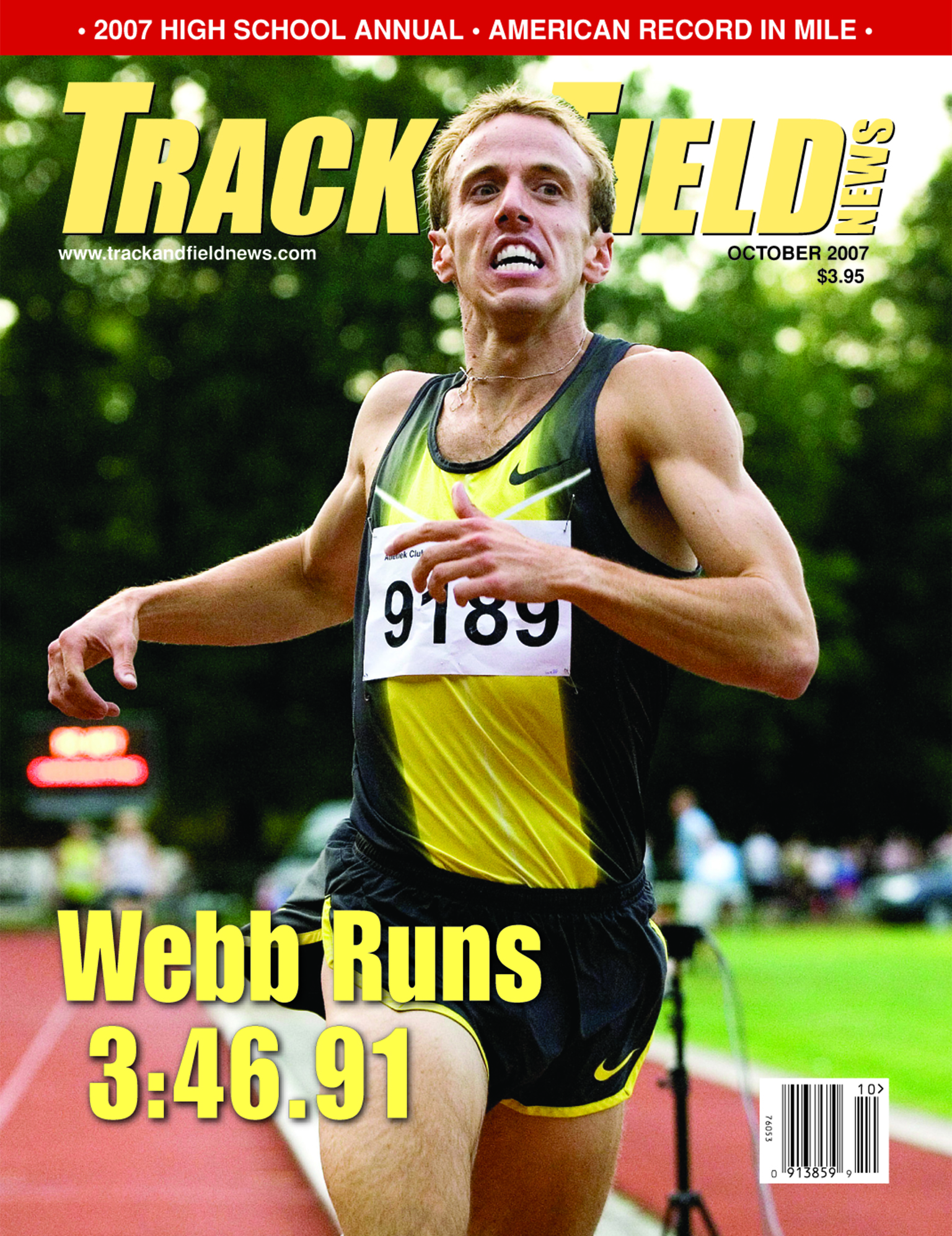
2007–Things hadn’t always gone well for Alan Webb during his career, but everything clicked on this day as he ran the Mile in 3:46.91 in Brasschaat, Belgium, to break Steve Scott’s 25-year old American record of 3:47.69. Frustrated by European meet promoters who didn’t want to put on a mile, Ray Flynn, Webb’s manager, took matters into his own hands and worked with the local organizers of the “Atletiek Vlaanderen” meet to put on this special race. He and coach Scott Raczko knew the time was right for Webb to take a shot at the record.
The setting was a 6 lane track, surrounded by trees, in the community park in Brasschaat, a suburb of Antwerp in the Flemish region of Belgium. It was Independence Day in Belgium and less than a thousand spectators were on hand. Webb and the other Americans competing in the meet didn’t have to travel far, since most of them were based in nearby Leuven while they prepared for other European meets.
Following the pacing of Australian Youcef Abdi and Kenyan Samson Surum, Webb went through approximate splits of 56.2, 1:53.7, and 2:50.6 for the first three quarters of a mile. Slower than the sub-2:50 he was looking for, but still well ahead of Scott’s pace (2:51.9) when he set the American Record in 1982.
With one lap to go, Webb was confident he could get the record. “I knew I had a little bit left going with a lap to go. I felt I had a really good chance”. Showing no signs of slowing down after the quick pace, Webb powered down the homestretch and crossed the line well under Scott’s record. The infield clock originally flashed 3:46.93, but the time was later corrected to 3:46.91.
As Webb made his way around the track for the final time, he was cheered on by the 30 or so athletes who had made the trip with him from Leuven. Said Webb, “That was the coolest part, because the biggest crowd was the Americans who drove up with me. It was athletes cheering on athletes. It was so awesome to have those guys there and it really inspired me to be able to do something like that at an intimate situation where those other athletes got to see it first-hand, right there. They were steps away from me. With 300 to go, all the Americans were stationed right there, so it was so cool”.
Steve Scott was gracious when informed that his reign as the American Record holder had come to an end. He told USATF, “I want to personally congratulate Alan. I anticipated it [the record] being broken. After his 1:45 [800m] and his 3:30 [1500m], you knew he was capable of it. It was just a matter of having the right pace and conditions. Even if conditions weren’t perfect, he’s so strong, I knew he could do it. I had a prediction of 3:46.5 for him. “I’m happy that it was Alan who broke it…I have nothing to be ashamed of, losing the record to him.”
When asked to put Webb’s performance in perspective, Flynn said, “It means he’s run faster than Sebastian Coe, faster than Steve Ovett, faster than Steve Scott. What else can you say?”. Amen to that.
As late as the day before the meet, I had contemplated going even deeper into debt than I already was by using one of those internet last-minute travel deals to make my way over to Belgium. I had been there when Webb ran his first sub-4 mile at NY’s Armory during the winter of 2001 (see below), and again at the Prefontaine Classic later that year when he ran 3:53.43 to break Jim Ryun’s revered high school record.
The temptation to be present at another potentially memorable moment was overcome by the economic reality of the situation. But, thanks to modern technology, I almost felt like I was there. Within minutes after the finish of the race, Flynn and Raczko each sent a text message giving the final time and Webb’s splits.
And a few hours later, I was one of a handful of reporters in the U.S. who spoke to Webb in a teleconference call that was quickly arranged by USATF’s Jill Geer. Also participating in the call were USATF CEO Craig Masback and Flynn, both of whom ran in Steve Scott’s American Record race. (Flynn set the still-standing Irish National Outdoor Record of 3:49.77, while Masback finished 5th in 3:56.59). And then, of course, there is the Flotrack video, which allows everyone to share in the experience of Webb’s big moment.
Many of the Americans who were there to cheer on Webb were also there to compete—some highlights:
Women’s 1500-1Lauren Fleshman (4:07.32), 2.Amy Mortimer (4:08.53)
Men’s 1500-2.Ian Dobson (3:39.62(
Men’s 800-2.David Krummenacker (1:46.75), 3.Jebreh Harris (1:46.78)
Men’s 400-1.Reggie Witherspoon (46.47)
Women’s 5000-1.Molly Huddle (15:26.54)
Men’s 5000-5.Dathan Ritzenhein (13:16.06)
Flotrack Video (race & interviews, with an excitable Mark Floreani providing the commentary):
https://www.youtube.com/watch?v=7aTRTvo2ouo
You can read my full report on the race (seen from the comfort of my living room) at:
http://www.runblogrun.com/2007/07/alan-webb-breaks-steve-scotts-record.html
T&F News Cover(October)
https://trackandfieldnews.com/wp-content/uploads/2018/11/2007-10.jpg
USATF.TV-The Alan Webb Story: http://www.usatf.tv/gprofile.php?mgroup_id=45365&do=videos&video_id=106500
RunTeamWebb: http://runteamwebb.wordpress.com/
Some quotes from the flotrack video:
Deena Kastor: “That was awesome. It was well worth the car rental and the scary drive over here to witness it. It was a great day for American distance running and we’re all very proud to be a part of it.
Webb: “I’m on top of the world, baby!”…”I think I can go faster…”
…