

Jonathan Edwards 30 years on
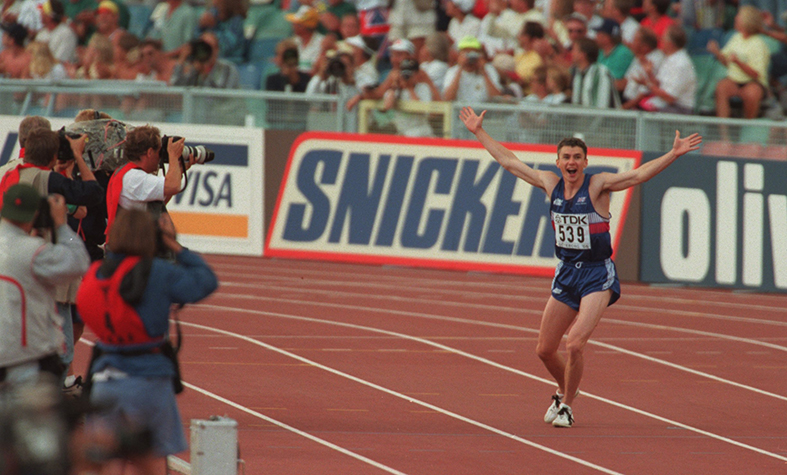
It is just over 30 years since Jonathan Edwards hopped, stepped, and jumped 18.29 meters to set a World Record in the 1995 World Championships in Gothenburg, Sweden. The record he broke was his own 18.16 meters, set twenty minutes previously. He had also, in another event, recorded 18.43m with an illegal (2.4) wind. To put that in context, Jordan Diaz won the 2024 Olympics with 17.86m, and Hugues Fabrice Zango won the 2023 World Championship with 17.64m. The US Champs this year were won with a distance of 17.15m, while in Jonathan’s home country, the 2025 GB Champs winning distance was 15.79m.
Christian Taylor (18.21m) is one of eight athletes since Edwards who have exceeded 18m, with Jordan Diaz being the only one to have done so in the last five years, that is, since Edwards achieved the feat twice in 20 minutes. Christian looked as if he might be the man to break the world record, but he once explained to me why it would be so difficult: “I can’t stress enough how much respect I have for the distance. The reason it has stood so long is that it is a phenomenal distance. I can’t speak about that without talking about the respect I have for the man and the distance”.
Jonathan’s own view of why the record has lasted so long is: “In field events, the talent pool has just gone, and I don’t think athletics has kept pace with the professionalisation and commercialisation of other sports. You can go elsewhere for better rewards and probably a better experience in terms of the coaching, social setting, and camaraderie.” (The Sunday Times, 9 August 2025).
Jonathan told me at the time that he could not explain what happened in Gothenburg: “I was running faster, I was stronger, I improved my technique, but it still did not add up to what happened. Obviously, I wasn’t aware of my potential, so it was still a big surprise to me. I look back and shake my head. Another thing to cope with was having broken through a barrier, the 18-meter triple jump. There had been 17-point-whatever for 35 years. So there is a whole tape playing in your mind. This is what triple jumpers do. They jump 17 meters. Then it goes to 18 meters. There is a whole paradigm shift you have to get used to when viewing the event. That doesn’t help either. It is totally incredible. And all the various awards that have been associated with it. I have just gone beyond what I ever dreamed was possible”.
What Edwards achieved was well summed up in a reader comment in response to a newspaper article this month: “Those jumps in Gothenburg were phenomenal. I remember watching them on TV. Edwards was poetry in motion; absolute perfection. The triple jump had never been more exciting. You felt he was going to break the world record every time he started running. An amazing athlete who reached the peak and still stands alone.” (James Varley, The Times,10 August 2025).
Not that his career was always smooth. He was 23rd in the 1988 Olympics and 35th in 1992 (not making the final in either). He went to the 1996 Olympics as a clear favorite and came second. He was a world champion in 1995 and 2001, but not in 1993, 1997, 1999, or 2003. Going back to the 1992 Olympics, Jonathan told me at the time: “I went into it thinking I had a chance of winning a medal, and then it all went very horribly wrong in the qualifying. I didn’t even reach 16 meters, despite having jumped 17 meters reasonably consistently throughout the season. It was probably the worst period of my life athletically. I was absolutely devastated”.

I knew Jonathan when he was competing and had several conversations with him. He was always a thoughtful athlete and also one who asked himself many questions about how he spent his life. Before becoming a full-time athlete, he worked in a hospital laboratory. He sometimes wrestled with having given up a “worthwhile” profession for something trivial. “You jump into a sand pit, they measure it, and suddenly you’re famous”, I heard him say. Again, he felt it was ridiculous to tell people, “I jump into a sand pit for a living!”
At the same time, he recognised that it was special: “I’m in a very unusual position. Very few people in any sphere of life can say that they are the best, quite clearly the best, indisputably the best, at something – even if the thing that you are best at is pretty insignificant – it is there for everyone to see”.
Another critical aspect of Jonathan’s complicated story refers to faith. He had a strong Christian faith while he was an athlete, and for several years, he never competed on Sundays. He later changed his mind and competed on Sundays, but still struggled with what it meant to be a Christian athlete. He talked about the selfishness required to compete at the top level being the “antithesis of the Christian life, which is about self-sacrifice and giving to other people”. Yet he was convinced that being an athlete was what God had planned for him. He took a tin of sardines to the 2000 Olympics to remind himself that just as Jesus had used five loaves and two small fish to feed 5000 people, Jesus could use Jonathan’s ability in the triple jump for God’s glory.
After he retired in 2003, he began to question his faith, describing himself in an interview as “probably agnostic, but practically an atheist.” He elaborated: “When you think about it rationally, it does seem incredibly improbable that there is a God,” adding that his view is that effectively everyone is agnostic, as no one can be sure. He said that having rejected the faith that he had in his childhood, he felt “internally happier than at any time in my life”. At the same time, he acknowledged that his success as an athlete was intrinsically linked with his Christian faith: “Looking back now, I can see that my faith was not only pivotal to my decision to take up sport but also my success…I was always dismissive of sports psychology when I was competing, but I now realise that my belief in God was sports psychology in all but name.” (The Times, 27 June 2007)
Only after he retired was he able to separate faith and sport: “My faith and athletics were always very much tied together, and when I retired, it gave me freedom to ask questions. My horizons were broadened. I didn’t just have this cosseted group in Newcastle based around family, friends, and church. I went further afield, working for the BBC, producing documentaries, and so on. I saw more of life”.
Whatever you think about his faith or the lack of it, Jonathan Edwards is the most excellent triple jumper who ever lived. His world record has stood for 30 years, and there is no sign that it is likely to be broken anytime soon.












Interesting article about Jonathan Edwards amazingly successful career as a triple jumper.. It fascinated me when he decided he no longer believed in that stuff anymore. Having won so many medals and written his name in history as the greatest triple jumper of this generation, he walks away from the God we gave him the success. His belief was built on solid ground. Jonathan Edwards will soon see the living God, Jesus Christ and he will be ashamed of the years he lost without Jesus. Those years of hardship that challenged his faith. Thise are the years that really count because they expose your weaknesses and strength to endure and breakthrough. The journey into Gods Kingdom is a long hard road and only a few make it into the Kingdom of Heaven. The amazing C.S Lewis wrote in his book Mere Christianity, ” the longest route round is often the shortest way home”.
Valerie, the journey to recognize one’s relationship with the Creator, however you see that deity, is a personal one.
I caution all in judgment, especially about the personal journey to decide, for oneself, if there is a creator of all
things. The Jesus that I believe in, the Jesus that was revealed in the New Testament, from the limited writings approved
at the Council of Nicea, would NOT judge Jonathan on his personal journey. Give to God what is God’s and to Caesar what is Caesar’s. Jonathan, like all athletes, may have been given a gift. Jonathan used it well. Now, Jonathan may be having what is called the Dark Night of the Soul. Give him a break and stop the guilt. I do not believe our Creator wanted us to guilt fellow humans. Thanks for your note.