

Modern Training: Thoughts on Hill Training, by Larry Eder (revised with addendum from Nobby Hashizume).
Hill Training is my secret weapon for training in cross-country and track and field. In the classic Arthur Lydiard plan, the New Zealand coach who revolutionized distance training in the 1960s, considered hill training a specific phase of training, preceding track work and sharpening. In the complex training system of Coach Pat Clohessy, the coach of Rob De Castella, a four-time Olympian, winner of Boston, Rotterdam, and the Commonwealth Games, and the 1983 World Champion, hill training was conducted throughout the year. A typical day would involve running over a 5 km distance with 8-10 hill charges.
The great Lasse Viren, 1972 and 1976 Olympic 10,000m and 5,000m champion, used hill training to prepare for track racing. His classic workout consisted of a 500m-800 m hill workout, done once or twice a week, followed, on another day, by some short track intervals after a 50-50-50 pattern of jog-sprint-jog for 5,000 meters on a soccer pitch. Kenny Moore noted that Mr. Viren did up to 20 times an 800m hill repeat, which some have contested.
On another day, Viren followed that up with 20 x 200m, then a 1-minute jog in between the 200 meter repeats. Viren achieved this in 1972, as part of his training for the 5,000m/10,000m. His 5000 m jog-sprint was completed in 13:52. He completed three workouts of 20 x 200m and was primed for the 1972 Munich Olympics.
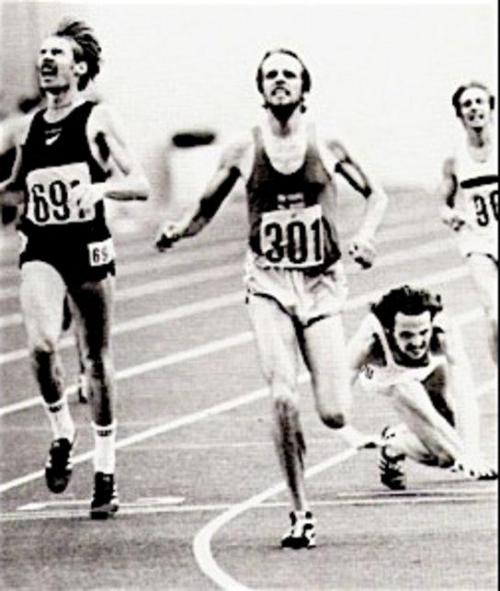
In 1976, he completed the 5,000 m jog-sprint-jog in 13:32 and ran 20 x 200m, and was ready for Montreal (this was after months of running 130 miles a week at altitude). (The hill workouts were described in Kenny Moore’s story on Lasse Viren from a Sports Illustrated article from 1976 on the 1972 Olympic double champion.)
I embraced hill training in my last years of college. Building up to 20 x 800m hill a day, 2-3 days a week, 8-10 weeks. I beat myself up, then dropped mileage, built into track work, and including 4 races in build up, ran 8 straight races, from 2 miles to 10,000m, scoring PBs, including four straight challenging 10ks on the road. That season, I went from 34:25 for 10k to 33:08 for 10k. Using the same program, I scored 8 PBs the following year, including a 32:08 10 K.
Hill training is a pan-effective form of training, as it can get you into shape relatively quickly. My coach buddy, Joe Mangan, with whom I worked for six years at Foothill College, was a hill evangelist. We did hills almost every day for 4 to weeks. We had young men and women who did not participate in running over the summer. We built them from grumpy out-of-shape runners to calloused cross-country runners who could handle the 4.2-mile XC courses with slight hills. We gave them six-mile hill runs that were challenging, as they were able to do them.
Hill work builds body strength, speed, and confidence, and helps you safely handle higher loads. Consider hill training all year long.
Ron Warhurst, the long-time developer of milers at Michigan, and coach at Very Nice Track Club, includes hill training all year long. One of his workouts consisted of a series of hill repeats, followed by some track work, and then additional hill repeats.
Lance Brauman, coach of great sprinters like Noah Lyles, has the team do 300m hill repeats; they hate it, but know it makes them really fit and confident during the season! Hills build confidence and speed!
I have added this addendum from Nobby Hashizume on Lydiard Hill training. Nobby is a lifelong student of the late Arthur Lydiard and supporter of the Lydiard Foundation:
“With Lydiard, first of all, hill training is a necessary exercise. Far too many people tend to run hard and fast, becoming highly anaerobic, and consequently, they start to struggle, causing their form to go out the window. I also highly doubt that Viren did 20 x 800 m.

That’s a total of 10 miles! If he jogged down the hill, that alone would become a 20-mile run, and I really don’t see a good purpose in it. In my research, Viren used a 500m hill (in fact, Coach Canova insisted that Viren used a 60m long hill, and that’s where he got the idea of short-sharp hill sprints, of which I don’t agree). I recall he did no more than 10 repeats. Also, the article is not clear, but, instead, almost insinuates that Viren “combined” the incredible-sounding 20X800m hill repeats ALONG WITH sprint-flow (50/50) of 5000m. (Editor: Since corrected, Never suggested that the sprint flow for 5,000m was done on the same day, sorry for the mistranslation). Lydiard liked to do 4 x 800m hill exercises, with some wind sprints that included 50/50 repeats, using the bottom flat 800m stretch (in the case of 50/50 repeats, that would give you 8 sprints). Viren was an incredible athlete. However, making it sound like he did some mystical super-workout can be counterproductive. “
Hills can work for you! Ask your coach their opinion!
#Hilltraining, #moderntraining, #coachingathletics, #patclohessy, #ronwarhurst, #lancebrauman, #lasseviren, #RolfHakkola, #ArthurLydiard,