
Walt Murphy’s News and Results Service ([email protected])
This Day in Track & Field–August 24
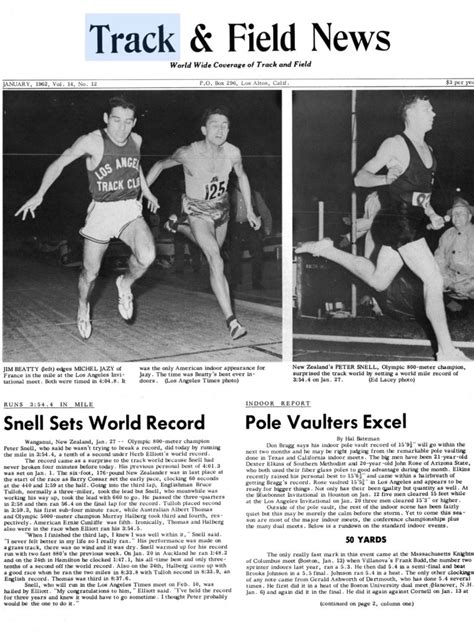
1962—Running in cold and rainy conditions in Turku, Finland, Jim Beatty set American Records for 3-miles (13:19.2) and 5000-meters (13:45.0). Max Truex was the previous record holder in both events (13:21.0, 13:49.6).
This was the fifth consecutive meet in which Beatty, often with the help of his Los Angeles Track Club teammates, set at least one American Record.
Beatty’s Remarkable Streak
August 9–Oslo, Norway–Ran 3:39.4 for 1500-meters to break his own previous mark of 3:39.9.
August 15–Avranches, France–Had hoped to challenge Michel Jazy’s World Record of 7:49.2, but had to settle for a new U.S. mark of 7:54.2 in cold and rainy conditions.
August 18–London, England–Won the mile in 3:56.5 to break Dyrol Burleson’s year-old AR of 3:57.6. Also under the old mark was LATC teammate Jim Grelle(3:56.7), who led Beatty with 220y to go.
August 21–Helsinki, Finland–Took .2s off his 3-day old mile record with his time of 3:56.3
August 24–Turku, Finland–two-for-one with his new marks for 3-miles and 5000-meters(see above)
(From Track & Field News)
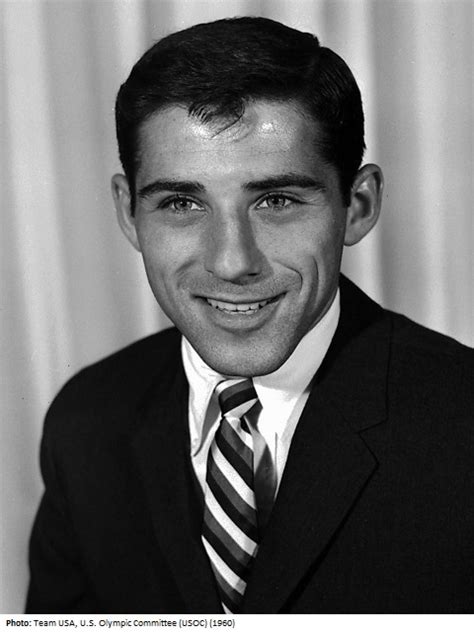
1977–Marty Liquori beat a star-studded 5000-meters field in Zürich and set an American Record of 13:16.0. Next across the line were New Zealand’s Dick Quax (13:17.32), Ethiopia’s Miruts Yifter (13:18.12), and the Kenya/Washington State duo of Samson Kimobwa (13:21.56) and Henry Rono (13:22.18).
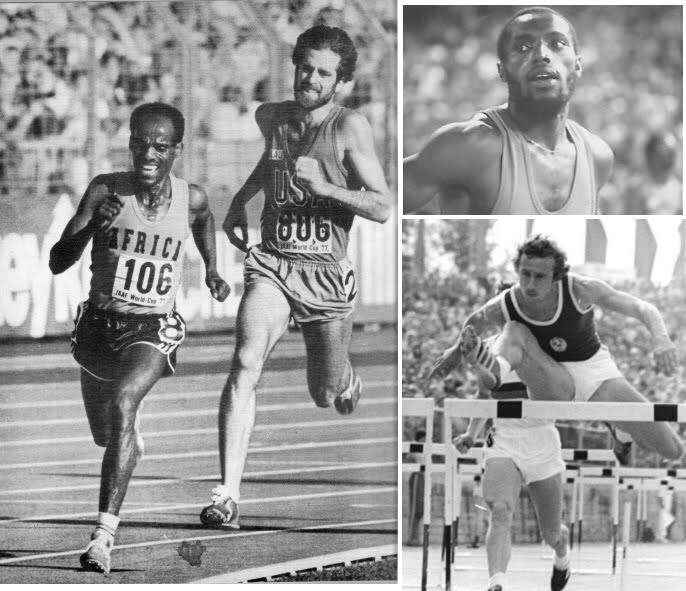
Mike Boit was ranked #1 in the world in the 800 in 1975 and Cuba’s Alberto Juantorena was the 1976 Olympic gold medalist (and World Record holder) in the event, a race Boit missed because of the African boycott. The two giants had never met before this night and their battle lived up to expectations. Juantorena led through 400-meters in an unheard-of (at the time) 49.7, with Boit right behind in 49.8. Boit tried to take the lead on the backstretch, but was held off by Juantorena, who wound up winning by a second, 1:43.6-1:44.6.
The two would meet a week later at the inaugural World Cup in Düsseldorf, with the outcome this time in doubt until Juantorena crossed the line a step ahead of Boit (1:44.0-1:44.1).
World Cup Video: https://www.youtube.com/watch?v=_9C2CDZvOOY
Sports Illustrated Vault(post-World Cup):
https://vault.si.com/vault/2002/12/23/runners-mike-boit-and-alberto-juantorena-september-12-1977
1979–Evelyn Ashford won the women’s 200-meters out of lane 8 at the 2nd World Cup in Montreal in 21.83, smashing her own American Record of 22.27. Finishing 2nd in 22.02 on the other side of the track in lane 1 was world record holder Marita Koch of East Germany. Ashford would win the 100 the next day over another East German world record holder, Marlies Oelsner-Göhr.
Results: https://en.wikipedia.org/wiki/1979_IAAF_World_Cup
Video(100&200): http://www.youtube.com/watch?v=x9LKNMPxpVo
Hall-of-Fame Bio(1997): https://www.usatf.org/athlete-bios/evelyn-ashford
1983—Calvin Smith, the newly crowned World Champion at 200-meters, was a 2-time sprint winner in Zürich with winning times of 9.97 and 19.99, the greatest 1-day double in history. 2nd in the 200 was Carl Lewis (20.21), who hadn’t yet recovered from his 3-gold medal-winning performance at the Worlds in Helsinki (100,LJ,4×100).
200: https://www.youtube.com/watch?v=w32X-Zbzym8
1984–Less than three weeks after they finished 1st and 7th, respectively, in the 800-meters at the L.A. Olympics, Brazil’s Joaquim Cruz and Johnny Gray went on a tear in Europe. On this day in Brussels, Cruz won in 1:42.41, while Gray finished 2nd in 1:43.28 to break his own American Record of 1:43.74, which was set in June at the U.S. Trials. (Cruz had run 1:42.34 in Zürich on August 22—Gray was 4th in 1:44.81)
Two days later in Cologne, Cruz, who had won his 2nd straight NCAA title in June as an Oregon soph, ran 1:41.77, just missing Seb Coe’s World Record of 1:41.73. Kenya’s Sammy Koskei was 2nd in 1:42.28, followed by Gray, who matched his new AR of 1:43.28.
Finally, with Cruz on his way back to Eugene, Gray scored the first international win of his career in Koblenz Aug.29), and lowered his American Record to 1:42.96. (He would return to Koblenz in 1985 to lower the AR to 1:42.60).
From Track & Field News
T&F News Interviews
Cruz(1984): https://trackandfieldnews.com/wp-content/uploads/2019/01/joaquim-cruz.pdf
Gray(1985): https://trackandfieldnews.com/wp-content/uploads/2019/01/Johnny-Gray.pdf
1991–Medalists in the 3 finals on the 1st day of competition at the World Championships in Tokyo:
Men’s 20k-Walk: Italy’s Maurizio Damilano (1:19:37/CR), the Soviet Union’s Mikhail Schennikov (1:19:46) and Yevgeniy
Misyulya (1:20:22)
Women’s 10k-Walk: Soviet Alina Ivanova (42:57/CR), Sweden’s Madeline Svensson (43:13), Finland’s Sari Essayah (43.13)
Women’s Shot Put: China’s Huang Zhihong (68-4 ¼ [20.83]), Soviets Natalya Lisovskaya (66-7 [20.29]) and Svetlana
Krivelyova (66-1 ¾ [20.16])
Medalists/Results: https://en.wikipedia.org/wiki/1991_World_Championships_in_Athletics
1994 Marc Davis ran 8:12.74 for 2-miles in Gothenburg, Sweden, to break Marty Liquori’s 19-year old American Record of 8:17.2.
http://www.runblogrun.com/2016/09/on-your-marc-in-praise-of-marc-davis-by-mike-fanelli.html
1997–Denmark’s Wilson Kipketer broke the World Record in the 800-meters for the 3rd time in seven weeks, running 1:41.11 in Cologne, Germany. That mark stood for 13 years until Kenya’s David Rudisha ran 1:41.09 in 2010. Finishing 5th in the race was American Rich Kenah (1:43.70).
Most distance World Records involve one runner against the clock, but not here in the steeplechase. Bernard Barmasai (7:55.72) only passed fellow Kenyan Moses Kiptanui (7:56.16) in the last 80-meters as both bettered the previous mark of 7:59.08, which was set by another Kenyan, Wilson Boit Kipketer, just 11 days earlier. Kiptanui had previously set World Records of 8:02.08 (1992) and 7:59.18 (1995).
Videos
800: http://www.youtube.com/watch?v=y-nktw7gZgU
SC: https://www.youtube.com/watch?v=yj2qX8igmhY
WR Progressions:
800: http://en.wikipedia.org/wiki/800_metres_world_record_progression
Steeplechase: http://en.wikipedia.org/wiki/Steeplechase_(athletics)
1999—Sitting in 4th place as he got ready for his final throw, Anthony Washington came through with a World Championship Record toss of 228-8 (69.08) to win the Men’s Discus in Seville over the formidable German duo of 39-year old Jürgen Schult (223-8 [68.08]), the World Record holder and 1987 World Champion, and Lars Riedel (223-4 [68.09]), who was hoping to win his 5th straight World title!
Said Washington, still the only American to win the event at the Worlds, “To tell you the truth, I don’t know how the heck I did that. I’m glad to show that a family man with a full-time job can win a World title”.
Many championship races become tactical affairs, but not this year in the Men’s 1500. With teammate Adil Kaouch acting as a rabbit (54.31, 1:52.15), Morocco’s Hicham El Guerrouj won his 2nd straight World title in 3:27.65, the fastest time, by far, ever run in a global final. In addition, the next 4 runners all ran faster than any previous World or Olympic Champion in history! Winning the silver medal was Kenya’s Noah Ngeny (3:28.73), followed by 3 Spaniards who would have preferred a slower pace: Reyes Estévez (3:30.57), Fermín Cacho (3:31.34), the 1992 Olympic Champion, and Andrés Díaz (3:31.83).
Jearl Miles-Clark, the 1993 World Champion at 400-meters, led the field in the Women’s 800 through the first 400-meters in a quick 57.63. She fought off Mozambique’s Maria Mutola, winner of the 800 at the 1993 Worlds, into the final homestretch, but was passed in the rush to the finish line by Czech Ludmila Formanová (1:56.68), Mutola (1:56.72), and Russia’s Svetlana Masterkova (1:56.93). Miles-Clark finished 4th in 1:57.40.
The great Haile Gebrselassie (27:57.27) won his 4th straight World title in the Men’s 10,000 over Kenya’s Paul Tergat (27:58.56) and fellow Ethiopians Assefa Mezgebu (27:59.15) and Girma Tolla (28:02.08).
Medalists in other events
Women’s Hammer: Romania’s Mihaela Melinte (246-9 [75.20]), Russia’s Olga Kuzenkova (238-1 [72.56]), American Samoa’s Lisa Misipeka (216-9 [66.06]), the 1998 NCAA Champion while at South Carolina.
Women’s Triple Jump: Greece’s Paraskevi Tsiamita (48-10 [14.88]), Cuba’s Yamilé Aldama (47-11 ¼ [14.61]), Greece’s Olga Vasdeki (47-11 ¼ [14.61])
Medalists/Results: https://en.wikipedia.org/wiki/1999_World_Championships_in_Athletics
IAAF Coverage Additional Reports
Videos: Men’s 1500 Women’s 800 Men’s 10,000 Men’s Discus
2001–In the fastest 1-2 finish in history, Morocco’s Hicham El Guerrouj held off Bernard Lagat in the 1500-meters in Brussels. Their times of 3:26.12 and 3:26.34 are still the 2nd and 3rd fastest ever, trailing only El Guerouj’s World Record of 3:26.00, which was set in 1998.
Four years to the day after the previous record of 7:55.72 was set, Morocco’s Brahim Boulami set a new World Record of 7:55.28 in the Steeplechase. Also getting under 8-minutes were Kenya’s Reuben Kosgei (7:57.29) and Stephen Cherono(7:58.66). Cherono would later change his name to Said Saeed Shaheen when he changed allegiance to Qatar.
Videos
1500: http://www.youtube.com/watch?v=UQjjLgT-WHA
SC: https://www.youtube.com/watch?v=owEoR_OR1gg
All-Time List:
http://www.alltime-athletics.com/m_1500ok.htm
http://www.alltime-athletics.com/m3000hok.htm
WR Progression: http://en.wikipedia.org/wiki/Steeplechase_(athletics)
2003—The IAAF’s unpopular new false-start rule, which called for the first offense to be charged against the field, with any subsequent offenders being disqualified, claimed its first major casualties in the 2nd ¼-final race of the Men’s 100 at the World Championships in Paris/St.Denis.
The 8 runners were put on notice after Jamaica’s Dwight Thomas committed the first false start. On the 2nd try, fellow Jamaican Asafa Powell and American Jon Drummond were both cited for leaving their blocks too soon. Drummond, who kept saying “I didn’t move”, refused to leave the start area and even lay down in his lane. After a 15-minute delay, Drummond, the top of his suit pulled down, started walking away, apparently resigned to his fate.
Before he could leave the track, he was approached by a U.S. official who told him that an appeal was being filed and that he could be allowed to “run under protest”. Pulling his top back up, Drummond turned around and resumed his position in front of his blocks in lane 4. Powell also returned to his lane, but officials decided to delay the restart to let the runners in the two remaining ¼-finals complete their races. In the interim, according to Drummond, he was approached by IAAF General Secretary Istvan Gyulai, who asked him to accept the false-start ruling to “avoid further scandal”. Drummond agreed to Gyulai’s request, and so, apparently, did Powell.
When it was time for the restart of ¼-final #2, lanes 4 & 5 were empty, with an emotionally drained Drummond being consoled at the practice track by coach John Smith.
But the drama wasn’t over yet. When the six remaining runners were called to their blocks, the crowd, thinking that Drummond and Powell were unjustly disqualified, began whistling (booing) loudly, forcing the starter to call the runners up. This happened a few times, with the runners, including Drummond’s training partner, Trinidad & Tobago’s Ato Boldon, who had endured a similar (but not as lengthy) delay when Great Britain’s Linford Christie refused to leave the track after being disqualified for two false starts in the 100 final at the 1996 Olympics, did their best to get the crowd calmed down. At last, the race finally went off, Boldon, showing remarkable poise after enduring such an ordeal, winning in 10.09, his fastest time of the season.
In an analysis of the chart produced by the Seiko equipment, Track & Field News came to the conclusion that Drummond, while he did “flinch” at one point while in the set position, was above the allowable reaction time when the gun went off and should have been allowed to remain in the race!
The IAAF wanted USATF to discipline Drummond for “unsportsmanlike’ conduct, but, since that could be a lengthy process, Drummond, who was scheduled to run in the 4×100, voluntarily withdrew from the Championships and the rest of the season. Said Drummond in a statement, “I honestly believe I did not false start. It was never my intention to harm the sport in any way or to inconvenience my fellow competitors or the fans. My spirit is broken because it has always been my desire to provide entertainment for the fans”.
(Check the links below for a full recap of the races!)
Delayed by the goings-on in the 100, the evening’s 3 finals were finally contested.
Sweden’s Carolina Klüft ran a personal best of 2:12.12 in the 800 to finish off her win in the Heptathlon, becoming the 2nd woman to break the 7,000-point barrier, just barely, with a score of 7,001 points. Finishing 2nd and 3rd were France’s Eunice Barber (6755) and Belarus’s Natallia Sazanovich (6524)
The past met the future in the Men’s 10,000 as 4-time defending champion Haile Gebrselassie was beaten by his heir-apparent, fellow Ethiopian Kenenisa Bekele, who won the first of his 4 World titles in this event (26:49.57-26:50.77). 3rd in this Ethiopian sweep was Sileshi Sihine (27:01.44). Finishing 16th was American Meb Keflezighi (28:35.08).
Kelli White won the Women’s 100 in 10.85 and would win the 200 four days later, but was eventually stripped of both titles for a doping violation. U.S. teammate Torri Edwards was elevated to the gold medal position in the 100, with silver and bronze going to the Bahamas’ Chandra Sturrup (11.02) and Greece’s Ekaterini Thánou (11.03). 36-year old Gail Devers, the 1993 World Champion in the 100 (and 2-time Olympic gold medalist in the sprint), finished last in 11.11.
(White’s full story will be reported on August 28).
Medalists/Results: https://en.wikipedia.org/wiki/2003_World_Championships_in_Athletics
Men’s 10,000(last 600m): https://www.youtube.com/watch?v=vvqAIl_Ydiw
All-Time List(Heptathlon): http://www.alltime-athletics.com/whepaok.htm
Wikipedia Bio(Klüft):http://en.wikipedia.org/wiki/Carolina_Klüft
NY Times Coverage(Drummond):
Men’s 100
“I Didn’t Move”: https://www.youtube.com/watch?v=Cxn7yaOfEoY
CBC Video(18+ minutes): https://www.youtube.com/watch?v=VmvBI7X5iKg
https://www.theguardian.com/sport/2003/aug/25/athletics.richardwilliams
IAAF Statement on Drummond: https://www.worldathletics.org/news/news/iaaf-decision-on-jon-drummond-incident
Drummond Statement: http://news.bbc.co.uk/sport2/hi/athletics/world_athletics_2003/3179423.stm
2004–Russia’s Yelena Isinbaeva won the Women’s Pole Vault at the Olympics in Athens, clearing the World Record height of 16-1 ¼ (4.91m). 2nd was her teammate, Svetlana Feofanova (15-7 [4.75]), and 3rd was Poland’s Anna Rogowska
(15-5 [4.70]).
American Joanna Hayes set an Olympic Record of 12.37 while winning the gold medal in the Women’s 100-meter hurdles. Winning silver and bronze were Ukraine’s Olena Krasovska (12.45) and American Melissa Morrison (12.56). Canada’s Perdita Felicien, who had won her semi-final in 12.49, crashed into the first hurdle and careened into Russia’s Irina Shevchenko, taking both of them out of the race!
Hicham El Guerrouj edged Bernard Lagat, still competing for his native Kenya, in the Men’s 1500-meters (3:34.18-3:34.30). 3rd was Portugal’s Rui Silva (3:34.68.
After a slowish early pace, El Guerrouj took the lead with 2 laps to go, with Lagat following close behind. Lagat made his move coming off the final turn and briefly moved into the lead, but El Guerrouj responded quickly and was able to hang on for the narrow win.
The Czech Republic’s Roman Šebrle beat Bryan Clay, 8893 (OR)-8820, to win the Decathlon. At the time, no one had ever scored more points and lost a 10-eventer! (France’s Kevin Mayer scored 8834 while finishing 2nd to Ashton Eaton’s winning score of 8893 points at the 2016 Olympics). Winning the bronze medal was Kazakhstan’s Dmitriy Karpov (8725). Clay would win the gold medal 4 years later in Beijing.
It was a Kenyan sweep in the Men’s Steeplechase, with Ezekiel Kemboi (8:05.81) winning the first of his two Olympic titles (would also win in 2012) over teammates Brimin Kipruto (8:06.11) and Paul Koech (8:06.64).
The Bahamas’ Tonique Williams-Darling (49.41) won the Women’s 400-Meters over Mexico’s Ana Guevera (49.56) and Russia’s Natalita Antyukh (49.89).
Medalists/Results: http://en.wikipedia.org/wiki/Athletics_at_the_2004_Summer_Olympics
…