
Walt Murphy’s News and Results Service ([email protected])
This Day in Track & Field–August 6
1932–American Jim Bausch won the Decathlon at the L.A. Olympics and set a World Record of 8462.235 points (6735-current tables). Winning the silver medal for the 2nd Games in a row was Finland’s Akilles Järvinen. Ironically, if today’s scoring tables had been in effect, Järvinen would have won the gold medal in 1928 and 1932! Winning the bronze medal was Germany’s Wolrad Eberle8030.30
Bausch was nicknamed “Jarring Jim” for his powerful running style as a fullback for the Kansas Jayhawks. In a 1930 game against Kansas State, he ran the opening kickoff 98 yards for a touchdown and intercepted a pass and ran it back 68 yards for another touchdown. Bausch also kicked both extra points as Kansas won 14-0.
Bausch and his American teammates in Los Angeles, Wilson Buster Charles (4th) and fellow Jayhawk Clyde (aka Cliff) Coffman (7th) were all coached by Hall-of-Fame charter member Brutus Hamilton.
Running an extra lap due to an error by the lap-counter, Finland’s Volmari Iso-Hollo won the Steeplechase in 10:33.4! Finishing 2nd & 3rd were Great Britain’s Tom Evenson (10:46.0) and American Joe McCluskey (10:46.2), who was in 2nd place when he crossed the “true” finish line.
Medalists/Results: http://en.wikipedia.org/wiki/Athletics_at_the_1932_Summer_Olympics
Olympedia Reports: https://www.olympedia.org/editions/10/sports/ATH
Steeplechase(no audio): https://www.youtube.com/watch?v=jNutXj_W0NY
Kansas Olympians: http://www.kumaddogs.org/about/runningtales/olyk.html
WR Progression(Decathlon): https://en.wikipedia.org/wiki/Decathlon_world_record_progression
1936–New Zealand’s Jack Lovelock beat a strong field at the Berlin Olympics to win the Men’s 1500-meters in the World Record time of 3:47.8. American great Glenn Cunningham was 2nd (3:48.4), followed by Italy’s Luigi Beccali (3:49.2), the defending champion, and Archie San Romani (3:50.0).
The race, and the 4 years of miling that preceded it, is chronicled in the book, Conquerors of Time, which was written by New Zealander Lynn McConnell. It looks at the great races and the characters of the era, including Lovelock, Beccali, and Cunningham, as well as Bill Bonthron, Gene Venzke, Sydney Wooderson, and Phil Edwards.
American Forrest “Spec” Towns won the gold medal in the 110-hurdles in 14.2 after tying his own World Record of 14.1 in his semi-final. 2nd & 3rd were Great Britain’s Don Finlay and American Fritz Pollard, both of whom ran 14.4.
There was a great competition in the Triple Jump, with Japan’s Naoto Tajima becoming the first man to jump 16-meters (52-6). Teammate Masao Hasada took the silver medal with a jump of 51-4 ½ (15,66), and the bronze went to Australia’s Jack Metcalfe (50-10 ¼ [15.50]), the previous world record holder.
Italy’s Trebisonda ‘Ondina’ Valla (11.7) won the 80-meter hurdles in a blanket finish over Germany’s Anna Steuer (11.7), Canada’s Elizabeth Taylor (11.7), Italy’s Claudia Testoni (11.7), and the Netherlands’ Kitty ter Brakke (11.8). Valla was a clear winner, while the next four came across together. Valla ran a wind-aided 11.6 in the semi-finals, but got credit for a world record since the 2.00mps maximum wasn’t put into effect until after the Games.
The medalists in the Men’s Javelin were Germany’s Gerhard Stöck (235-8 [71.84]), who had earlier won the bronze medal in the Shot Put, and Finland’s Yrjö Nikkanen (232-2 [70.77]) and Kalervo Toivonen (232-0 [70.72]). The 3rd Finn, Matti Järvinen, the defending champion and World Record holder, was hampered by a back injury and wound up in 5th place (226-11 [69.18).
Medalists/Results: http://en.wikipedia.org/wiki/Athletics_at_the_1936_Summer_Olympics
Olympedia Reports: https://www.olympedia.org/editions/11/sports/ATH
Conquerors of Time: http://www.amazon.com/Conquerors-Time-Lynn-McConnell/dp/1899807888;
“A Glittering Icon of Fascist Femininity”: Trebisonda ‘Ondina’ Valla
https://www.tandfonline.com/doi/abs/10.1080/714001498?journalCode=fhsp20
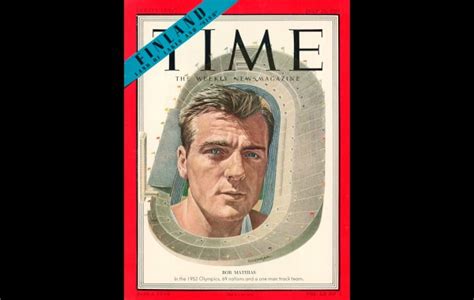
1948–17-year old Bob Mathias won the first of his two Olympic gold medals in the Decathlon, scoring 7,139 points (6,638 current tables) in London. Silver and bronze went to France’s Ignace Heinrich (6974/6559) and American Floyd Simmons (6950/6531).
Fanny Blankers-Koen (24.4), who had already won the 100-meters and 80-meter hurdles, became the first woman to win three individual events at the same Olympics after winning the 200-meters by an amazing 7-meters. She would win a 4th gold the following day in the 4×100. 2nd and 3rd in the 200 were Great Britain’s Audrey Williamson (25.1) and American Audrey Patterson (25.2).
Sweden got a 1-2 finish in the Men’s 1500 from Henry Eriksson (3:49.8) and Lennart Strand (3:50.4), with the Netherlands’ Wim Slijkhuis (3:50.4) placing 3rd.
Results: https://en.wikipedia.org/wiki/Athletics_at_the_1948_Summer_Olympics
Mathias
ESPN.com Story: http://espn.go.com/sportscentury/features/00016202.html;
NY Times Obituary(Mathias):
http://www.nytimes.com/2006/09/03/world/americas/03iht-obit.2679546.html
“Hometown Hero” DVD:
https://www.ebay.com/itm/Brand-NEW-Bob-Mathias-Hometown-Hero-DVD-/284104247715?_ul=IL
Trailer: http://www.youtube.com/watch?v=zGs1hwRk_T8
Google Photos: http://tinyurl.com/mftoul
Blankers-Koen Feature: http://www.youtube.com/watch?v=D4zQPmR8DFk
1958–An overflow crowd of 22,000 jammed into the brand new stadium in Dublin to watch local hero Ron Delany, the 1956 Olympic 1500-meter champion, battle young Australian star Herb Elliott in the mile. The 20-year old Elliott spoiled the party by winning, but gave the fans a treat by running 3:54.5 to take an amazing 2.7-seconds off the previous World Record of 3:57.2, which was set by England’s Derek Ibbotson the previous year. Also under the old record was another Australian, Merv Lincoln, who ran 3:55.9, while Delany edged New Zealand’s Murray Halberg for 3rd, with both clocking 3:57.5, just outside the previous WR! Finishing 5th in this greatest mile of its time was yet another Aussie, Albert Thomas, who ran 3:58.6.
Thomas, who had set a 3-mile World Record of 13:10.8 on this same track a month earlier, set another mark on the 2nd day (Aug.7) of this 2-day affair, winning the 2-mile in 8:32.0. Setting the pace for his friend for the first 5 laps was none other than Elliott, who finished 2nd in 8:37.6
Much more in Sports Illustrated’s coverage:
https://vault.si.com/vault/1958/08/18/toward-a-physiological-absolute
1958–Glenn Davis ran the 400-meter hurdles in 49.2 in Budapest to break his own World Record of 49.5, which was set at the 1956 Olympic Trials.
WR Progression: http://en.wikipedia.org/wiki/Men’s_400_metres_hurdles_world_record_progression
1984—A busy Olympic day inside the L.A. Coliseum. Two months after winning the 800 and 1500 at the NCAA Championships, Oregon’s (and Brazil’s) Joaquim Cruz (1:43.00-OR) upset World Record holder Sebastian Coe (1:43.64) to win the gold medal in the Men’s 800-meters. Winning the bronze medal was American Earl Jones (1:43.83), while Johnny Gray was 7th (1:47.89) and Steve Ovett 8th (1:52.28).
Winner of the Women’s 800 was Romania’s Doina Melinte (1:57.60), with American Kim Gallagher taking the silver medal (1:58.63) and Melinte’s teammate, Fița Lovin (1:58.83), won the bronze. Gallagher would win the bronze medal 4 years later in Seoul.
Roger Kingdom, the 1983 NCAA Champion from Pittsburgh, won the first of his two Olympic gold medals in the Men’s 110-meter hurdles, setting an Olympic Record of 13.20 to edge teammate Greg Foster (13.23). 3rd was Finland’s Arto Bryggare (13.40).
Valerie Brisco was another Olympic Record setter, running 48.83 to win the Women’s 400-meters. Her time also established a new American Record, one that lasted for 22 years until Sanya Richards ran 48.70 in 2006. Winning silver and bronze were American Chandra Cheeseborough (49.05) and Great Britain’s Kathy Smallwood-Cook (49.42).
Medalists in the 10,000-Meters were Italy’s Alberto Cova (27:47.54), the 1983 World Champion, Great Britain’s Mike McLeod (28:06.22), and Kenya’s Mike Musyoki (28:06.46). Finland’s Martti Vainio originally finished 2nd, but was disqualified 5 days later for a doping violation!
Finland’s Juha Tiainen (256-2 [78.08]) won the Hammer Throw over the German duo of Karl-Hans Riehm (255-10 [77.98]) and Klaus Ploghaus (249-1 [75.94]). Missing from the competiton due to the Soviet-led boycott was Yuriy Siedykh, the World Record holder and 2-time defending Olympic champion!
Medalists in the Women’s Javelin were Great Britain’s Tessa Sanderson (228-2 [69.56]), Finland’s Tiina Lillak (226-4 [69.00]), the 1983 World Champion who was dealing with a foot injury, and another Brit, Fatima Whitbread (220-3 [67.14]).
All of the above winners were worthy of Olympic glory, but the one man that many fans had come to see was Carl Lewis, who was trying to emulate Jesse Owens’s 4-gold medal winning performance at the 1936 Olympics. He had already won the 100-meters and would try to get his 2nd gold in the Long Jump.
Lewis, who had won his first two qualifying races in the 200-meters during the morning session, effectively ended the competition in the long jump with his opening leap of 28-1/4 (8.54). He fouled in the second round, then, confident that his opening mark would hold up, decided to skip his remaining 4 jumps. Most track fans, mindful that Lewis still had two more rounds of the 200 coming up in two days, as well as three rounds of the 4×100 relay, understood his need to conserve his energy. But the casual sports fans among the 85,000 spectators in attendance didn’t care about that–they were hoping to see Lewis set a world record and actually booed when it became known that he was done for the day after only two jumps!
Australia’s Gary Honey and Italy’s Giovanni Evangelista both jumped 27-1/2 (8.24), with Honey winning the silver medal based on a better 2nd jump.
Medalists/Results: http://en.wikipedia.org/wiki/Athletics_at_the_1984_Summer_Olympics
Olympedia Reports: https://www.olympedia.org/editions/21/sports/ATH
Lewis: http://www.heraldscotland.com/carl-lewis-olympic-long-jump-gold-at-los-angeles-1.862629
Videos: M800 W400 M110h W800 MLJ WJT MHT
1986–World Record holder (12.93) Renaldo Nehemiah returned to the world of big-time track after a short NFL career with the San Francisco 49ers and won the 110-hurdles in Viareggio, Italy (13.48)
Kenny Moore’s story in Sports Illustrated:
1992–Kevin Young won the gold medal in the 400-meter hurdles at the Barcelona Olympics and set a World Record of 46.78 (broken in 2021 by Karsten Warholm). Winning silver and bronze were Jamaica’s Winthrop Graham (47.66) and Great Britain’s Kriss Akabusi (47.82).
Already the winner of the 100-meters, Gail Devers was well on her way to winning a 2nd gold medal in the 100-Meter Hurdles when she hit the final barrier with her lead foot and stumbled across the line in 5th place. Sweeping past her to win the medals were Greece’s Voula Patoulidou (12.64), American LaVonna Martin (12.69), and Bulgaria’s Yordanka Donkova (12.70), the World Record holder in the event.
With pre-Games pick Michael Johnson sidelined by a case of food poisoning, the favorite’s role for the final of the Men’s 200-Meters was taken on by Michael Marsh. After setting an American Record of 19.73 in his semi-final, Marsh was a convincing winner of the gold medal, beating Namibia’s Frank Fredericks by .12s (20.01-20.13). Marsh’s teammate, Michael Bates, won the bronze medal in 20.38.
Czech Robert Změlík (8611) won the Decathlon over Spain’s Antonio Peñalver (8412) and American Dave Johnson (8309). Absent was American Dan O’Brien, the 1991 World Champion, who failed to make the U.S. team after no-heighting in the Pole Vault at the U.S. Trials.
Mike Powell had beaten Carl Lewis with a World Record in their historic long jump duel at the 1991 World Championships in Tokyo and also beat him at the U.S. Olympic Trials. Lewis gave fair warning that he was going to be tough to beat here as he led the preliminary round with a leap of 28-5 ¾ (8.68m), still the longest qualifying mark in history.
Lewis, the 2-time defending Olympic Champion in the event, immediately put pressure on Powell in the final by reaching out to 28-5 ½ (8.67m) on his opening jump. This was not to be a repeat of the 1991 battle, but Powell made things interesting by almost “stealing” the win with his final jump of 28-4 ¼ (8.64). Lewis had his 3rd gold medal in the event and Powell had to settle for his 2nd consecutive Olympic silver medal. Winning the bronze medal was American Joe Greene (27-4 ½ [8/34]).
Medalists/Results: http://en.wikipedia.org/wiki/Athletics_at_the_1992_Summer_Olympics
WR Progression(400h): http://en.wikipedia.org/wiki/Men’s_400_metres_hurdles_world_record_progression
Videos: 400h 100h MLJ(Highlights) MLJ (Complete)
1995—Canadians Donovan Bailey (9.97) and Bruny Surin (10.03) passed early leader Ato Boldon (10.03) of Trindad & Tobago 60-meters into the race and finished 1-2 in the men’s 100-meters at the World Championship in Gothenburg, Sweden. Boldon hung on to win the bronze medal
American Gail Devers (12.68) won the 2nd of her three World titles in the 100-meter hurdles. Finishing 2nd and 3rd were Kazakhstan’s Olga Shishigina (12.80) and Russia’s Yuliya Graudyn (12.85)
Italy’s Fiona May won the Women’s Long Jump (22-10 3/4w [6.98]), while two of the event’s giants didn’t fare so well. Germany’s Heike Drechsler, the defending champion, fouled on her first two jumps and her final effort of 21-9 ½ (6.64) left her short of qualifying for the final three rounds. An injured Jackie Joyner-Kersee, the 1987 and 1991 World Champion, finished 6th with a jump of 22-1 ½ [6.74]).
Winning the silver was Cuba’s Niurka Montalvo (22-6 ¼ [6.86]) and the bronze went to Russia’s Irina Mushayilova (22-5 [6.83).
Medalists in the Hammer Throw were Tajikistan’s Andrey Abduvaliyev (267-7 [81.56]), Belarus’s Igor Astapkovich (266-1 [81.10]), and Hungary’s Igor Gécsek (265-8 [80.98]).
Finishing 4th & 5th were Hungary’s (and USC’s) Balázs Kiss (259-3 [79.02]), who had won the 3rd of his 4 NCAA titles in June, and American Record holder Lance Deal (257-10 [78.60]). Kiss & Deal would win gold & silver, respectively, at the following year’s Olympics in Atlanta.
Italy’s Michele Didoni (1:19:59) won the 20k-Walk over Spain’s Valentin Massana (1:20:23) and Belarus’s Yevgeniy Misyulya (1:20:48).
Medalists/Results: http://en.wikipedia.org/wiki/1995_World_Championships_in_Athletics
1997—Hicham El Guerrouj (3:35.83) won the first of his four World titles in the Men’s 1500-Meters in Athens, while Algeria’s Noureddine Morceli, the 3-time defending champion, finished 4th behind Spain’s Fermín Cacho (3:36.63) and Reyes Estévez (3:37.26).
Cuba’s Javier Sotomayor won the Men’s High Jump with a clearance of 7-9 ¼ (2.37). Poland’s Artur Partyka and Australia’s Tim Forsyth both cleared 7-8 ½ (2.35), with Partyka winning the silver medal with fewer misses.
It was a blanket finish as Kenya swept the medals in the Steeplechase: Wilson Boit Kipketer (8:05.84), Moses Kiptanui (8:06.04), the 3-time defending champion, and Bernard Barmassi (8:06.04). American Mark Croghan (8:14.09) finished 6th.
With 600-meters to go in the Men’s 10,000, Ethiopia’s Haile Gebrselassie (27:24.58) sprinted away from the lead pack and went on to win the 3rd of his 4 World titles in this event. Kenya’s Paul Tergat (27:25.62) won the silver medal and Morocco’s Salah Hissou (27:28.62) the bronze.
The Czech Republic’s Tomáš Dvořák (8837) won the 1st of his 3 World titles in the Decathlon. Silver and bronze went to Finland’s Eduard Hämäläinen (8730) and Germany’s Frank Busemann (8652). 4th was American Steve Fritz (8463).
Results: https://en.wikipedia.org/wiki/1997_World_Championships_in_Athletics
Videos
M1500: https://www.youtube.com/watch?v=Dl4twDQ1rmM
M10k: https://www.youtube.com/watch?v=eEPclVOIiIM
SC: https://www.youtube.com/watch?v=JOcRVYb2zoA
2001—Stacy Dragila, the inaugural winner of the Women’s Pole Vault at the 1999 World Championships and 2000 Olympics, won her 2nd World title in Edmonton, beating Russia’s Svetlana Feofanova on fewer misses as both cleared 15-7 (4.75). 3rd was Poland’s Monica Pyrek (14-11).
Great Britain’s Jonathan Edwards had set the World Record of 60-1/4 (18.29) while winning at the 1995 Worlds in Gothenburg, Sweden, but had to settle for silver in 1997 and bronze in 1999. He finally won his 2nd title here with a jump of 58-9 ½ (17.92). Sweden’s Christian Olsson (57-3 ¾ [17.47]) edged Russia’s Igor Spasokhadvskiy (57-2 ¾ [17.44]) for the silver medal and would go on to win at the 2003 Worlds and 2004 Olympics.
The Bahamas’ Avard Moncur, the 2000 NCAA Champion while at Auburn, won the men’s 400 in 44.64. 2nd & 3rd were Germany’s Ingo (44.87) and Jamaica’s Greg Haughton (44.98).
The U.S. was shut out of the medals for the first time at the World Championships. Antonio Pettigrew, the only American in the final, finished 4th, but was eventually disqualified for a drug violation.
Ukraine’s Zhanna Pintusevich-Block (10.82