
Walt Murphy’s News and Results Service ([email protected])
This Day in Track & Field–August 31
1904—Many of the events at the Olympics in St.Louis were dominated by Americans and that was evident on this day as the U.S. swept the medals in all 4 finals.
Men’s 200—Archie Hahn (21.6), winner of the 60-Meters 2 days earlier, added a gold in the 200-Meters (straight). 2nd and
3rd were Nate Cartmell (21.9-estimated) and William Hogenson (22.1e).
Men’s 400-Meter Hurdles (set at 30”)-After hitting the last hurdle, Harry Hillman (53.0) held off Frank Waller (53.2e)
estimated). 3rd was George Poage (58.4e), the first black athlete to win an Olympic medal in track & field.
Men’s Shot Put—19-year old Ralph Rose, all 6’-6”, 236 (1.98/107kg) of him, won the Shot Put with a throw of (48-7 ¼
[14.81]), which equaled his pre-IAAF World Record. Winning silver and bronze were Wesley Coe (47-3 [14.40]) and Leon Feuerbach (43-10 ½ [13.37]), who apparently is not related to former World Record holder Al Feuerbach.
Standing High Jump—Ray Ewry (5-3 [1.60]) won his 2nd gold medal of the Games (already won the standing LJ), 2.Joseph
Stadler (4-9 [1.45]), 3.Lawson Robertson (4-9 [1.45]).
Medalists: https://en.wikipedia.org/wiki/Athletics_at_the_1904_Summer_Olympics
1909–Running on a 368m track in a Stockholm velodrome, Sweden’s Thure Johansson improved the Marathon best to 2:40:34.2.
http://en.wikipedia.org/wiki/Thure_Johansson_(athlete)
WR Progression: http://en.wikipedia.org/wiki/Marathon_world_record_progression
1924–Paavo Nurmi ran 30:06.2 in Kuopio, Finland, to regain the World Record for 10,000-meters from fellow Finn Ville “Willie” Ritola (30:23.2)
WR Progression: http://en.wikipedia.org/wiki/Men’s_10,000_metres_world_record_progression
1960—American Bill Nieder was trailing 2-time defending champion Parry O’Brien in the Shot Put on the opening day of competition at the Rome Olympics when he locked up the gold medal with an Olympic Record of 64-6 3/4 (19.68) in the 5th round. O’Brien took the silver with his best toss of 62-8 1/2 (19.11) while Dallas Long completed the U.S. sweep with a throw of 62-4 ½ (19.01). Long would win Olympic gold in Tokyo in 1964.
The Soviet Union’s Vera Krepkina (20-10 ¾ [6.37]) won the Women’s Long Jump over Poland’s Elżbieta Krzesińska (20-7 [6.27]), the defending champion, and East Germany’s Hildren Claus (20-4 ½ [6.21]), who had set 2 World Records earlier in the season.
http://en.wikipedia.org/wiki/Athletics_at_the_1960_Summer_Olympics
Olympedia Reports: http://www.olympedia.org/editions/15/sports/ATH
1961–Russia’s Valeriy Brumel set his 3rd World Record of the season in the High Jump by clearing 7-4 ½ (2.25) at the World University Games in Sofia, Bulgaria.
WR Progression: http://en.wikipedia.org/wiki/Men’s_high_jump_world_record_progression
1968–Competing on the track at Echo Summit (South Lake Tahoe,CA) that would be used for the U.S. Olympic Trials, Vince Matthews bettered the existing World Record for 400-meters with his time of 44.4. However, his mark couldn’t be officially recognized since he was wearing Puma’s illegal “Brush Spikes”, which featured many more than the allowable number of spikes on a shoe. John Carlos (200) and Lee Evans (400) would lose records for the same reason at the Trials.
Another “lost” record was the 1:14.3 that Lee Evans ran for 600-meters while beating Larry James (1:14.6) and Mark Winzenried (1:14.8).
Running impressive times in the 7,300‘ altitude were Jim Ryun in the 1500 (3:43.0) and Ron Kutschinski (1:46.7) and Dave Patrick (1:46.9) in the 800.
Sports Illustrated revisited the brush spikes issue in this November, 2019 article:
https://www.si.com/track-and-field/2019/11/15/puma-shoe-upended-1968-olympics
1972–Americans Rey Robinson and Eddie Hart, two of the favorites in the Men’s 100-Meters, won their respective heats in the morning of the first day of competition at the Munich Olympics, but missed their afternoon 1/4-final races due to a misunderstanding over the time schedule. The 3rd American sprinter, Robert Taylor, was able to get to the stadium in time to win the 3rd 1/4-final and went on to win the silver medal in the final.
Stan Wright, the sprint coach of the U.S. team, was vilified for years for his role in the embarrassing incident, but was rewarded for his lifelong contributions to the sport by being named to the National Hall of Fame in 1993.
Another disappointment for the U.S. team came in the first heat of the Men’s 800-meters when Rick Wohlhuter, who had run 1:45.0 behind Dave Wottle at the U.S. Trials, tripped himself up on the break-in and fell to the track. By the time he got back on his feet, he was 25 meters behind the leaders. With only the top 3 advancing to the semi-finals, his valiant effort to qualify fell just short, finishing 4th in 1:49.4, the same time as the 2-3 placers!
Medalists in the two finals held on this date
Men’s 20k-Walk: East Germany’s Peter Frenkel (1:26:42.4), the Soviet Union’s (and Ukraine’s) Vladimir
Golubnichy (1:26:55.2), the defending champion, and East Germany’s Hans-Georg Reimann (1:27:16.6).
Women’s Long Jump: West Germany’s Heide Rosendahl(22-3[6.78]), Bulgaria’s Diana Yorgove (22-2 ½ [6.77]), Slovakia’s
Eva Šuranová (21-10 ¾ [6.67]).
Medalists/Results: https://en.wikipedia.org/wiki/Athletics_at_the_1972_Summer_Olympics
Olympedia Reports: https://www.olympedia.org/editions/18/sports/ATH
Stan Wright
(for subscribers): http://articles.latimes.com/1993-11-29/sports/sp-62198_1_stan-wright
Conway Hill Remembers: http://trackchill.com/?p=841
Hart-No Bitterness:
http://www.sfgate.com/sports/knapp/article/Eddie-Hart-wins-gold-for-his-outlook-3051673.php
Eddie Hart: http://www.georgethomasclark.com/?p=777
Hall of Fame Bio (Wright): https://www.usatf.org/athlete-bios/stan-wright
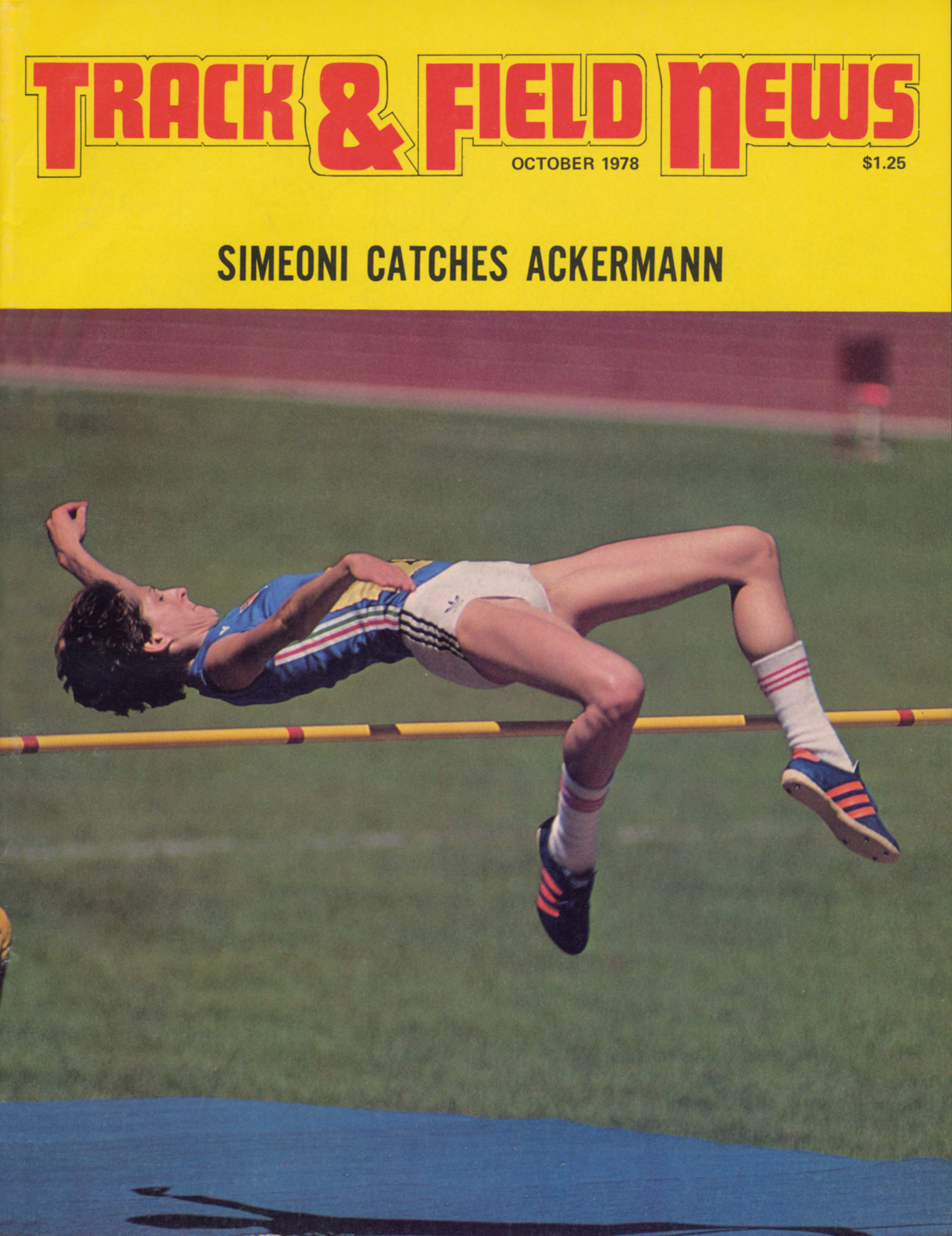
1978–Italy’s Sara Simeoni cleared 6-7 (2.01) at the European Championships in Prague to equal her own World Record in the High Jump.
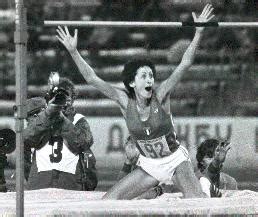
It took a WR for Simeoni to beat West Germany’s Rosemarie Ackermann, who held the Record before Simeoni. The two were locked in a see-saw battle when Simeoni cleared 6-7 on her 2nd jump. Ackermann then followed with her own “clearance” at that height, only to see the bar fall off while she was still celebrating! She missed on her 3rd attempt and wound up with the silver medal (6-6 ¼ [1.99]).
Medalists/Results: https://en.wikipedia.org/wiki/1978_European_Athletics_Championships
https://spikes.worldathletics.org/post/sara-simeoni-is-a-fantastic-high-jumper
WR Progression: http://en.wikipedia.org/wiki/Women’s_high_jump_world_record_progression
Video: https://www.youtube.com/watch?v=5J2SOLoIzWE
T&F News Cover: https://trackandfieldnews.com/wp-content/uploads/2020/01/1978_10.jpg
1980–19-year old Carl Lewis won the 100 (10.43) and 200 (20.72) at the Pan-American Junior Championships in Sudbury, Ontario (Aug.29-31). Finishing 2nd in both races was Calvin Smith (10.51, 20.94), who went on to become a 2-time World Champion in the 200 and a World Record holder in the 100. Smith and Lewis ran legs 3-4 on the winning 4×100 relay (39.61). Lewis, of course, would go on to become one of the legends of the sport,
Lance Deal, destined to become America’s #1 Hammer thrower, won the Discus with a throw of 184-4 (56.18). Another double winner was Brazil’s Joaquim Cruz, who won the 800 (1:47.85) and 1500 (3:49.96). Cruz would win the 800 at the 1984 Olympics in Los Angeles. 2nd in the 800 was John Marshall, later a 1984 Olympian.
Finishing 1-2 in the Women’s 800 were future stars Joetta Clark (2:05.65) and Kim Gallagher (2:06.52). And who knew then that the winner of the Women’s Long Jump would become one of the greatest athletes in history? Jackie Joyner, who had just completed her senior year at East St.Louis H.S. in Illinois, finished first with a jump of 20-3 ¼ (6.175)
Medalists: http://en.wikipedia.org/wiki/1980_Pan_American_Junior_Athletics_Championships
1982—Finishing 2nd to Germany’s Thomas Wessinghage (4:52.20), Steve Scott ran 4:54.71 for 2000-meters in Ingelheim, Germany, to break his own American Record of 4:58.72, set earlier in the year.
1983-The incomparable Edwin Moses celebrated his 28th birthday in style, running 47.02 in Koblenz, Germany, to set his 4th (and final) World Record in the 400-meter hurdles. Moses set his first WR (47.64) at the 1976 Olympics in Montreal, his 2nd (47.45) at the 1977 U.S. Championships in Los Angeles, and his 3rd (47.13) in Milan, Italy, in 1980. His reign as world record holder lasted for 16 years until Kevin Young took over when he ran 46.78 at the 1992 Olympics in Barcelona.
Moses was pressured through the first 8 hurdles by Andre Phillips, who finished 2nd in 48.26
Intros/celebration, but NOT the race! https://www.youtube.com/watch?v=D8pPLY4taP0
Race: https://www.youtube.com/watch?v=jNHOeIfecL8
Hall of Fame Bio: https://www.usatf.org/athlete-bios/edwin-moses
WR Progression: http://en.wikipedia.org/wiki/Men’s_400_metres_hurdles_world_record_progression
1984–Rome–France’s Thierry Vigneron jumped 19-4 ¾ (5.91) in Rome to break Sergey Bubka’s World Record of 19-4 ¼ (5.90), but lost the win and the record to Bubka, who missed once at 19-4 3/4, then passed to 19-5 ¾ (5.94), clearing on his first attempt.
WR Progression: http://en.wikipedia.org/wiki/Men’s_pole_vault_world_record_progression
Video: https://www.youtube.com/watch?v=RH_TN-73rTg
https://www.nytimes.com/1984/09/01/sports/pole-vault-mark-broken-twice-in-rome.html
1987–Bulgaria’s Khristo Markov jumped 58-9 ½ (17.92/now =#10 All-Time), just shy of Willie Banks’ World Record of 58-11 ½ (17.97), to win the Men’s Triple Jump over American Mike Conley (57-11 ¾ [17.67]) at the 2nd World Championships in Rome. Winning the bronze medal was the Soviet Union’s Oleg Sakirkin (57-2 ¼ [17.43]). Banks failed to make the final in Rome.
It was a 1-2 sweep in the Women’s 800 by East Germany’s Sigrun Wodars (1:55.26) and Christine Wachtel (1:55.32). The bronze went to the Soviet Union’s Lyubov Gurina (1:55.56), who finished ahead of Cuba’s Ana Quiros’ (1:55.84) and Czech Jarmila Kratochvílová (1:57.81), the defending champion and World Record holder.
East Germany got another 1-2 finish from Martina Hellmann (235-0 [71.62]) and Diana Sachse-Gansky
(230-1 [70.12]) in the Women’s Discus. 3rd was Bulgaria’s Tsvetanka Khristova (225-9 [68.82]).
The Soviet Union’s Olga Bryzgina won the Women’s 400 in 49.38. Winning silver and bronze were East Germany’s Petra Schersing (49.94) and Kirsten Siemon-Emmelmann (50.20).
World Record holder Jackie Joyner-Kersee scored a world-best first-day total of 4256 points in the Heptathlon.
Medalists/Results: https://en.wikipedia.org/wiki/1987_World_Championships_in_Athletics
Videos
W800: https://www.youtube.com/watch?v=TEDvmhYZgQc
NBC’s Day 3 Coverage: https://www.youtube.com/watch?v=WF8OJw8biH0
1991—Moses Kiptanui (8:12.59) beat teammate Patrick Sang (8:13.44) to win the 1st of his 3 World Championship titles in the Steeplechase in Tokyo. Algeria’s Azzedine Brahmi (8:15.54) prevented a Kenyan sweep by overtaking Julius Kariuki (8:16.81) to win the bronze medal. 5th was American Brian Diemer (8:17.76). Italy’s Francesco Panetta, the defending champion, was with the leaders early in the race before fading to 8th (8:26.79).
Kiptanui started a streak of 15 straight wins by Kenyan natives in the Steeplechase at the World Championships. (Stephen Cherono represented his adopted country of Qatar when he won in 2003 and 2005 as Saif Saaeed Shaheen). Kenyans also won the Steeplechase at 11 straight Olympics in which they’ve competed (boycotted in 1976 and 1980). Both streaks ended at the 2019 Worlds and the 2021 Olympics.
Switzerland’s Werner Günthör (71-1 ¼ [21.67]), returning from back surgery that almost ended his career, won the 2nd of his 3 World titles in the Men’s Shot Put. Winning silver and bronze were Norway’s Lars Arvid Nilsen (68-1 [20.75]) and the Soviet Union’s Oleksandr Klymenko (66-8 ¾ [20.34]).
Hassiba Boulmerka (4:02.21) came from behind in the homestretch to win the Women’s 1500-Meters. She let out a scream of joy after she crossed the finish line to celebrate the fact that she was the first woman from Algeria (and Africa) to win a World Championship! Finishing 2nd and 3rd were the Soviet pair of Tatyana Samolenko-Dorovskikh (4:02.88), the defending champion, and Lyudmila Rogachova (4:02.72). Boulmerka would win Olympic gold in Barcelona in 1992 and would win a 2nd World title in 1995.
Despite a 7am start, the conditions for the Men’s 50k-Walk were still brutal, with temperatures moving into the 80s (26-27c) and 97% humidity. Soviets Aleksandr Potashov and Andrey Perlov, long-time friends, were far ahead of the rest of the field when they decided to cross the finish line together with their arms around each other. They were both given a time of 3:53:09, but officials determined that Potashov had finished .01s ahead of his pal, making him the World Champion. Finishing 3rd was Germany’s Hartwig Gauder (3:55:14).
Bulgaria’s Tsvetanka Khristova threw 233-0 (71.02) in the final round to win the Women’s Discus over Germany’s Ilke Wyludda (226-9 [69.12]), whose 40-meet winning streak came to an end. Winning the bronze medal was the Soviet Union’s Larisa Mikhalchenko (223-11 [68.26]).
The U.S. was eliminated in the qualifying round of the Women’s 4×100 when Carlette Guidry and Esther Jones failed to connect on the 1st exchange, leaving Evelyn Ashford without a chance to finally win a World Championships medal.
Medalists in other events
Women’s High Jump: Germany’s Heike Henkel (6-8 ¾ [2.05]), Soviets Yelena Yelesina (6-6 [1.98]) and Inha Babakove (6-5 [1.96])
Medalists/Results: https://en.wikipedia.org/wiki/1991_World_Championships_in_Athletics
Kenyan Dominance in the Steeplechase
WC: https://en.wikipedia.org/wiki/Steeplechase_at_the_World_Championships_in_Athletics
OG: https://en.wikipedia.org/wiki/Steeplechase_at_the_Olympics
2003–18-year old Eliud Kipchoge of Kenya (12:52.79) was the upset winner in a thrilling Men’s 5000-Meters on the final day of the World Championships in Paris (St.Denis), beating Morocco’s Hicham El Guerrouj (12:52.83) and Ethiopia’s Kenenisa Bekele (12:53.12). El Guerrouj and Bekele, who had already won the 1500 and 10,000, respectively, were hoping to come away with a 2nd gold medal in the 5000. Kipchoge would eventually become the #1 marathoner in the world.
A flawless pass from Jearl Miles-Clark (50.0) to 18-year old Sanya Richards (Ross) on the final exchange allowed the U.S. to move from 2-meters down into the lead in the Women’s 4×400. Texas’ Richards (50.6), the winner of the NCAA 400 in June, then held off challenges from Russia’s Natalya Nazarova (50.9) and Jamaica’s Lorraine Fenton (49.4) to give the U.S. the win in 3:22.63. Russia (3:22.91) held on for 2nd over Jamaica (3:22.92). It was the first of 7 global relay golds for Richards (4xWorlds, 3xOlympics). Running the first two legs for the U.S. were Lisa Barber (51.1) and Demetria Washington (50.9).
Jerome Young held off France’s Marc Raquil to give the U.S. the “win” in the Men’s 4×400, but, sadly, this was another title the U.S. lost in the aftermath of subsequent doping penalties imposed on lead-off man Calvin Harrison (and Young)! France (2:58.96) was later awarded the gold medals. Moving up to silver and bronze were Jamaica (2:59.60) and the Bahamas (3:00.53).
Kenya’s Catherine “The Great” Ndereba set a Championship Record of 2:23:55 in the Women’s Marathon. 2nd and 3rd were Japan’s Mizuki Noguchi (2:24:14) and Masako Chiba (2:25:09).
South Africa’s Hestrie Cloete cleared a personal best of 6-9 (2.06/=#7 All-Time) to win the Women’s High Jump. She cleared 8 heights on her 1st attempt before missing 3 times at the World Record height of 6-10 ¾ (2.10). Silver and bronze went to Russia’s Marina Kuptsova (6-6 ¾ [2.00]) and Sweden’s Kajsa Bergqvist (6-6 ¾ [2.00]).
Russia’s Sergey Makarov (280-4 [85.44]) won the Men’s Javelin over Estonia’s Andrus Värnik (279-5 [85.17]) and Germany’s Boris Henry (278-0 [84.74]). Aleksandr Makarov, Sergey’s dad, was the silver medalist in the Javelin at the 1980 Olympics. Competing in his record 8th World Championships, World Record holder and 3-time World Champion Jan Železný finished 4th (275-10 (84.09).
The U.S., with a lineup of John Capel, Bernard Williams, Doc Patton, and Joshua Johnson, won the Men’s 4×100 in 38.06. 2nd and 3rd were Brazil (38.26) and the Netherlands (38.87).
Medalists in other events
Men’s 800: Algeria’s Djabir Saïd-Guerni (1:44.81), Russia’s Yuriy Borzakovskiy (1:44.84), South Africa’s Mbulaeni
Mulaudzi (1:44.90). 4th was Denmark’s Wilson Kipketer, the World Record holder and 3-time World
Champion (’95,’97,’99).
Women’s 1500: Russia’s Tatyana Tomashova (3:58.52/Championship Record), Turkey’s Süreyya Ayhan (3:59.04), Great
Britain’s Hayley Parry-Tullett (3:59.95).
Medalists/Results: https://en.wikipedia.org/wiki/2003_World_Championships_in_Athletics
IAAF Coverage Additional Reports