
Walt Murphy’s News and Results Service ([email protected])
This Day in Track & Field–September 8
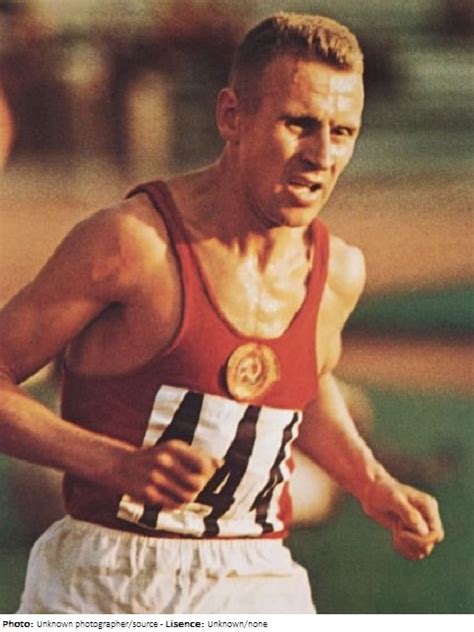
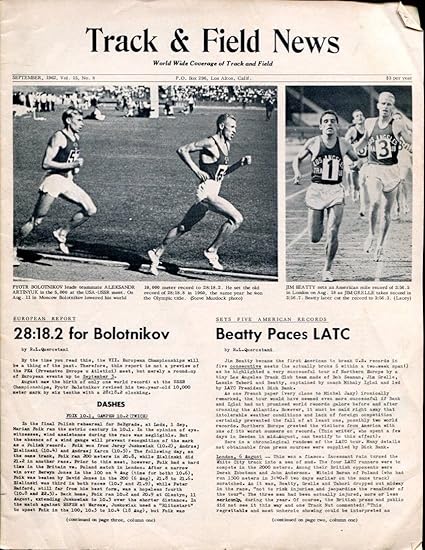
1960-The Soviet Union’s Pyotr Bolotnikov won the 10,000-meters in Rome with an Olympic Record time of 28:32.2. Winning silver and bronze were East Germany’s Hans Grodotzki (28:37.0) and Australia’s Dave Power (28:38.2). Max Truex finished 6th in 28:50.2 to smash Buddy Edelen’s American Record of 29:58.9. Truex’s time was also recognized as an American Record for 6-miles.
Viktor Tsybulenko gave the Soviets another gold medal, winning the Men’s Javelin with a throw of 277-8(84.64). 2nd and 3rd were East Germany’s Walter Krüger (260-4 [79.36]) and Hungary’s Gergely Kulcsár (257-9 [78.57]).
American Al Cantello, not allowed to compete with the “Held” javelin that he used to set the World Record of 282-3 (86.04), finished a disappointing 10th (245-1 [74.70]). (The IAAF had imposed the use of Swedish metal “Seefab” javelins or wooden Finnish “Sportartikles” implements).
“The circumference of the shaft was different, the position of the grip was different, and that made the center of gravity different,” Cantello said. “As a result, the ‘moment’ was different, the microsecond that the throw starts when your left foot hits the ground.”
Cantello might still have challenged for a medal, but he needed three throws in the previous day’s qualifying round to make the final (throwing 261-6 (79.72), which would have been good enough to finish 2nd in the final). “The next day, I had no arm”. A coach at the Naval Academy for 55 years (50 as head of the men’s x-country program), Cantello retired in 2018. He passed away in January, 2024, at the age of 92.
Romania’s Iolanda Balaș, the World Record holder, won the Women’s High Jump with a clearance of 6-3/4 (1.85). There was a tie for 2nd between Poland’s Jarosława Jóźwiakowska and Great Britain’s Dorothy Shirley, both of whom cleared 5-7 ¼ (1.71)
Wilma Rudolph put the finishing touch on her memorable Olympics by anchoring the U.S. to victory in the Women’s 4×100 Relay (44.5). Preceding Rudolph for the U.S. were her Tennessee State Tigerbelle teammates–Martha Hudson, Lucinda Williams, and Barbara Jones. The same lineup set a World Record of 44.4 in the qualifying round. 2nd and 3rd were Germany (44.8) and Poland (45.0).
In the Men’s 4×400, Jack Yerman (46.2) gave the U.S. a lead it never lost, but their win wasn’t assured until the anchor leg, when the 1-2 finishers in the 400 battled again. Otis Davis (45.2) picked up his 2nd gold medal after fighting off a challenge from Germany’s Carl Kaufmann (44.9) before pulling away to give the U.S. the win as both teams broke Jamaica’s World Record of 3:03.9 (3:02.2-3:02.7). Handling the middle legs for the U.S. were Earl Young (45.5) and Glenn Davis (45.3), who had won the gold medal in the 400m-Hurdles. The British West Indies (3:04.0) won the bronze medals.
The race was run with 2 staggers, with the 2nd runner breaking to the inside right after the exchange was made.
(The Women’s 4×400 wasn’t added to the Olympic program until 1972).
The stage was set for a great battle between the U.S. and Germany in the Men’s 4×100 relay, the final event held inside the stadium. The Germans had equaled the World Record of 39.5 in their heat and each team had won their respective semi-final races in 39.7.
Frank Budd put the U.S. in front with a strong lead-off leg, but Ray Norton’s nightmarish Olympics continued as he left too soon and his exchange with Budd took place outside the passing zone, a clear violation. Germany, with 100-meter champion Armin Hary running the 2nd leg, was now in the lead, while Stone Johnson kept the U.S. close. Anchor Dave Sime passed Germany’s Martin Lauer and brought the U.S. across the line first with an apparent World Record (39.4). The U.S., of course, was disqualified, ending their Olympic winning streak at 8. The victory went to Germany, which again tied the WR of 39.5. Silver and bronze went to the Soviet Union (40.1) and Great Britain (40.2).
Medalists/Results: http://en.wikipedia.org/wiki/Athletics_at_the_1960_Summer_Olympics
Olympedia Reports: http://www.olympedia.org/editions/15/sports/ATH
Rudolph Links
Photos: http://tinyurl.com/o3tx3
Videos: M4x100 M4x400 Rudolph (100, 200, 4×100)
ESPN Bio: http://tinyurl.com/e5kkx
Hall of Fame Bio: https://www.usatf.org/athlete-bios/wilma-rudolph
Rome 1960-The Olympics That Changed the World
Amazon: http://www.amazon.com/Rome-1960-Olympics-Changed-World/dp/1416534075
Ed Temple and the Tigerbelles: https://vault.si.com/vault/1960/11/14/like-nothing-else-in-tennessee
1963–Frances Davenport threw 168-5 (51.34) in Wissen, Germany to break her own American Record of 166-10 (50.87) in the Women’s Javelin. Davenport had won her 2nd U.S. title earlier in the year.
AR Progression: http://trackfield.brinkster.net/RecProg_AllUSA.asp?RecCode=WR&EventCode=WF8&Gender=W&P=F
1972–The altitude of Mexico City might have cost Jim Ryun the gold medal in the 1500 meters at the 1968 Olympics and he never got a 2nd chance after falling in his heat on this date at the Munich Olympics.
Seeded into the wrong heat because officials mistook his 3:52.8 mile time for a 1500 clocking, Ryun got tangled up with Ghana’s Billy Fordjour. He went down hard and lost precious time as he struggled to get back on his feet. He continued to run but could only finish 9th in 3:51.5.
The winner of the heat? Kip Keino, the man who had beaten him in Mexico City. Keino consoled Ryun after his long-time rival crossed the finish line. Ryun, with reported help from ABC broadcaster Howard Cosell, presented an appeal to an Olympic official, who, while understanding Ryun’s disappointment, basically told him, “come back in four years and try again”.
Ryun, a devout Christian, sheepishly admits he didn’t react too well to the decision. As he recalls in the wonderful video linked below, “What I wanted to do in my heart, was to reach out and grab him by his tie and to shake him a little bit with one hand, and (with) the other hand wanted to beat on him so he could feel some of (my) pain”.
His anger quickly subsided as he was greeted by his young wife Anne, who comforted him as he made his way out of the stadium.
The Soviet Union’s (and Ukraine’s) Nikolay Avilov won the gold medal in the Decathlon and set a World Record of 8,454 points (adjusted to 1984 tables–8466). The previous mark of 8417(adjusted-8310) was set by Bill Toomey in 1969. 2nd to Avilov was Soviet teammate (and fellow Ukrainian) Leonid Litvinenko (8035/7970). Poland’s Ryszard Katus (7984) edged American Jeff Bennett (7974/7920) by 10 points to win the bronze medal.
East Germany’s Joachim Kirst, the 2-time European Champion (and the pre-Games favorite), was leading Avilov after the first day of competition, but withdrew after falling in the 110-Meter Hurdles. He still might not have been able to beat Avilov, who recorded personal bests in 9 events, and tied his best in the 10th!
The distance for the Women’s “Sprint” Hurdles was increased from 80- to 100-Meters and the first Olympic gold medalist in its new incarnation was East Germany’s Anneliese Ehrhardt, who set a World Record of 12.59. Winning silver and bronze were Romania’s Valeria Bufanu (12.84) and East Germany’s Karin Balzer (12.90).
19-year old American Randy Williams set a World Junior Record of 27-4 ½ (8.34) in the qualifying round of the Men’s Long Jump. He would win the gold medal the following day.
Medalists/Results: http://en.wikipedia.org/wiki/Athletics_at_the_1972_Summer_Olympics
Olympedia Reports: https://www.olympedia.org/editions/18/sports/ATH
Videos
W100h: https://www.youtube.com/watch?v=3KXuQMm1mP8
Ryun’s Fall: https://www.youtube.com/watch?v=YfYL7XIYAuU
http://tinyurl.com/RyunNotBitter
http://online.wsj.com/article/SB10001424052702303610504577420700522693534.html
WR Progression: http://en.wikipedia.org/wiki/Decathlon_world_record_progression
Ryun: https://www.youtube.com/watch?v=RZA_xHArgOA
1982–Great Britain’s Daley Thompson scored 8,743 points (adjusted-8,774) at the European Championships in Athens to break the World record of 8,723 (Adjusted-8,741), which was set by Germany’s Jürgen Hingsen
less than a month earlier. Hingsen finished 2nd here with a score of 8,517 (Adjusted-8.530).
Another WR was set by East Germany’s Marita Koch, who won the Women’s 400 in 48.16. It was the 6th of the 7 World Records Koch set in the event (including the current standard of 47.60).
Medalists/Results: https://en.wikipedia.org/wiki/1982_European_Athletics_Championships
Videos:
W400: https://www.youtube.com/watch?v=6dKgMpVcIpM
Decathlon 1500: http://decathlonpedia.com/video/126
WR Progressions:
Decathlon: http://en.wikipedia.org/wiki/Decathlon_world_record_progression
400: https://en.wikipedia.org/wiki/Women%27s_400_metres_world_record_progression
http://en.wikipedia.org/wiki/Daley_Thompson
https://en.wikipedia.org/wiki/Marita_Koch
1988— Cuba’s Javier Sotomayor set the first of his 3 World Records in the High Jump with his clearance of 7-11 ½ (2.43) in Salamanca, Spain.
WR Progression: http://en.wikipedia.org/wiki/Men’s_high_jump_world_record_progression
1993—-China’s Wang Junxia, the winner of the 10,000 at the World Championships in Stuttgart the previous month, set a World Record of 29:31.78 for the event at the National Games in Beijing. The controversial runner, who was a member of “Ma’s Army” at the time, took an amazing 41+ seconds off the previous record of 30:13.74, which was set by Norway’s Ingrid Kristiansen in 1986. Runnerup Zhong Huandi was also under the old record with her time of 30:13.37.
Wang, who always claimed that her success was the result of hard work, rather than enhanced by “artificial” means, was named as one of the charter members of the IAAF’s Hall of Fame in 2012, a decision that didn’t sit too well with some observers.
The race marked the beginning of a week-long orgy of super-fast times at the meet, as new standards were also set by Qu Yunxia in the 1500 (3:50.46), and a 2nd mark by Wang Junxia in the 3,000 (8:06.11). Check the all-time list links below to see the full impact of the meet. (T&F News lists the marks as “questionable”)
WR Progression: http://en.wikipedia.org/wiki/10,000_metres
WikiBio: http://en.wikipedia.org/wiki/Wang_Junxia
http://www.dailymail.co.uk/columnists/article-231634/Chinas-cheats-destroy-lifes-work.html
2004 Article: http://www.theguardian.com/sport/2004/apr/08/athletics.duncanmackay
All-Time Lists
1500: http://www.alltime-athletics.com/w_1500ok.htm
3000: http://www.alltime-athletics.com/w_3000ok.htm
10,000: http://www.alltime-athletics.com/w_10kok.htm
Top-10 w/o the Chinese marks: https://trackandfieldnews.com/tfn-lists/world-all-time-list-women/
1995—In a made-for-TV event, Dan O’Brien scored 7,891 points in a 60-minute Decathlon in Pullman, Washington, just missing the “World Record” of 7,897, which was set by Czech Robert Změlík in 1992. Změlík, the 1992 Olympic gold medalist in the traditional decathlon, finished a distant 2nd here (6974), while Chris Huffins finished 3rd (5736).
O’Brien, who set the “real” World Record of 8,891 points in 1992, collected $25,000 for his effort.
Frank Zarnowski, the world’s leading authority on the multi-events, explains the format: “…2-3 athletes compete concurrently, all competing in each running event at the same time and the starting times for those were pre-scheduled. For the field events the athletes could do them in any order they wanted but had to submit a plan as they moved from event to event so they would not bump into each other….so the field events were done out of order…but come hell or high water they had to be at the 400m start at 20 minutes after and at hurdles 40 minutes after the start”.
I worked on the show, which aired on ESPN (with 2-time Olympic Decathlon champion Daley Thompson as one of the announcers) and it was my first (and only) trip to the Washington State campus. I was surprised to see so many international flags flying atop the stadium until I found out they represented the countries of former Cougar T&F athletes!
O’Brien’s marks: 10,68 – 7.28(23-10 ¾) – 15.50(50-10 ¼) – 2.10(6-10 ¾) – 58.68 (Obviously not wanting to expend too much energy in the 400!) – 14.60 – 49.36(161-11) – 5.10(16-8 ¾) – 62.22(204-1) – 5.23,18.
2019—The Men’s and Women’s races at this year’s 5th Avenue Mile were among the most exciting ever in the history of the event.
Running side-by-side for almost the entire race, veteran Jenny Simpson (4:16.2) barely edged Elle (pronounced “Ellie”) Purrier-St.Pierre (also 4:16.2), a relative newcomer on the elite scene, to win the Women’s race for an incredible 8th time! Both were under the event record of 4:16.6.
Just as he had done in last year’s race, Sam Parsons collected $1,000 bonus for being first across the ½-way point in the Men’s race, but his big lead evaporated as the field soon caught up to him.
It looked like anyone’s race at this point, but then Great Britain’s Chris O’Hare jumped into a quick lead and appeared to be headed towards his 1st win on 5th Avenue after finishing 2nd in 2015 and 2017. But 36-year old Nick Willis of New Zealand put on a late rush in the final 50-meters to catch O’Hare right at the finish to win the event for the 5th time. The finish was so close that it took officials a few minutes before declaring Willis the winner. Willis and O’Hare were both timed in 3:51.7, with Sam Prakel a close 3rd in 3:51.8.
Unlike past years, when this would be the final race of the season for most of the runners, many, including Simpson and Purrier, were still looking ahead to compete at the following month’s World Championships in Doha.
As usual, the post-eve