


Deji Ogeyinbgo wrote this feature on Collen Kebinatshipi, after his two 9.89 runs over 100 meters at the Botswana National championships last weekend, April 4-5, 2026.
Collen Kebinatshipi: The never-ending story of quarter-milers with fast 100m times
There are moments in sport when an athlete briefly steps outside the role the world has assigned to them and, in doing so, reveals something deeper about performance itself, suggesting the body is capable of holding more than one truth at the same time. A 400m runner is supposed to belong to rhythm and endurance, to the long arc of effort that builds and unravels over a lap, yet every so often one of them drifts into the short, explosive theatre of the 100m and leaves behind a performance that feels both deliberate and slightly improbable.
We’ve been here before. In fact, a couple of times, and it usually comes with a series of outcomes.
Busang Collen Kebinatshipi, the reigning world champion over 400m, arrived at the Botswana Championships and chose to run the shortest race on the programme. He had spoken openly about it beforehand, describing the 100m as a way to refine his speed while his training remained rooted in the longer sprint, and there was a sense that this was part of a process rather than a statement.
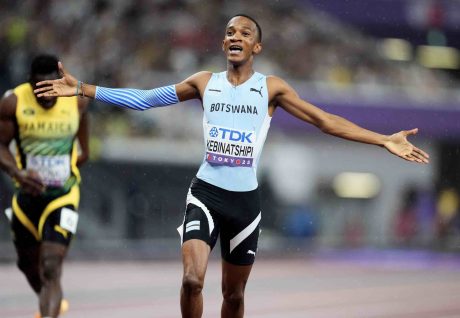
In the semi-final, he ran 9.89s with a legal wind of 0.8 meters per second, a time that carried a certain clarity as soon as it appeared, even if the scoreboard briefly hesitated between 9.91 and 9.89 before settling on the latter. The time stood on its own, fast enough to demand attention, fast enough to redraw expectations, yet there was still the final to come and with it the quiet question of whether this was a moment or the beginning of something more consistent. A few hours later, under a slightly stronger headwind of +1.2 m/s,1.2m/s he ran 9.89 again, and in that repetition, there was something more convincing than the original performance.
The race itself did not unfold with dramatic tension, because Kebinatshipi separated himself from the field with a kind of calm authority that suggested control rather than risk, finishing well ahead of Gaodiraone Lobatlamang, who followed in 10.21. There had been the prospect of a more layered contest, with Letsile Tebogo entered in the heats, though an awkward slip from the blocks and the injury that followed removed him from the race before the story could develop.
It is tempting to explain a performance like this by looking backwards, to search for a precedent that might make it feel familiar, yet Kebinatshipi’s path resists easy comparison. Before this season, his experience in the 100m had been limited, with only a handful of recorded races and a modest progression that had not suggested a sudden leap into the sub-ten-second range. Only weeks earlier, he had run 10.53, a time that sat comfortably within the expectations of a 400-meter specialist using shorter races as part of their preparation. The jump from that to 9.89, even allowing for altitude and favourable conditions, asks for a different kind of explanation, one that leans more toward potential than precedent.
That potential has always been visible over 400m, where his world title in 43.53s placed him among the fastest men in history, confirming his place in a generation of athletes steadily redefining the event. What the Gaborone races offered was a glimpse of the underlying speed that feeds endurance, the raw component that, when further developed, can shift an athlete from excellent to something more difficult to contain. There is a quiet logic to the idea that a faster 100 meters leads to a more dangerous 400, not as a direct translation but as an expansion of what becomes possible in the latter stages of the race.

At the same time, there is a need for patience in how this performance is understood. Gaborone sits at an altitude, and while the times are legal, they occur within a context that tends to favour sprinting performances, just as early-season races often have a different rhythm to those later in the year, when competition deepens and expectations settle into something firmer. Kebinatshipi himself has not suggested any immediate shift in focus, and there is a sense that these races are part of broader preparation for the 400 meters rather than an attempt to enter the crowded, demanding world of elite 100-meter sprinting.
Still, athletics rarely resists the urge to imagine what might come next, and there is something about this performance that invites that imagination. A 22-year-old world champion who can move between distances with this level of fluency suggests a trajectory that has not yet reached its limit.
There is also the broader context of Botswana itself, a nation that in recent years has developed a habit of producing sprinters who feel both individual and collective, athletes who arrive with their own stories yet contribute to a wider sense of momentum. Kebinatshipi’s performance sits alongside that movement, not as an outlier but as part of a pattern that continues to gather strength.