
Walt Murphy’s News and Results Service ([email protected])
This Day in Track & Field–August 30
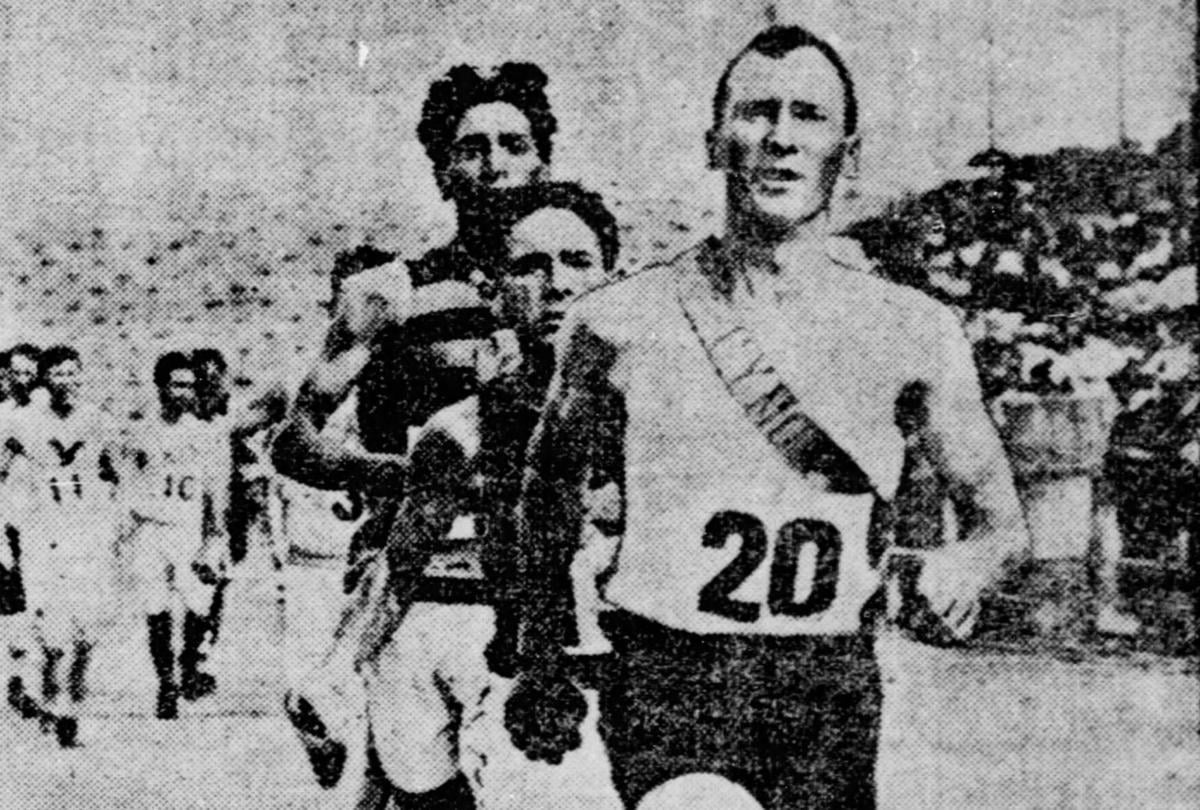
1904—The Marathon at the St.Louis Olympics, which were held in conjunction with the city’s World’s Fair, might have been the strangest rendition of the event ever staged.
American Tom Hicks (3:28:53) was the winner of the almost-26 mile race on a hot and dusty day, but barely survived the effort.
From “The Strange Story of the 1904 Olympic Marathon”:
“So who was the eventual winner? That honor went to the English-born Tom Hicks. Hicks had a terrible race, suffering in the dust and heat, and was desperate for a drink by the ten-mile mark. His two-man support team refused him water, and instead fed him a concoction of egg whites and strychnine.
Strychnine was used to stimulate athletic performance at the time, but is also a strong poison which leads to convulsions, asphyxia, and death. Still, Hicks took the dose and somehow managed to continue running for a while longer.
When he began to tire again, the support team gave him more egg whites and strychnine, and this time he was allowed to wash it down with brandy. He continued to battle onwards, hallucinating, barely able to walk for most of the course. When he reached the stadium his support team carried him over the line, holding him in the air while he shuffled his feet as if still running. The judges decided this was acceptable, and gave him the gold medal. He never ran professionally again.”
Shades of Rosie Ruiz, the infamous “winner” of the 1980 Boston Marathon–Hicks wasn’t the first man to cross the finish line. That “honor” went to American Fred Lorz, who had initially dropped out of the race after 9 miles. He hitched a ride back to the stadium in a car, which broke down at the 19-mile mark. He then rejoined the race and jogged across the finish line and was hailed as the winner. He even posed for a picture with Alice Roosevelt, the daughter of President Teddy Roosevelt! His ruse was discovered before he could be presented with the gold medal, and he claimed he was just going along with the deception as a joke. Officials initially banned him for life, but they soon gave him a reprieve and he went on to win the 1905 Boston Marathon (legitimately)!
From Simthsonianmag.com: “…from the start the 1904 marathon was less showstopper than sideshow, a freakish spectacle that seemed more in keeping with the carnival atmosphere of the fair than the reverential mood of the Games. The outcome was so scandalous that the event was nearly abolished for good.”
Check these links for more details of this bizarre race.
https://en.wikipedia.org/wiki/Athletics_at_the_1904_Summer_Olympics_–_Men%27s_marathon
https://en.wikipedia.org/wiki/Frederick_Lorz
1959–Tom Murphy held off George Kerr of the British West Indies to win the 800-meters at the Pan-American Games in Chicago. Both were timed in 1:49.4. Kerr won the 400 in 46.1 and would win the bronze medal in the 800 at the 1960 Olympics (my cousin was eliminated in the semis!).
The meet featured many past and future Olympic gold medalists (In BOLD) and Hall-of-Famers (click on name/ *-bio not available)
Other notable winners/results(US unless otherwise noted):
Men
100&200—Ray Norton (10.3,20.6)
1500—Dyrol Burleson (3:49.1), Jim Grelle (3:49.9)
5000—Bill Dellinger (14:28.4)
110h—Hayes Jones-1964 (13.6w), Lee Calhoun*-1956,1960 (13.7w)
400h—Josh Culbreath (51.2)
HJ—Charlie Dumas-1956 (6-10 ¾ [2.10])
PV—Don Bragg-1960 (15-1 ¾ [4.62])
LJ—Bo Roberson (26-1 ¾ [7.97]), Greg Bell (24-11 ¼ [7.60])
TJ—Adhemar da Silva-1952,1956 (BRA/52-2 [15.90])
SP—Parry O’Brien*-1952,1956 (62-5 ¾[19.04]), Dallas Long-1964 (60-8 ¾])
DT—Al Oerter-’56,’60,’64,’68 (1908[58.12)
HT—Al Hall(195-10 [59.71]), Hal Connolly-1956 (195-9[59.67])
Women
60—Isabelle Daniels-1960/4×100 (7.4)
100&200—Lucinda Williams-1960/4×100 (12.1,24.2)
SP&DT—Earlene Brown (48-2 [14.69]/161-9 [49.31])
JT—Marlene Ahrens (Chile/146-11[45.38])…silver medalist-1956 OG
Medalists: http://www.absoluteastronomy.com/topics/Athletics_at_the_1959_Pan_American_Games#encyclopedia;
1982—A British lineup of Peter Elliott (1:49.2), Garry Cook (1:46.2), Steve Cram (1:44.5), and Sebastian Coe (1:44.0) set a World Record of 7:03.89 in the 4×800 in London. The record lasted for 24 years until Kenya ran 7:02.43 in 2006. 2nd in that race was the Santa Monica Track Club (7:02.82), which was also under Great Britain’s record.
All-Time List: http://www.alltime-athletics.com/m4x800ok.htm
1985—Judi Brown-King ran 54.66 at the Ivo Van Damme Memorial in Brussels to equal Latanya Sheffield’s American Record in the 400-meter hurdles. Brown-King would take sole possession of the AR the following week by running 54.38 in Rome.
Mary Decker-Slaney won the Women’s 1500-Meters in 3:57.24, just missing her American Record of 3:57.12.
1986–The Soviet Union’s Yuriy Syedikh won the Hammer Throw at the European Championships in Stuttgart and set the current World Record of 284-7 (86.74m). He had set the previous mark of 284-4 (86.66) in June. It was Sedykh’s 6th World Record and his 3rd straight European title.
https://www.youtube.com/watch?v=9s2-GsdFHdA
WR Progression: http://en.wikipedia.org/wiki/Men’s_hammer_throw_world_record_progression
1987–Bulgaria’s Stefka Kostadinova set a World Record of 6-10 ¼ (2.09) while winning the Women’s High Jump at the World Championships in Rome. 2nd and 3rd were the Soviet Union’s Tamara Bykova (6-8 ¼ [2.04]) and East Germany’s Susanne Beyer (6-6 ¼ [1.99). Kostadinova’s record stood for 37 years until Ukraine’s Yaroslava Mahuchikh jumped 6-10 ½ (2.10) in 2024.
Kostadinova, who set the previous WR of 6-9 ¾ (2.06) in 1986, needed a 3rd-jump clearance of 6-8 ¼ [2.04]) to stay in the competition, and took the lead from Bykova when she cleared 6-9 (2.06). American Record holder Louise Ritter, who had beaten Kostadinova in Zürich just 11 days earlier with a jump of 6-7 (2.01), could clear no higher than 6-4 (1.93) in Rome and wound up tied for 8th. She would gain redemption the following year by winning the gold medal at the Seoul Olympics.
Just 10 minutes earlier, an apparent World Record was set in the Men’s 100-meters as Canada’s Ben Johnson ran 9.83 to beat defending champion Carl Lewis (9.93). After admitting in 1990 that he had used performance-enhancing drugs, Johnson was stripped of his title and record by the IAAF, giving Lewis his 2nd 100-meter title AND the World Record. The silver and bronze medals went to Jamaica’ Ray Stewart (10.08) and Great Britain’s Linford Christie (10.14), who would win the 1993 World title.
East Germany got a 1-2 finish in the Women’s 100-Meters from Silke Gladisch-Möller (10.90) and Heike Drechsler (11.00). Winning what would become just one of many bronze medals she would earn during her career was Jamaica’s Merlene Ottey (11.04).
Finland’s Seppo Räty (274-1 [83.54]) won the Men’s Javelin over the Soviet Union’s Viktor Yevsyukov (270-9 [82.52]) and Czech Jan Železný (269-8 [82.20]), who had set the 1st of his 5 World Records in May (287-7 [87.66]). Tom Petranoff (266-9 [81.29]), the American Record holder, finished 4th. Železný would go on to win 3 World and 3 Olympic titles!
Maurizio Damilano (1:20:45), the 1980 Olympic Champion, pleased Italian fans by winning the 1st of his 2 World titles in the Men’s 20k-Walk. Winning silver and bronze were Czech Josef Pribilinec (1:21:07) and Spain’s José Marín (1:21:24).
Medalists/Results: https://en.wikipedia.org/wiki/1987_World_Championships_in_Athletics
Sports Illustrated Vault(pre-drug scandal)
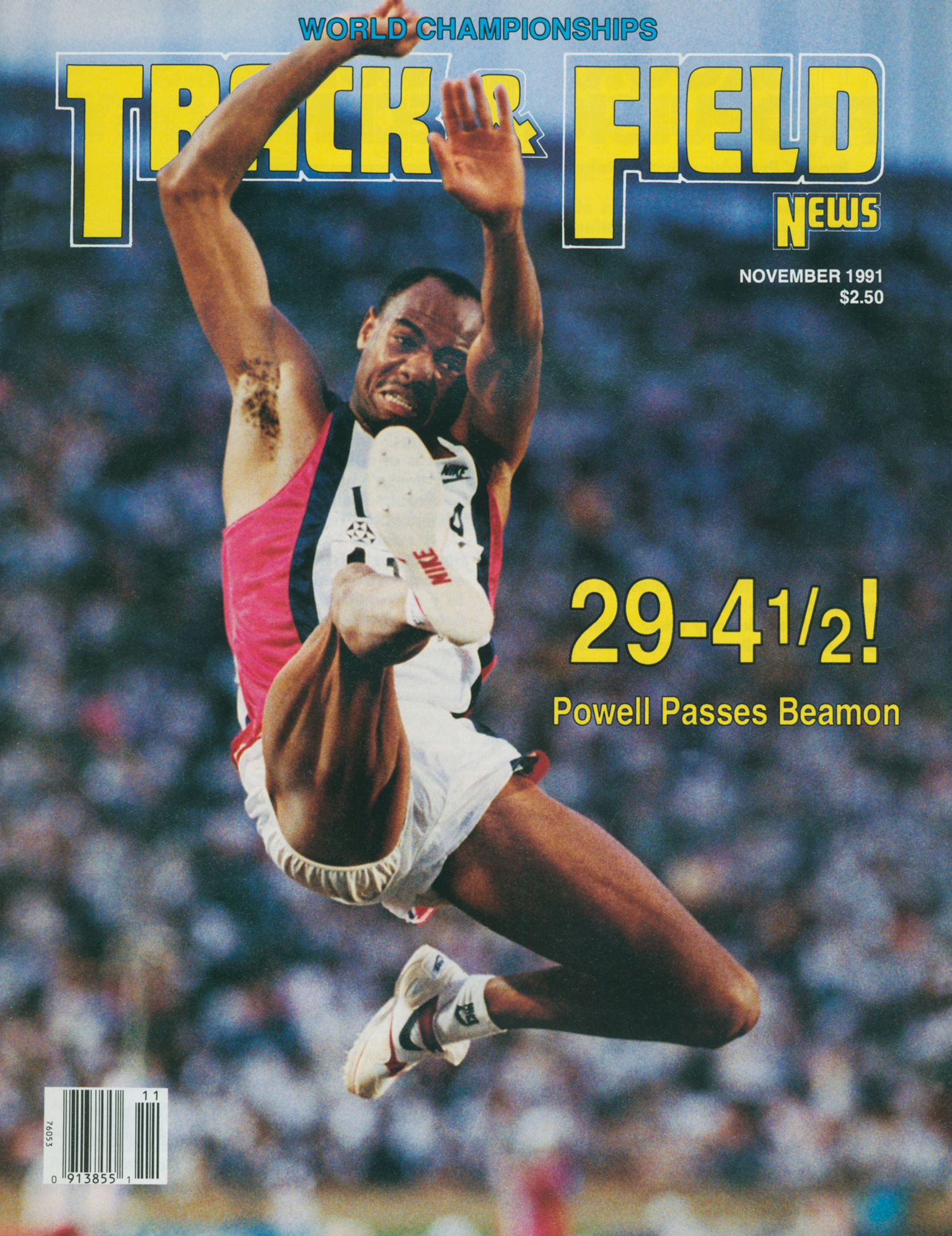
1991–At the 3rd IAAF World Championships in Tokyo, Carl Lewis had already been involved in the greatest 100-meters in history (at the time), running 9.86 five days earlier to beat training partner Leroy Burrell (9.88) as both bettered Burrell’s 2-month old World of 9.90.
But now he was about to engage rival Mike Powell in an epic duel in the Long Jump. Lewis had dominated the event for a decade, winning two Olympic and two World titles, and was riding a 65-meet winning streak as the competition began. Powell, meanwhile, had edged Lewis for the #1 position in Track and Field News’s world rankings in 1990 and had gained confidence with a series of long jumps in the altitude of Sestriere, Italy, prior to the Worlds. Also in the competition was the 3rd American, Larry Myricks, who had the misfortune of having his career coincide with that of Lewis.
Round One-Powell had trouble with his steps and could only manage a paltry 25-9 ¼ (7.85). Myricks had a long foul, but Lewis set the standard for the rest of the competition by stretching out to 28-5 ¾ (8.68), breaking his own Championship Record by one centimeter.
Round Two-Powell found his rhythm and moved into 2nd place with a jump of 28-1/4 (8.54). Myricks had a fair jump of 26-11 (8.20) while Lewis had another long one that was ruled a foul.
Round Three-Still no indication of what he was about to do as Powell’s 3rd jump was “only” 27-2 1/2 (8.29). Myricks had another foul, but Lewis rode a 2.3mps wind out to 28-11 ¾ (8.83), the longest jump of his career!
Round Four-Now it got serious. Powell appeared to be beyond 29-feet on his 4th jump, but a late red flag indicated a foul. Powell went from jubilation to heartbreak in a second as he raced to the board to plead his case to officials, who confirmed that he had fouled by the barest of margins. Myricks put a lock on the bronze medal with a jump of 27-7 ¼ (8.41–he would improve to 27-7 1/2/8.42 in the 5th round).
Lewis, perhaps sensing that Powell was “on”, raised the ante with an amazing effort. He knew it was wind-aided (2.9mps), but he still punched the air with delight when the indicator board finally flashed the distance–8.91 (29-2 3/4). Lewis had finally achieved one of his goals–jumping farther than Bob Beamon’s seemingly untouchable world record distance of 29-2 ½ (8.90m), which was set at the 1968 Olympics in Mexico City. But, with two rounds to go, Lewis had to be restrained in his celebration…
Round Five-…and with good reason. Putting together all of the pieces that he and coach Randy Huntington had worked on, Powell landed close to the 9-meter marker that was placed alongside the pit. The wind was legal (0.3mps), and, after what seemed like an eternity, the display board flashed 8.95-meters (29-4 1/2). Powell had wiped out Beamon’s 23-year old world record, but he knew that his historic jump might not be enough to win the gold medal. Along with the rest of the world’s elite jumpers, Powell had felt the sting of “King” Carl’s penchant for coming through when the pressure was on. Sure enough, Lewis responded with a jump that made Powell nervous. All eyes were on the indicator board, which finally flashed the metric 8.87 (into a slight headwind)–a legal lifetime best of 29-1 1/4 for Lewis, but not good enough to overtake Powell.
Round Six-Powell fouled on his last jump, then watched nervously as Lewis almost broke his heart again, coming close with another great jump of 29-feet even (8.84). Powell fell to the ground when Lewis’s mark finally came up, then ran over to the runway and picked up a Japanese official as part of his celebration.
2-time defending champion Lewis, with three 29-foot jumps to his credit, had achieved the greatest series in history, but had to settle for the silver medal. Larry Myricks made it a U.S. sweep, winning the bronze medal with a leap of 27-7 ½ (8.42).
Footnote: After Jackie Joyner-Kersee injured her ankle after slipping on the plasticine during the Women’s Long Jump five days earlier, officials made some adjustments to make the takeoff board safer. If those changes hadn’t been made, it’s believed that Powell and Lewis might not have competed in the Men’s event!
Dan O’Brien won the first of his three World Championships titles in the Decathlon, setting an American Record of 8,812 points. Silver and bronze went to Canada’s Mike Smith (8549) and Germany’s Christian Schenk (8394).
The Soviet Union’s (and Russia’s) Ludmila Narozhilenko (12.59) won the 100-Meter Hurdles over American Gail Devers (12.63) and Soviet Natalya Grigoryeva (12.69).
Narozhilenko later married a Swedish businessman and became a Swedish citizen in 1996. She would win gold at the 1996 Olympics and 1997 Worlds under her married name of Engquist.
Devers had made a remarkable recovery from her battle with Graves disease that kept her out of action in 1989 and 1990. https://www.wellandgood.com/gail-devers-graves-disease/
Great Britain’s Liz McColgan (31:14.31) won the Women’s 10,000-Meters in hot and humid conditions over China’s Zhong Huandi (31:35.08) and Wang Xiuting (31:35.99). Finishing 5 was American Lynn Jennings (31:54.44), followed by Germany’s Uta Pippig (31:55.68) and Norway’s Ingrid Kristiansen (32:10.75), the World Record holder at 5000 and 10,000 Meters.
It was déjà vu all over again as the top 4 placers in the Women’s 100 repeated their finish order in the 200—Germany’s Katrin Krabbe (22.09), American Gwen Torrence (22.16), Jamaica’s Merlene Ottey (22.21), the Soviet Union’s Irina Privalova (22.28).
Medalists/Results: https://en.wikipedia.org/wiki/1991_World_Championships_in_Athletics
IAAF Coverage:
Videos: MLJ (long version) W200 DEC W100h W10k
Sports Illustrated Vault(Powell)
(2004) https://vault.si.com/vault/2004/02/09/mike-powell-long-jumper-september-9-1991
T&F News Cover(November): https://trackandfieldnews.com/wp-content/uploads/2019/04/1991_11.jpg
1992—Sergey Bubka jumped 20-1 (6.12) in Padua, Italy, to add a centimeter to his World Outdoor Record in the Pole Vault. He had earlier set the World Indoor Record of 20-1 ¼ (6.13) in February.
WR Progression: https://en.wikipedia.org/wiki/Men%27s_pole_vault_world_record_progression
2003—Allen Johnson won his fourth World Championships title in the 110-meter hurdles, running 13.12 in Paris/St.Denis to beat teammate Terrence Trammell (13.20) and 20-year old Liu Xiang of China (13.23).
“Bad timing is my life story.” So bemoaned Allen Johnson after his fourth World Championships gold medal in Paris on Saturday night. The affable American knew full well that the Sunday headlines wouldn’t be about his win but rather “l’affaire Kelli White” and that again his efforts will be overshadowed. “Whether I get the headlines or not, I’m happy,” he exclaimed to reporters jamming the (athlete/press) mixed zone under the stadium. (It wasn’t the first time that Johnson would be overshadowed by others after a win).
Christine Aaron thrilled the home crowd by passing Torri Edwards on the anchor leg to give France the win over the U.S. in the Women’s 4×100 relay (41.78-41.83). Russia finished 3rd in 42.66. The U.S. ran without Kelli White, who had won the 100 and 200 meters earlier in the championships, but then tested positive for modafinil. White actually took herself off the team, even though the IAAF was going to allow her to run.
From the IAAF statement: “As both the nature of the substance and the content of her explanation require further inquiry and investigation, the IAAF has taken the view that bearing in mind the very serious consequences for the athlete of being suspended and being removed from competition at this late stage, the most appropriate course of action is to allow her to compete pending the completion of the necessary scientific and factual investigations”.
https://www.worldathletics.org/news/news/iaaf-statement-on-kelli-white
Ethiopia’s Tirunesh Dibaba captured the 1st of her 12 global gold medals(track & XC), coming from behind on the homestretch to win the Women’s 5000-Meters. Silver and bronze went to Spain’s Marta Domínguez (14:52.20) and Kenya’s Edith Masai (14:52.30). 17 at the time (she would turn 18 on October 1), is still the youngest World Champion in any event (men and women).
France’s Eunice Barber won the Women’s Long Jump in front of a friendly and enthiastic crowd with her final effort of 22-11 ¼ (6.99). 2nd and 3rd were Russia’s Tatyana Kitova (22-1 ½ [6.74]) and India’s Anju Bobby George (21-11 ¾ [6.70])
Medalists in the Men’s Marathon were Morocco’s Jaouad Gharib (2:08:31), Spain’s Julio Rey (2:08:38), and Italy’s Stefano Baldini (2:09:14), who would win Olympic gold in Athens the following year. Gharib and Rey had entered the stadium tunnel together, but by the time they emerged on the track, Gharib had already started to pull away for the win.
Greece’s Miréla Manjani (218-3 [66.52]), the 1999 Champion, won the Women’s Javelin over Russia’s Tatyana Shikolenko (207-7 [63.28]) and Germany’s Steffi Nerious (205-8 [62.70]).
Medalists/Results: https://en.wikipedia.org/wiki/2003_World_Championships_in_Athletics
IAAF Coverage Additional Reports
Videos: M110h W4x100 W5k WLJ MMar
http://news.bbc.co.uk/sport2/hi/athletics/3177582.stm
10-Years Later(White): http://tinyurl.com/KelliWhite
http://en.wikipedia.org/wiki/Kelli_White (Jim) Dunaway’s Worlds: https://www.worldathletics.org/news/news/dunaways-worlds-4
2005–Jack “Legs” O’Reilly, the PA announcer at many meets, including the Penn Relays, passed away at the age of 89.
Penn Relays Director Dave Johnson Remembers Legs
Jack was 89 when he passed away on Aug. 30 of complications due to Alzheimer’s disease. He had been the Penn Relays chief public address announcer for 31 years (1971-2001), plus another 10 years before that as assistant announcer to Pinky Sober.
I’ve known several people who have suffered through Alzheimer’s, but was saddened by none so much as by Jack. Jack’s life was being a story teller, and when the stories began to fade from memory, his life began to ebb.
At his best, Jack was the best. Among track and field public address announcers, he had the best voice of anyone. Sure, maybe it wasn’t quite Mel Torme, but it was still The Voice. It was sharp enough to cut through a din, cool enough to listen to for hours–if he didn’t drive you nuts from mistaken facts. But it wasn’t the facts you loved about O’Reilly, it was the voice and the delivery.
No one had a better sense of the crowd, had a better anticipation for the perfect moment, than Jack. It’s easy for an announcer to utter the perfect comment, only to have it drowned out by an enthusiastic crowd. That seldom happened with Jack. He knew when the time was right, and he was a master at letting the crowd perform the music of the sport. He was merely the master conductor, the maestro.
Jack may also have been the most idiosyncratic of all of them, maybe even the nuttiest. All in all, he was a delightful character. A dapper dresser, he was always perfectly coordinated, but he rarely wore socks! And the nickname, “Legs.” Somehow it seemed to fit perfectly. I don’t know where the name came from or how far back it goes, perhaps to the days when he was a half-miler at Brooklyn Prep.
An announcer is often remembered by his stock phrases. Jack had several. In addition to being the Penn Relays announcer, he served as the PA for the IC4A, and for the first 20 years or so for the NCAA Indoor. But whenever you were at an IC4A meet, Jack wouldn’t let you forget it: “This isn’t just any meet, this is the I-C-4-A!”
I don’t know if Jacko was the first to greet coaches and their teams on the PA, but his comments were unforgettable: “We WEL-come coach Baldy Castillo and his Arizona State Sun Devils” I remember him saying that the fi
…