
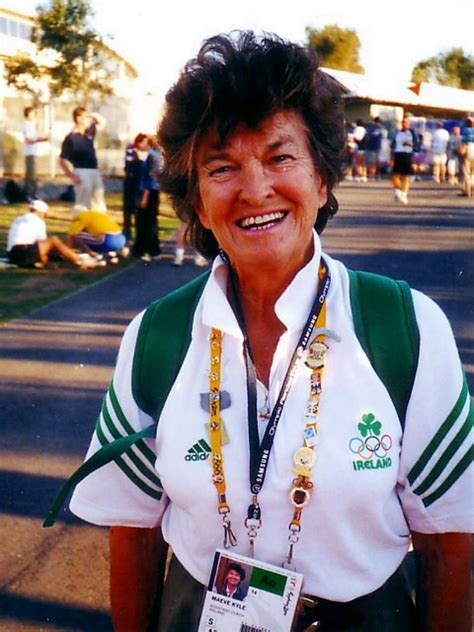
This is a piece by Stuart Weir, quite heartfelt, on one of the immortals of Irish Athletics and Irish sport: Maeve Kyle, who passed away at the wonderful age of 96. What a wonderful life! The interview was done in 2010 when, senior writer for Europe, Stuart Weir, our man around the world met the iconic Irish athlete and trail blazer in women’s sports!
Maeve Kyle – triple Olympian
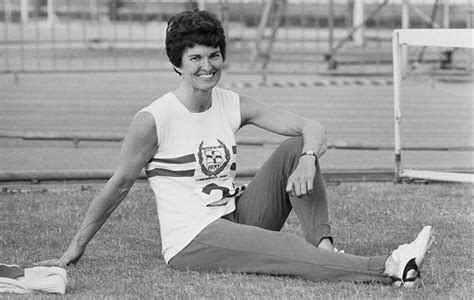
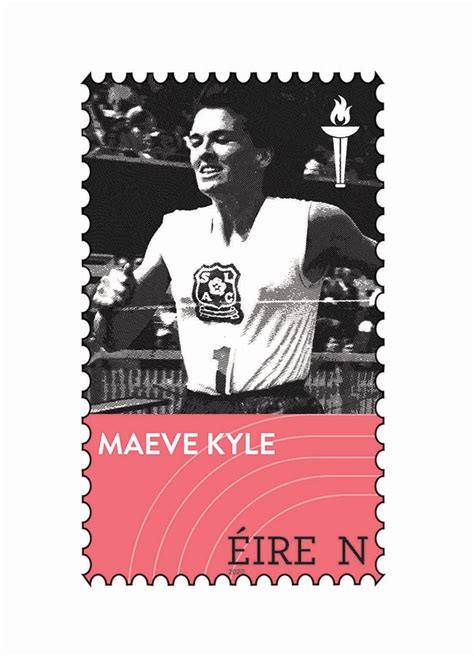
The death was recently announced of Maeve Kyle aged 96. She competed in the 1956, 1960 and 1964 Olympics. As track and field is a summer sport, she played field hockey in the winter ginning 58 caps for Ireland. Her friend and Olympic gold medallist Mary Peters paid tribute to her as a “pioneer of women’s sport in both athletics and hockey for Ireland”.
Her best events were 400m and 800m but when she was at her peak, it was thought that women were incapable of running such distances*! She made her Olympic debut in Melbourne, age 27, in the 100m and 200m and ran the same distances in Rome 1960. By the time was the 1962 European Championships, now 33, she was allowed to run the longer distances coming sixth in the 400 and setting a national record in the 800. In 1964, the first year that an Olympic women’s 400m was run – aged 35 – she reached the semi-finals in Tokyo of both the 400m and 800m. In 1966 she took the bronze medal in the 400m at the European Indoor Championships. She also competed in two Commonwealth Games including running the 400m in 1970, reaching the final aged 42! She called herself “The Irish suffragette of athletics”.
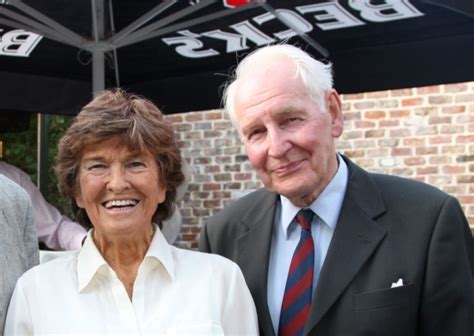
At the 2010 European Championships I was invited to a function and got into conversation with the lady who turned out to be Maeve Kyle. When she said her name I remember my first words to her where “the famous Maeve Kyle?”. Her reply was “infamous more likely”. After we had chatted for a while I asked if she would be willing to let me record an interview with her. She graciously agreed.
She explained to me the context of her early Olympic career: “In 1956 the only events for women were 100, 200, 80h, javelin, shot and discus, LJ, HJ – so nothing on the track longer than 200 meters. This was because men thought that women were not capable of running longer distances and that it wouldn’t be nice if they fell down and had to be resuscitated. I suspect that events like the hammer, triple jump and pole vault were thought to be not healthy for women. I don’t think at that time there was any medical evidence to prove or disprove it.
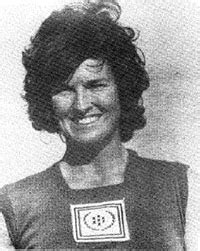
“You need to understand that at that time all sport for male dominated and women played social sports rather than competitive sports. As far my involvement was concerned I don’t think men had any great hang ups about it but some older woman did and there was more opposition from, say, my mother’s age group than anyone else. They did not approve and I think I made them feel uncomfortable. I had the distinction of having a letter in the Irish Times saying what a disgraceful hussy I was going off to the Olympics leaving my husband and small child behind. That shows you the attitude of certain sections of what was a very conservative society”.
Her times were remarkable, given that she was completely an amateur, Training in primitive conditions: “In preparation for Melbourne 1956 I had trained on the road because I didn’t have a training facility and the grass was often too wet and soggy. I remember training once on the local school cricket pitch and was sent packing! So I just trained where I could. My husband, Sean, was my coach and I used to train in his lunch hour on a cycle track at the local football ground. And it was fine – it was flat and hard, of course sometimes it rained and was windy – but I was able to train
“I also played international hockey which broke up the year for me so that it wasn’t just athletics and athletics training. Hockey also gave me, I felt, a good all round fitness. And I loved having a summer and winter sport. Just running 100 and 200 suited me and the training was manageable – I don’t think there’s any way as an amateur that I could have managed the amount of training people do today.
“It is great that women now have a much greater range of events but I had to worry that women are often put on men’s training programmes, particularly in the 16 to 20 age range, when their body strength and body requirements are totally different from young developing men, yet often they are put on almost identical programmes”.
Maeve told me another story to illustrate the ethos of sport in her day: “We were once invited to Scottish Games and there was a children’s race and my daughter won and got a small cash prize. But I had to say to her, you will have to give the money back or you won’t be allowed to run again – and I wasn’t totally joking because another child in Scotland aged 11 had actually been banned (and deemed to be a professional) for accepting a small voluntary prize. That shows you how amateur the sport was in those days”.
Looking back on her career I asked her to reflect on what she got out of athletics? “Millions of hours of enjoyment, fun and friendship. I still keep in touch with huge numbers of athletes. One of the joys of Facebook is that I am suddenly in touch with an athlete that I have not heard of for 30 years”. In terms of the Olympics, she loved the international camaraderie and has one special memory: “The great thing about the Olympics is that you can sit down for breakfast and be sitting with six nobodies or six superstars. I remember in Rome in 1960 sitting down to eat with a young Muhammad Ali. He was a lovely guy, only 19 at the time. But you could feel he had greatness ahead of him. And it is moments like that in your career that always stay with you.”
*The women’s 800m event was first included in the Summer Olympics in 1928, at the Amsterdam games. However, due to concerns about the distance being too strenuous for women, it was removed and not reinstated until the 1960 Rome Olympics.