

Wanyonyi’s Relentless Front-Running Secures 800m Gold in Tokyo
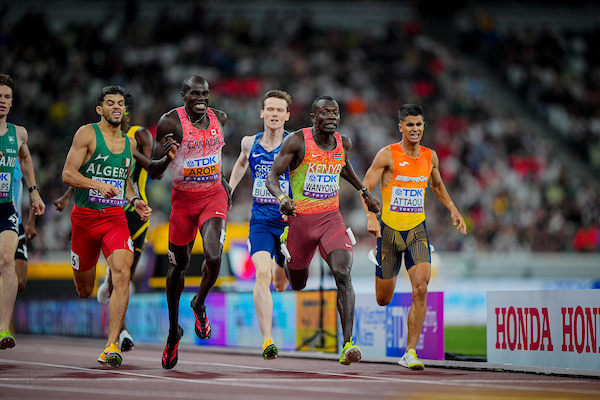
The men’s 800 meters has always carried a touch of unpredictability. Two laps around the track can expose hesitation as quickly as it rewards courage. On Day 8 of the World Championships in Tokyo, Emmanuel Wanyonyi leaned on the latter, driving from the front and daring the rest of the field to keep up. His reward was a championship record of 1:41.86, a second global gold to go alongside the Olympic crown he earned last year in Paris.
At 21, Wanyonyi has matured quickly into the most reliable figure in the event. He admitted after the race that he does not enjoy front-running, but his strategy has now brought him back-to-back titles. On Friday evening in the Japan National Stadium, he carried the field through the first lap in 49.26 seconds. It was almost identical to the opening split David Rudisha produced in London in 2012 when he set the world record of 1:40.91. Rudisha was in the stands this time, watching his Kenyan successor hold off every challenge down the homestretch.
The race itself was as deep as any 800 ever contested. Eight men broke 1:43, a benchmark that has rarely been breached by so many in a single race. The medals went to the three who had won the event in Paris a year ago. Algeria’s Djamel Sedjati moved one step up the ladder with silver in 1:41.90, while Marco Arop of Canada added bronze in 1:41.95 to go with his Olympic silver and last year’s world gold.

Wanyonyi’s composure was clear from the gun. He did not look back or flinch when Sedjati edged closer on the final bend. He simply kept his rhythm, eyes fixed on the line, shoulders rolling but stride intact. By the time he dipped for the finish, the margin was slim but decisive. He spoke later of meeting Rudisha the day before the race, and of being told to rest, focus, and believe that everything was possible. His victory suggested that the advice had stuck.
The depth of the final added weight to the performance. Ireland’s Cian McPhillips set a national record of 1:42.15 to finish fourth. Spain’s Mohamed Attaoui ran 1:42.21 for fifth after threatening the podium with 100 meters to go. Great Britain’s Max Burgin clocked a personal best of 1:42.29 in sixth, while Jamaica’s Navasky Anderson set a national record of 1:42.76 in seventh. It was the type of race that forces excellence from every competitor, a reminder that the event remains brutally competitive even in an age dominated by longer distances.

Sedjati offered a smile through disappointment as he spoke afterward. He had executed his plan and believed he had done everything right, apart from winning gold. His words carried an air of acceptance and even generosity, as he dedicated his medal to his Algerian teammate Yasser Triki, who had missed the podium in the triple jump earlier in the week.
Arop, who has been a fixture at the top for four straight major championships, left wondering if any tactical adjustment might have changed the outcome. He had tried to keep the pace honest, knowing that a hard race might dull the finishing kicks behind him. But even with his effort, Wanyonyi proved stronger. Four medals in four global finals is no small achievement, and Arop recognized as much when he reflected on the consistency his camp has worked to achieve.
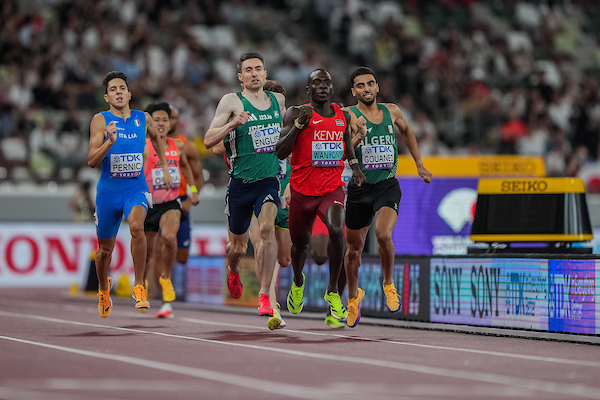
Tokyo WCH 25, photo by World Athletics
Wanyonyi’s ambitions stretch further now. He spoke of defending his title at the next Worlds and even hinted that a world record attempt might soon sit in his plans. For an event that has lived in Rudisha’s shadow since London, the suggestion feels both bold and credible. Wanyonyi’s 1:41.86 is still more than a second away, yet his age and his willingness to test himself at the front leave the door open.
The Tokyo race will be remembered for its blend of speed and depth, but also for the clarity of its winner. Wanyonyi carried the pace, absorbed the pressure, and finished with enough daylight to call the night his own. For a young man already in possession of Olympic and world titles, the next chapter promises to be even more compelling.